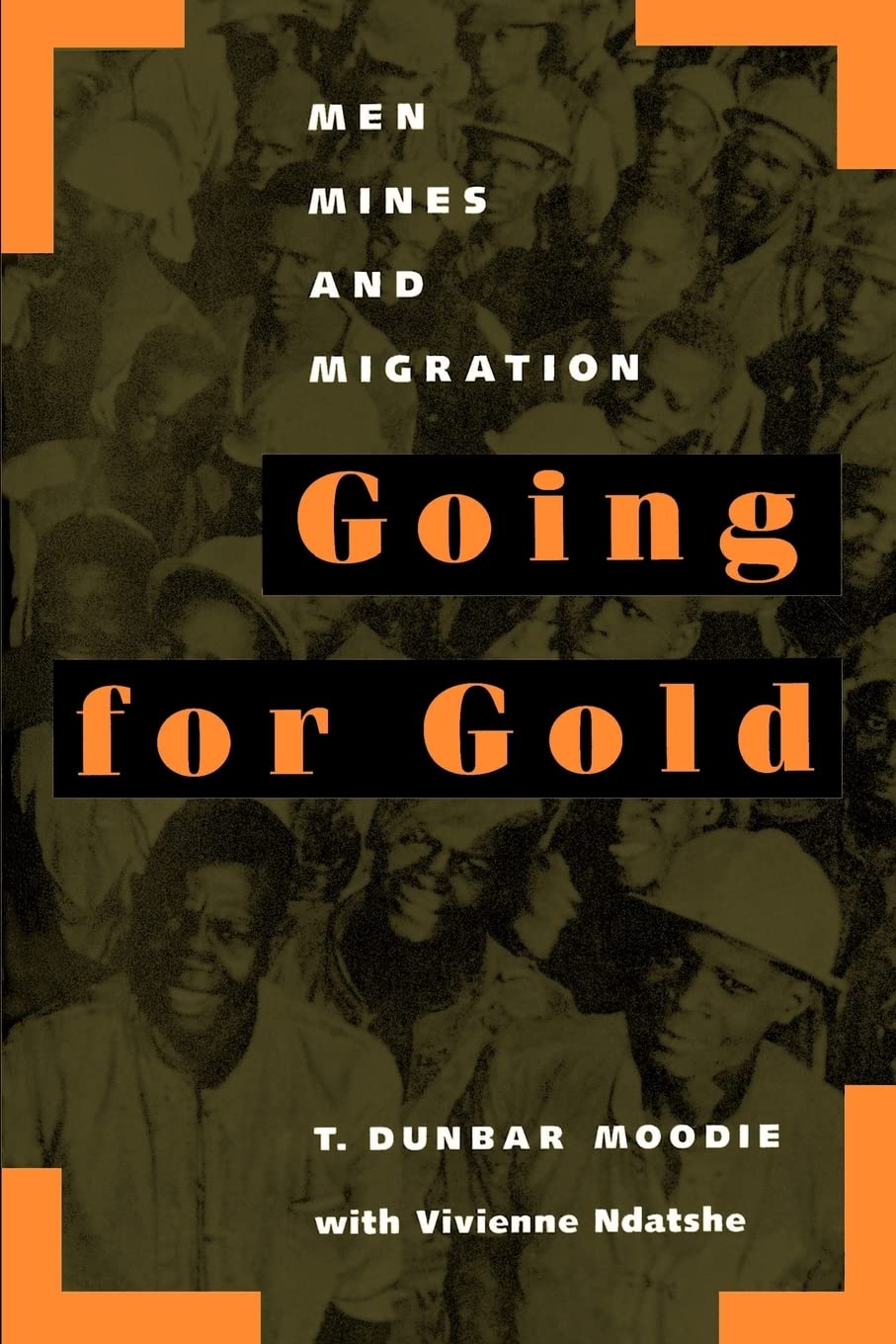
Going for Gold: Men, Mines, and Migration (Perspectives on Southern Africa) (Volume 51)
$29.86
by T. Dunbar Moodie



This book tells the story of the lives of migrant black African men who work on the South African gold mines, told from their own point of view and, as much as possible, in their own words. Dunbar Moodie examines the operation of local power structures and resistances, changes in production techniques, the limits and successes of unionization, and the nature of ethnic conflicts at different periods and on different terrains of struggle. He treats his subject thematically and historically, examining how notions of integrity, manhood, sexuality, work, power, solidarity, and violence have all changed over time, especially with the shift to a proletarianized work force on the mines in the 1970s. Moodie integrates analyses of individual life-strategies with theories of social change, illuminating the ways in which these play off each other in historically significant ways. He shows how human beings (in this case, African men) build integrity and construct their own social order, even in situations of apparent total repression. "An indispensable look at the working conditions, social lives, and collective action of black miners. . . . [Moodie's] meticulous, reflective, incessantly questioning approach to power, drink, sexuality, conflict, and routine life in mines and compounds reveals an extraordinary world at the edge of hope and desperation." Charles Tilly, The New School for Social Research "Combines a rigorous use of theory with a marvellous and sensitive sympathy." Terence O. Ranger, co-editor of The Invention of Tradition "An indispensable look at the working conditions, social lives, and collective action of black miners. . . . [Moodie's] meticulous, reflective, incessantly questioning approach to power, drink, sexuality, conflict, and routine life in mines and compounds reveals an extraordinary world at the edge of hope and desperation."―Charles Tilly, The New School for Social Research "Combines a rigorous use of theory with a marvellous and sensitive sympathy."―Terence O. Ranger, co-editor of The Invention of Tradition T. Dunbar Moodie is Professor of Sociology at Hobart and William Smith Colleges and the author of The Rise of Afrikanerdom (California, 1975). Vivienne Ndatshe is a former teacher who now works as a domestic servant. She grew up in Pondoland, where her father was a migrant gold miner. Her interviews with mine workers and their families added an essential dimension to this work. Going for Gold By T. Dunbar Moodie University of California Press Copyright © 1994 T. Dunbar Moodie All right reserved. ISBN: 9780520086449 Introduction This book may be read on a number of different levels. At its most accessible, it is a detailed description of the lives of black South African mine workers, written as far as possible from their point of view. Their tale is about men who migrate from all over Southern Africa to work the gold mines of the South African high veld. By 1910 there were about 200,000 of them; by 1940, 300,000; by 1985, 500,000. Historically, they have come from as far north as Angola and Tanzania, have been barracked together in huge single-sex compounds, and herded before dawn to work thousands of feet underground in desperately dangerous conditions. The mines themselves opened on the Witwatersrand near Johannesburg in 1886 and spread east and west. By the 1930s the most profitable mines were in the far east. Now they lie in the far west and the southwest, so that the gold-bearing reef forms a great semicircular rim like the edges of a giant geological saucer, tipped and broken, covering a narrow, buried slice of gold-bearing rock, many meters beneath the earth (see maps 1?4). Many have written of the forces, especially colonial conquest, taxation, and economic underdevelopment, that drove these men to the Rand and of the exploitation, indeed superexploitation, they suffered there. The standard works from this perspective are Wilson 1969 and Johnstone 1976. Others, usually associated with the industry, have claimed that the workers came of their own free will, led on by the lure of cash wages and a spirit of adventure. This book makes no effort to repeat these arguments or to refute them. Instead, it tries to tell of the integrity with which these migrant black working men, disciplined and controlled as they were, retained their senses of identity, measuring them not only against those of the white men who employed them and those who supervised them but also against those of black officials in the compounds and black supervisors underground. Migrant masculinity was sustained in solidarity with fellow mine workers and in partnership with women and other men at home. Thus, migrant miners understood themselves as men not only in relation to their wage labor in the capitalist system on the mines but also through their independence as patriarchal homestead proprietors in the country. The book tries to capture black miners' changing conceptions of persona