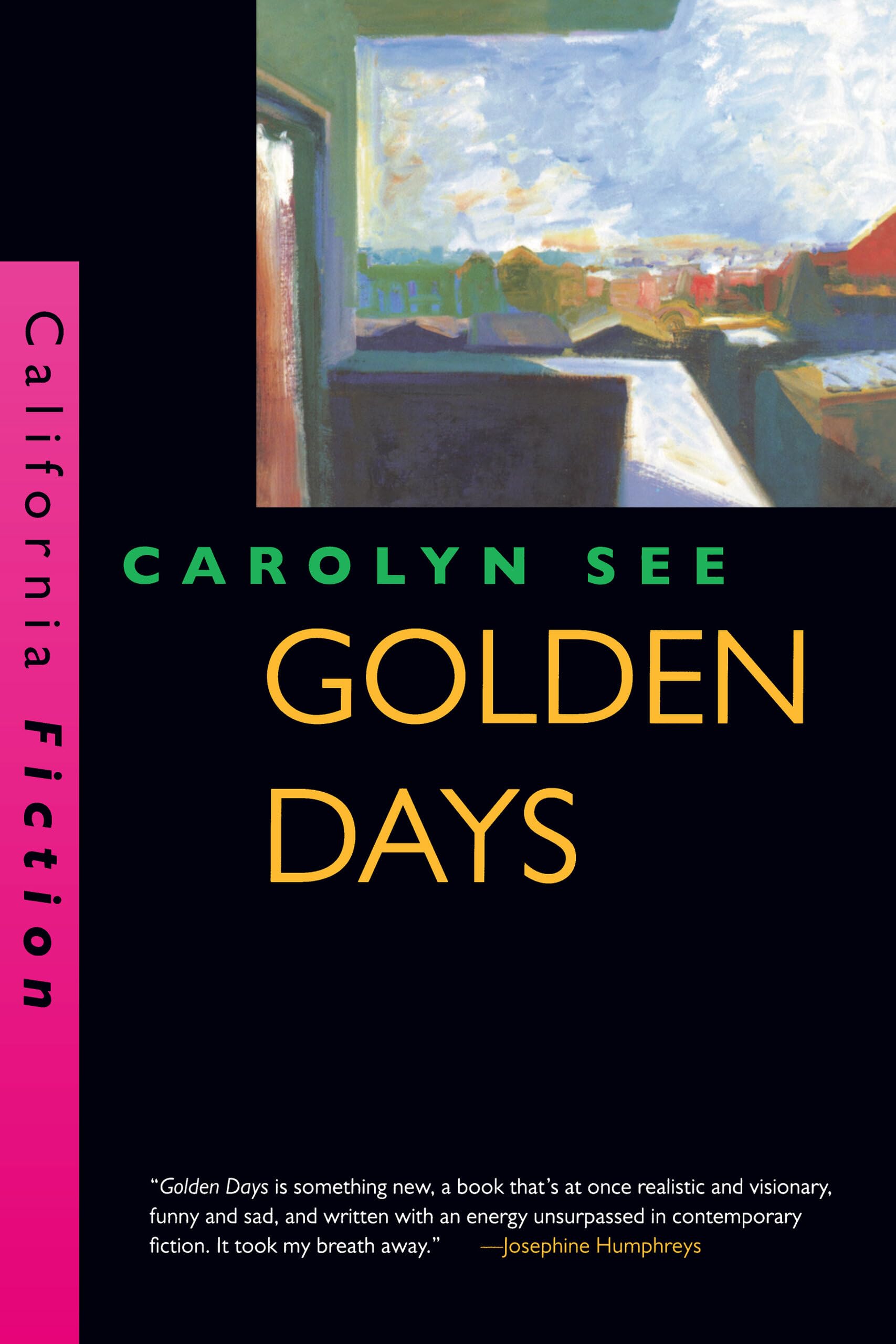



Available again in paperback, Golden Days is a major novel from one of the most provocative voices on the American literary scene. Linking the recent past with an imagined future, Carolyn See captures life in Los Angeles in the 70s and 80s. This marvelously imaginative, hilarious, and original work offers fresh insights into the way we were, the way we are, and the way we could end up. "An adventuresome blend of feminist fiction and nuclear apocalypse fantasy set in California."--R. Z. Sheppard, "Time Carolyn See, the author of Dreaming: Hard Luck and Good Times in America (California, 1996) and five novels, is a book reviewer for The Washington Post and an adjunct professor of English at University of California, Los Angeles. Golden Days By Carolyn See University of California Press Copyright 1996 Carolyn See All right reserved. ISBN: 0520206738 1 April - November 1980 Once, I remember, in an entirely different world, I interviewed that East Coast photographer who made a good living taking pictures of people as they jumped. He asked if he could take a picture of me, and I jumped! I put everything into it! I took a look outside of his white studio into the grimy New York streets below; I thought of how I'd jumped from a ratty house with a tired mom, past two husbands, one sad, one mad; hopscotched with kids and lovers and ended uphere? In New York! I sized up the directions of the room, tried to find east. I started out from there, ran a maximum of ten heavy steps, and jumpednot far, not far enough by a long shotand came down hard. The photographer winced. "Try it again," he said. So I went back to the far corner, ran, defied gravity, jumped. This time I held up my arms, held up my chin, grinned. His camera clicked. "That's it." "That's it? " "You only have one jump in you," he said. (I found out later he said it to everybody.) That wasn't fair. But maybe it was right. I began to noticeI date it from that day, not that it was new materialmost of us have just one story in us; we live it and breathe it and think it and go to it and from it and dance with it; we lie down with it, love it, hate it, and that's our story. About that time I noticed something else: There was a ratio involved here. Just as those poor woolly headed American nigras only got seven-tenths of the vote (after the Civil War, if and when they got the voteI can't really remember), so, too, there was a basic inequality in the country I grew up in and lived in. One man, one story. For women, it generally took two or even three to make one story. So that in shopping malls you sometimes saw two fat women waddling along, casting sidelong glances at one another's fat. Or two pretty girls outprettying each other. Two femmes fatales, eyeing each other's seductions. This is partly the story of Lorna Villanelle and me; two ladies absolutely crazed with the secret thought that they were something special. But if you think you aren't going to care about this story, hold on. It's the most important story in the Western world! Believe me. Take this for a story. It's four in the afternoon: 1950 something. A chunky thirteen-year-old walks home after school, kicking at leaves with heavy shoes, up the buckling sidewalks of Micheltorena Hill, in the parched and arid heart of Los Angeles. She dawdles, she doesn't want to get there. Her father's gone, there's no joy here, or ever, maybe. At 3:45 she drifts down through a small "Spanish" patio and into a house that perches precariously on the side of this hillcrackling with dried and golden rye grassbangs the door, clumps down the tiled hall to the sunken living room, where she sees her mother crying. Her mother looks up, twists her tear-stained linen handkerchief, and says, with all the vindictiveness a truly heartbroken woman can muster, "Must you always be so heavy? " The thirteen-year-old, her face flushed from the sun, the walk, and pure shame, walks on tiptoe without speaking, past her mother to the picture window, which faces diagonally west. She doesn't think to look below, to the patio perfect for parties they'll never give, but only out , out to the horizon where, past twenty miles of miniature city, the oceanthin stripcatches the afternoon sun, and blazes. Ah! "Don't put your head on the window!" her mother snaps, and the girl lurches back as if the window burned, but her forehead mark, brain fingerprint, remains. After the day of the clumsy jump I realized I wasn't built to live in New York. It was the greatest city in the world, but I couldn't get on its pretty side. I'll go further and say that after several short trips to Paris, Madrid, Rome, I realized that I'd been going in the wrong direction; the further east you got the further back in you were. By now I could look at my life as a series of sterling wrong choices