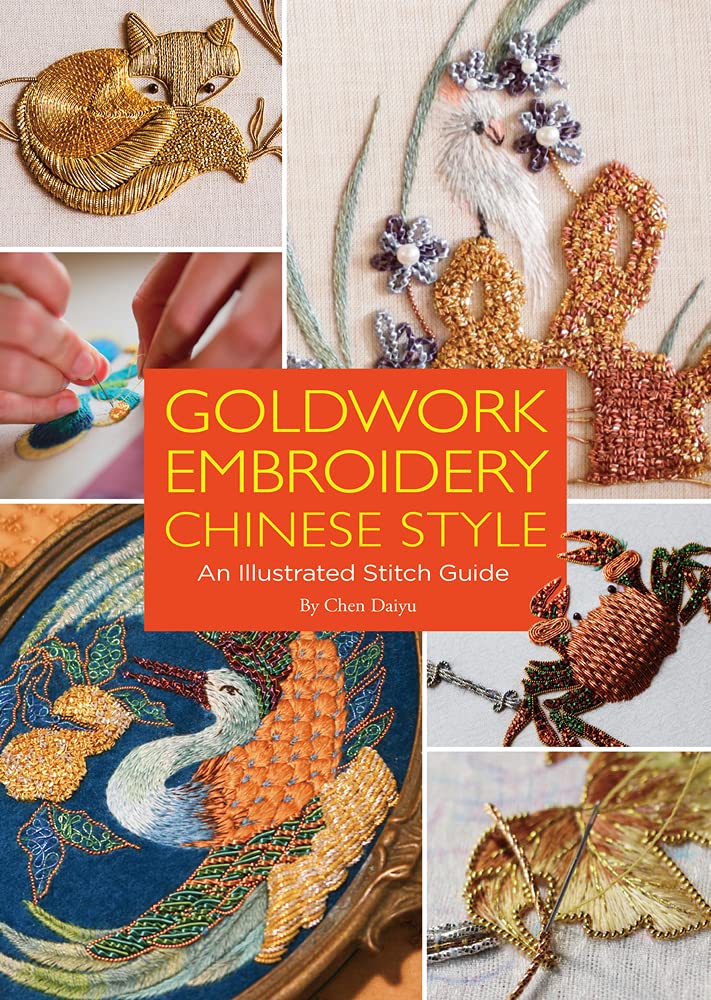



Discover the ancient art of goldwork embroidery, reimagined with a Chinese aesthetic. Goldwork Embroidery Chinese Style unveils the secrets of this traditional technique, blending Chinese silk embroidery with European goldwork to create stunning and elegant designs. Author Chen Daiyu, with two decades of experience, guides you through each step, from selecting materials to mastering essential stitches. Learn to combine traditional Chinese silk embroidery with European goldwork techniques. - Create unique and original embroidery designs inspired by Chinese art. - Master essential goldwork embroidery techniques, including padding, couching, and cutwork. Perfect for embroidery enthusiasts, crafters, and anyone seeking to explore the beauty of Chinese art through needlework. Unleash your creativity and craft exquisite pieces that blend cultural heritage with artistic innovation. “ Goldwork Embroidery Chinese Style lays out the steps in such detail that it is both supportive and encouraging to adventurous crafters.” — Foreword Review Chen Daiyu graduated from the Design Art Department of the Guangzhou Academy of Fine Arts and holds a master’s degree from the University of the Arts in London. The focus of her current research is the contemporary application of embroidery. After attending the Royal College of Embroidery to study embroidery techniques, she founded the Daiyu Embroidery Studio and became an independent embroidery artist. She excels at goldwork embroidery, wool embroidery, blackwork embroidery, whitework embroidery, canvas embroidery, and the application of embroidery to the field of jewelry design. Goldwork Embroidery Chinese Style (excerpt) There are many different types of embroidery, including silk shading, whitework, blackwork, silk ribbon, and crewelwork. Among these types, goldwork embroidery is unique in that it is based on padding and stacking. It is distinctive due to its richness and variety of threads, its versatility of expression, its stacked three-dimensional shapes, and its high degree of integration with many other types of embroidery. Goldwork embroidery has a long history in China as a traditional craft, originally serving the imperial palaces and temples. The exact date of its origin is unknown in historical records, but it can be inferred from excavated artefacts that embroidery on clothing became a marker of social class from the Western Zhou dynasty (1046–771 BC). During the Tang dynasty (617–907), it developed considerably. Religious embroidery arose, such as scriptures and Buddhist statues. Working with gold thread instead of silk thread gradually became popular. In 1987, five miniature garments with cluster goldwork embroidery (an elaborate technique in which gold and silk threads are wound into patterns and then fixed onto silk) on crimson silk fabrics from the Tang dynasty were excavated from the underground palace at the Famen Temple in Shaanxi Province (Fig.?). The twisted gold threads used in these artefacts were made from a core of silk, which was wound with fine gold foil wire at 3,000 loops per meter (Fig.?). According to historical records, embroidery in the Tang dynasty already consisted of gold and silver embellished with beads. The color shading technique was also extremely advanced, using gold and silver threads to coil the outlines of the patterns—an innovation of that era. During the same period, Chao embroidery was developed in the Chaozhou area of Guangdong Province, also featuring goldwork. This is one of two important branches of Chinese goldwork embroidery, the other being the gold- and silver-colored embroidery of Ningbo. The latter uses mostly gold and silver metal threads and is plain and elegant, while the Chaozhou style favors multiple colors and is highly vivid (Fig.?). Since Chaozhou embroidery is more exceptional in general, the following section focuses on its techniques and history as a reference. According to Huang Yanfan in his book Chao Embroidery —which systematically and comprehensively records and describes the history of the style and its specific application of stitches—it was originally a branch of Guangdong embroidery, but due to its geographical and humanistic characteristics, it became more decorative, complex, and vivid. Unlike Su and Xiang embroideries, which favor humanistic depictions, it is more often based on themes of daily life, giving it a strong sense of worldliness. It has a free and spontaneous composition, and is very dramatic. Chaozhou embroidery is also based on characters from the theatre and mythological themes, and its style can be traced to the same origin as Chaozhou gold lacquer wood carvings (Fig.?). Chaozhou goldwork embroidery gradually separated from other traditional styles in terms of the development of its padding techniques and the application and innovation of gold threads, and eventually became a school of its own. The Song and Ming dynasties were periods of refin