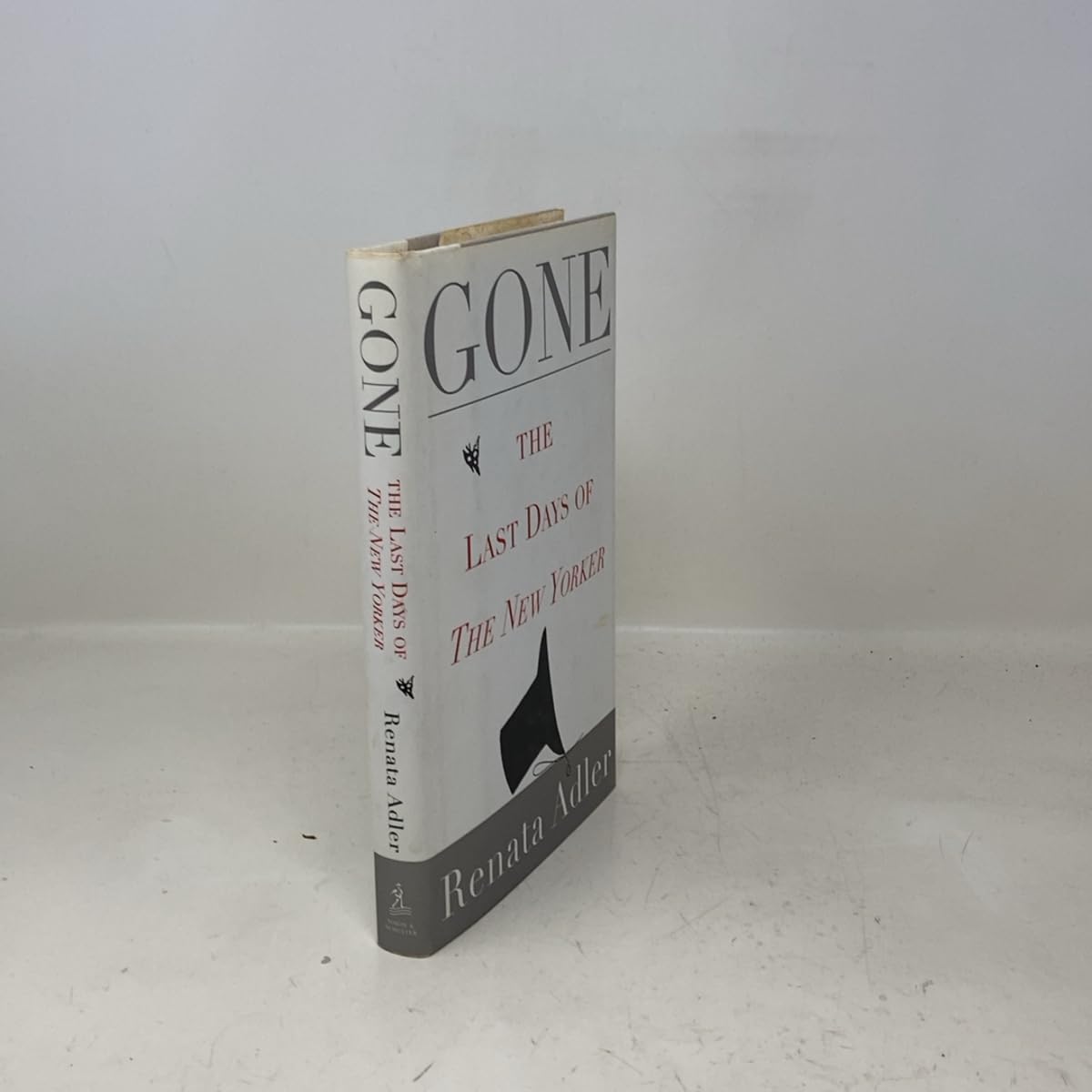



A fascinating and sweeping profile of a great magazine captures The New Yorker's last three decades in vivid detail and exposes the truth behind such literary luminaries as Brendan Gill, Calvin Trillin, Hannah Arendt, and Tina Brown, among others. Renata Adler's fulminating, fascinating defense and prosecution of her longtime employer The New Yorker may not be the best book ever written on the subject. Brendan Gill's Here at the New Yorker remains the classic, and Nancy Franklin's profile of Katharine White in Life Stories is more graceful and insightful. But Gone is without doubt the hottest (as ex-editor Tina Brown might say) chronicle of the magazine's history: a scathing portrait of a world with the mad logic of Alice's Wonderland and intrigues as viciously intricate as anything in le Carré. Adler's narrative zooms like a speedboat through decade after decade of controversy. Still, Gone is essentially a heart-shredding account of the fall of a dynasty--that of longtime editor William Shawn, one of the century's crucial journalistic geniuses. "Mr. Shawn was the father," recalls Adler, "Lillian Ross, the mother. The son was Jonathan Schell; the spirit was J.D. Salinger. This family, it seemed to me, was ferociously judgmental." Yet nobody is more ferocious than the author herself, who was taken into the bosom of this family and stomps all its members to smithereens. According to Adler, she was one of the lucky few invited into the circle of Mr. Shawn's biological clan, not to mention the parallel world of his mistress and "office wife" Lillian Ross. The author is quick to take Ross to task for her own trash-talking memoir of Shawn. Yet Adler is hardly a whit less destructive in Gone , although she wields the shiv with far greater literary skill. Indeed, those who still worship at the late editor's shrine will be shocked at her portrait of Shawn as a cruel despot who nurtured and destroyed talent according to meticulously articulated, infinitely arbitrary, altogether lunatic rules adjudicated by himself alone. Apparently he had three main responses to criticism: silence, lies, and high-handedness cloaked as high-mindedness. Adler rages at Shawn's hypocrisy, citing his refusal to give his son Wallace Shawn a job on the basis of the magazine's "No Nepotism rule." Not only was this rule nonexistent but the editor rubbed salt in the wound by hiring Schell instead, who happened to be the younger Shawn's college roommate. Adler notes that the writers who bullied the conflict-averse Shawn tended to prosper, while those who revered him withered away, unpublished. Amazingly, she blames literature's loss of Salinger on Shawn: the ever-elusive author of The Catcher in the Rye "said that the reason he chose not to publish the material he had been working on was to spare Mr. Shawn the burden of having to read, and to decide whether to publish, Salinger writing about sex." Space, alas, prevents full comment on all of Adler's red-hot disclosures. Suffice it to say, however, that like a certain Truman Capote piece she insists on trashing, Adler's memoir of her office family is written in cold blood indeed. --Tim Appelo A longtime New Yorker staffer follows up works by Lillian Ross and Ved Mehta, giving us her account of the magazine's history. Copyright 1999 Reed Business Information, Inc. Novelist and ex-staffer Adler (Politics, 1988, etc.) offers an accusatory dirge for the William Shawn New Yorker that is actually three volumes in oneto its ultimate cost. Adlers first volume is a brisk analysis of the magazines decline under S.I. Newhouses ownership. The new regimewhose ascent had been unwittingly prepared for by beloved longtime editor Shawns unwillingness to anoint a successormounted an expensive chase for new subscribers at the cost of alienating the old, ran color ads that interrupted the magazines formerly sacrosanct columns of printed copy, and accelerated the New Yorkers uneasy embrace of the New Left politics personified by Jonathan Schell. Adler keeps interrupting her indictment, however, for digressive accounts of her own friends and adventures at the magazine. While many of these recollectionsof Donald Barthelme, Shawns son Wallace, Adlers arrest in a subway sweep while she was on her way to cover the Ariel Sharon libel trialare vivid and memorable, none adds authority to her diagnosis of the magazines ills. Instead, personal history and philippic meet up in her third volume to create a piquant anthology of invective bound to satisfy everyone but its targets. Thus, in Adlers view, the rival New Yorker memoirs of Lillian Ross and Ved Mehta are self-serving and embroidered; Pauline Kaels movie reviews are inaccurate, sneering, mean; Newhouse publisher Steven Florio is young, blustering, cheerful, coarse, incompetent; Newhouse editor Robert Gottlieb is almost comedically incurious; and Watergate Judge John Sirica (who might have thought himself safe from harm in a New Yorker memoir) is corrup