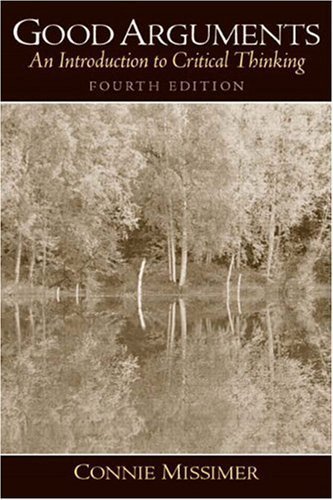
Good Arguments: An Introduction to Critical Thinking (4th Edition)
$41.35
by Connie A. Missimer



This book proceeds from CT in everyday life to sophisticated critical thinking in academic fields, with chapters which clearly outline the types of evidence in science, the social sciences, and the humanities. Unlike most other books, it offers a clear description of CT as the comparison of formulas of CT . Chapter topics include issue, conclusion, and reason; how to create alternative arguments; deciding to accept an argument; assumptions and implications; prescriptions; deliberations; experiment, correlation, and speculation; and problem solving by way of review. For a lifetime of thinking critically, reading the good arguments of others, and creating your own—across a wide spectrum of subjects. It's hard to believe that this much technology is packed into such a small and stylish package. The Slip from Tifosi has a grilamid TR-90 frame that has an extremely high alternative bending strength, low density, and high resistance to chemical and UV damage. Ideal for small to large faces it also has adjustable ear pieces for a custom fit and hydrophillic rubber ear and nose pieces for a clean, no-slip fit. Students who approach this subject are far more timid than is warranted! The reason may be that to many ears critical thinking has a forbidding sound"perfect, negative thinking," a new student of mine offered. If nothing else, I hope that this book will disabuse you of that impression. Critical thinking is the comparison of arguments on a subject to see which argument is likeliest, and this book is devoted to showing you how to do just that. There are a few basic concepts to master, along with the language in which these ideas are put, and the result is an endless array of subject-matter on which you can think critically. Indeed, I would argue that over the past centuries critical thinking has been responsible for the growth of knowledge in every field, from football to physics. Yet while critical thinking has produced good arguments that have vastly increased our store of knowledge, any piece of critical thinking is far from perfect. At least I would assume so, on the theory that if we don't search for even better arguments, for more evidence, we will never find them. The idea of critical thinkers weighing arguments about an issue may sound remote from your life or interests, but I would argue that you think critically many times a day. Unless you reached into the closet out of habit, you made a decision what to wear today. You had reasons for your choice which you found better than those for things you left on the hangers. You made assumptions about the weather. Similarly, your choice of breakfast (or not to bother with one) entailed some quick critical thinking. Your discussion of which team was likely to win the playoff, or which political candidate would do a better job, would probably be critical thinking. "Well," you might infer, "if I already do critical thinking, I don't need a course in it." Not so fast! In the areas you know well, you easily think critically. The purpose of this book is to back up a bit and show you exactly what it is that you have been doing so naturally, put names to the various types of thoughts you've had and how they are structured, so that it will be easy for you to apply the same good thinking in areas you're not as familiar with. You may want to think about two assumptions underlying this book. One is that your time is best spent on a dozen basic workhorses of reason, rather than on learning many aspects of reasoning. In the vast majority of cases, even cases of complicated reasoning, these are features of thought which are used. There are many more concepts in informal logic, not to mention the rigors of formal logic. However, you will be best served by learning to manipulate these major mental gears. The second assumption is that it is vital to practice the common phrases that indicate the structure of critical thinking. These phrases appear in boldface throughout the book. This edition contains expanded chapters, including a comparison of theories about critical thinking in Chapter 8. I gratefully acknowledge the assistance of Steve Carlson: Our conversations on the nature of evidence were clarifying and most enjoyable. Many thanks to the reviewers of this fourth edition: George O'Har, Boston College; Steven A. Greenlaw, Mary Washington College; and Carol Watt, Lane Community College. I would also like to thank the reviewers of the previous editions for their excellent suggestions: Diane M. Thiel, Department of English, Florida International University, Miami, Florida; Stephen T Mayo, Department of Philosophy, Molloy College, Rockville Centre, New York; Amy Hayek, Department of English, Florida International University, Miami, Florida; and M. Kip Hartvigsen, Department of English, Ricks College, Rexburg, Idaho. I hope that you will become at ease in recognizing the structure of critical thinking and enjoy a lifetime of fascination, reading others'