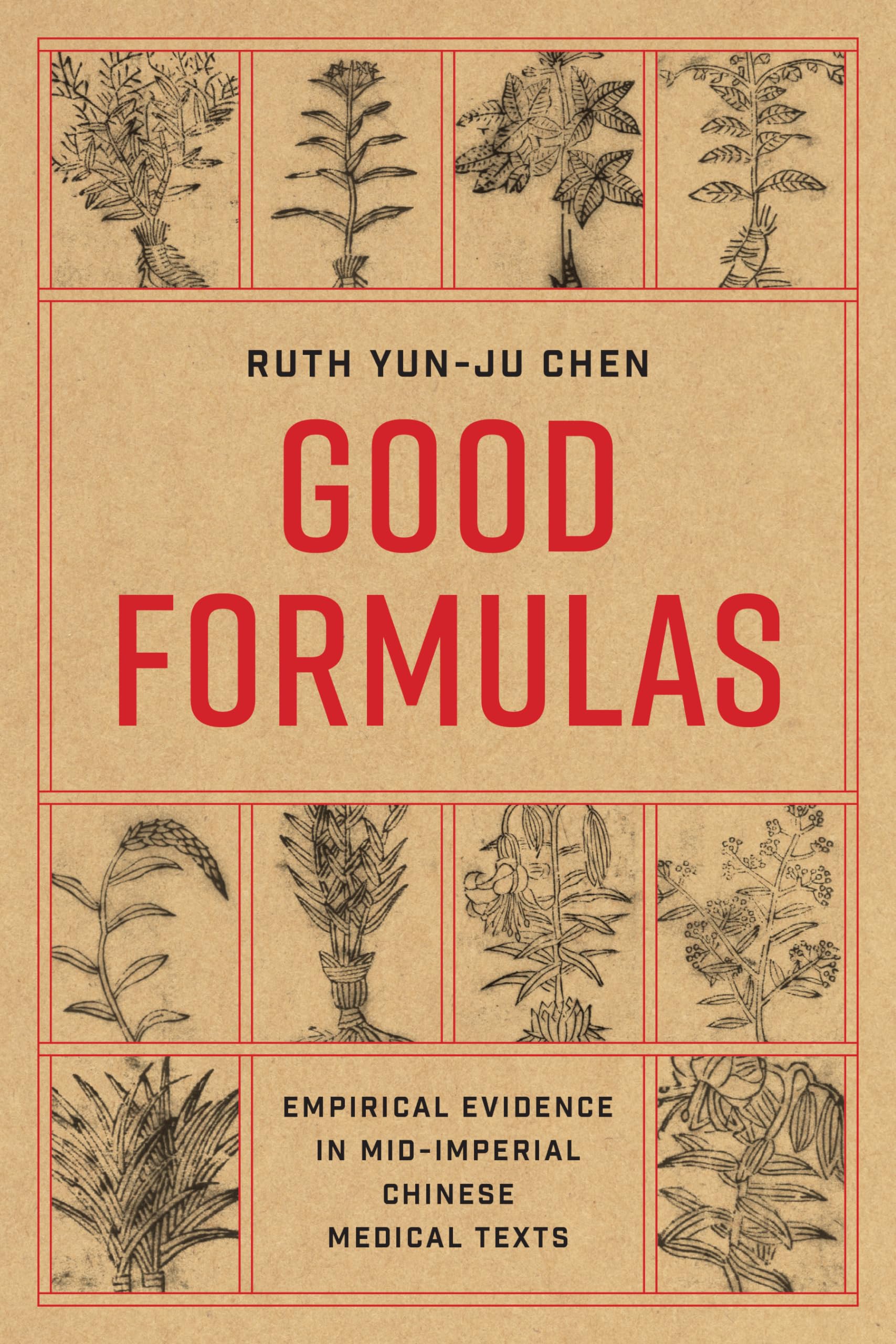
Good Formulas: Empirical Evidence in Mid-Imperial Chinese Medical Texts
$35.00
by Ruth Yun-Ju Chen



How early print culture reshaped strategies for presenting medical knowledge Why and how did the strategy of documenting medical practices through personal experience rise to prominence in China? This question is at the heart of Good Formulas , the first book-length study of the use of empirical evidence in Chinese medicine between the ninth and thirteenth centuries. The rise of this new approach to substantiating knowledge, which had appeared only sporadically in earlier medical literature, provides a window into transformations in the construction of textual authority in mid-imperial China. Focusing on medical genres and working extensively with notebooks ( biji ), Ruth Yun-Ju Chen shows that employing empirical evidence became prominent in conjunction with a publishing boom that enabled wider availability of medical texts and treatises. To convince a more socioculturally diverse readership to believe their claims and to win intertextual debates with contemporaneous authors, many Song medical authors turned to empirical methodology. Revealing a correlation between publishing cultures and changes in persuasion strategies in medical genres, Good Formulas offers new insights into the histories of medicine, knowledge production, and publishing in China. It also provides rich examples for scholars interested in the development of empirical evidence in the premodern world. "Very original in conception. No previous study has looked at the medical tradition from the perspective of verification exhaustively."―Miranda Brown, author of The Art of Medicine in Early China: The Ancient and Medieval Origins of a Modern Archive "Chen is the first scholar to illuminate the new epistemic culture in middle-period China replete with new virtues that valued witnessing and historicity."―Marta Hanson, author of Speaking of Epidemics in Chinese Medicine: Disease and the Geographic Imagination in Late Imperial China "Chen examines a variety of sources, in particular formularies: collections of medicinal formulas ( fangshu ) and works on materia medica ( bencao ). In these texts, written by public officers and physicians, Chen finds a new way of evaluating knowledge based on an author's experience. . . Chen's valuable contribution provides new documentation and opens up new perspectives for this field of research."― Journal of Chinese History " Good Formulas introduces several fresh perspectives into the field of medical history. The focus on epistemology enables Chen to probe deep into the patterns of reasoning and underlying assumptions, revealing mechanisms of knowledge production that are not always articulated in historical terms. That depth then generates a breadth, which brings into relief the organic mutual embeddedness of medicine and knowledge production at large across the cultural universe of medieval China. . . . [The book] has transcended boundaries and created new opportunities for dialogue between studies of medicine and cultural history, as well as among scholars spanning the early medieval through the late imperial periods. It will stand as a crucial read for readers interested in premodern China."― Journal of Song-Yuan Studies " Good Formulas presents invaluable insights into the intimate connections between medical knowledge-making and the scholarly culture of personal experience and attestation in middle China. By enriching our understanding of the medical literature of this time, this thought-provoking work also provides an important baseline for assessing the nature of later developments in the history of Chinese medicine."― Bulletin of the History of Medicine "Historians of Chinese medicine would appreciate Chen’s laborious philology work on the intertextual and commentary tradition. Most importantly, Chen’s book seeks to engage historians of medicine outside of Asia and start a dialogue on alternative modes of writing about medicine and doing science in the premodern world."― Isis: A Journal of the History of Science Society How early print culture reshaped strategies for presenting medical knowledge Ruth Yun-Ju Chen is assistant research fellow at the Institute of History and Philology, Academia Sinica.