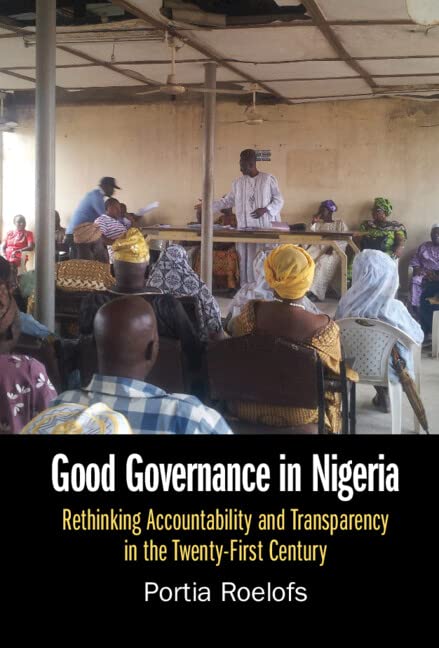
Good Governance in Nigeria: Rethinking Accountability and Transparency in the Twenty-First Century
$58.50
by Portia Roelofs



Drawing on original fieldwork in Nigeria, Portia Roelofs argues for an innovative re-conceptualisation of good governance. Contributing to debates around technocracy, populism and the survival of democracy amidst conditions of inequality and mistrust, Roelofs offers a new account of what it means for leaders to be accountable and transparent. Centred on the rise of the 'Lagos Model' in the Yoruba south-west, this book places the voices of roadside traders and small-time market leaders alongside those of local government officials, political godfathers and technocrats. In doing so, it theorises 'socially-embedded' good governance. Roelofs demonstrates the value of fieldwork for political theory and the associated possibilities for decolonising the study of politics. Challenging the long-held assumptions of the World Bank and other international institutions that African political systems are pathologically dysfunctional, Roelofs demonstrates that politics in Nigeria has much to teach us about good governance. ‘This seminal work takes a new look at the long-contested terrain of ‘good governance’ and suggests a renewed focus on the subject as a socially embedded activity. Rich in methods, theory, and data, it examines the Nigerian case to show how an experience long on bad news could produce promising opportunities and resources for good governance and democracy in Nigeria - and beyond.’ Adigun Agbaje, University of Ibadan ‘Portia Roelofs has written a bold contribution to ongoing debates on governance quality and democracy. Challenging ontological and epistemological assumptions in the mainstream literature, Roelofs’ approach to socially-embedded good governance is an excellent, empirically grounded and locally sensitive understanding of home-grown governance principles in Nigeria.’ Wil Hout, International Institute of Social Studies, Erasmus University Rotterdam ‘Roelofs is to be commended for taking the terms of Nigerian political life seriously, reading them not as evidence for a theory generated elsewhere, but as serious theoretical and ethical contributions to global and local discussions about accountability and transparency in politics. Paired with her refreshingly clear and direct writing, this book is as readable as it is compelling.’ Leigh K. Jenco, London School of Economics and Political Science ‘A grounded and nuanced argument for alternative, locally shaped and socially embedded models of governance.’ Stephanie Wanga, LSE Review of Books Drawing on original fieldwork in Nigeria, Portia Roelofs reconsiders what good governance means, focusing on accountability and transparency. Portia Roelofs is Lecturer in Politics at King's College London. She was previously the Junior Research Fellow in Politics and Political Thought at St Anne's College Oxford and an LSE Fellow in International Development. She has spent time as a visiting scholar at the universities of Ibadan and Maiduguri, and the Institute Français de Recherche on Afrique – Ibadan. She has published in African Affairs, the Journal of Modern African Studies, Governance, Oxford Development Studies and Review of African Political Economy.