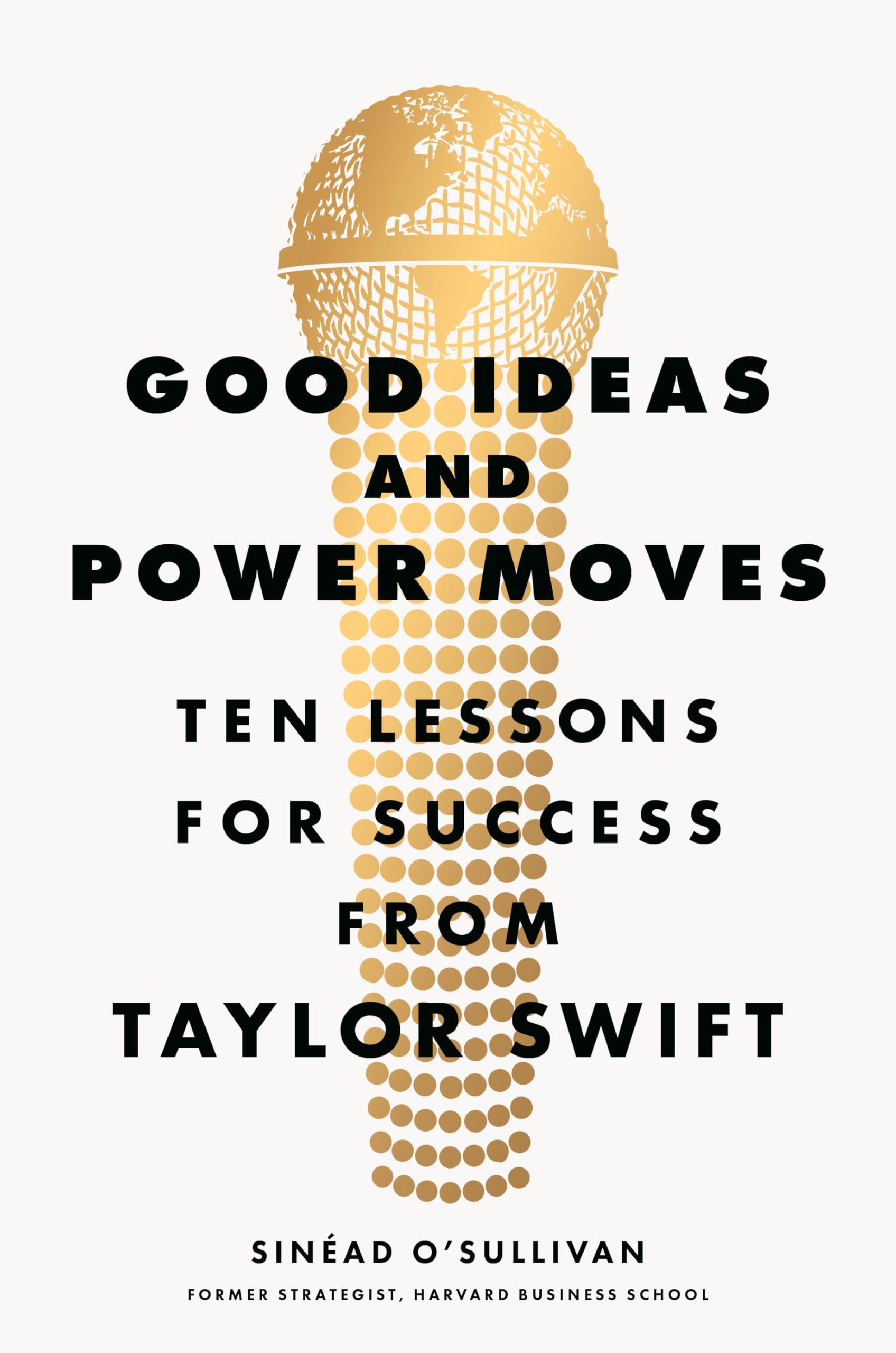
Good Ideas and Power Moves: Ten Lessons for Success from Taylor Swift
$25.99
by Sinéad O'Sullivan



A guide to the 10 power moves that have built Taylor Swift’s superstardom and empire, from a former Strategist at Harvard Business School’s Institute for Strategy Taylor Swift’s genius is not limited to her singing and songcraft: as the founder of her own multi-billion dollar enterprise she has higher returns than 99.9% of hedge funds, and has built a stronger global corporation than nearly every other American conglomerate CEO. She is the only person that the US Federal Reserve and European Central Bank track with precision. She has a larger impact on the economy than most economists that have ever lived, and has done more for US antitrust law than any sitting member of Congress. There is a lot to learn from Taylor Swift. Global investment fund manager and former head of Strategy at HBS (and Swiftie!) Sinead O’Sullivan taps into the same genius that sells out stadiums and shuts down the internet to give Taylor—the CEO, the strategist—the respect she deserves. O’Sullivan sums up Swift’s business savvy into ten big, teachable lessons, including: - Build a World (Not a Product) : how to create value that is greater than the sum of its parts (or, how Taylor created the fan-centered Swiftverse that fosters community, belonging, and off-the-charts engagement) - Be Anti-Fragile : how to embrace volatility, build resilience, and thrive in uncertainty--when your competitors can't (or, how Taylor gamed the chaos of Covid shutdown to own the airwaves) - Don’t Just Play the Game, Change It : how to rewrite the rules on your own terms when your chips are down (or, how Taylor almost lost control of her music catalog to Private Equity—but re-recorded all her masters and took them back) “The book connects with a wide audience by leveraging Taylor Swift’s influence, showing how her story offers powerful insights for anyone looking to pursue their dreams with intention, clarity, and resilience.” —Jenny Fleiss, cofounder of Rent the Runway “Jay-Z famously said he wasn't a businessman, he was "a business, man". The reality is that the biggest business in music today is Taylor Swift, and Sinead does a wonderful job in dissecting what makes that business tick.” —Robin Wigglesworth, author of Trillions “Merging basic business advice with nontraditional marketing strategies, including a “unite and lead” approach to influencing that she terms “white psyops,” O’Sullivan lays out an accessible road map to achievement.” — Publishers Weekly Sinéad O’Sullivan has an MBA from Harvard Business School where she formerly served as the chief strategist of the HBS Institute for Strategy and Competitiveness, working with top business economists, global CEOs, prime ministers, and financiers. She has also worked at Massachusetts Institute of Technology’s Sloan School of Management and was a professor at Illinois Institute of Technology’s Stuart School of Business. She has served as an aerospace engineer and a human spaceflight designer at NASA and its Jet Propulsion Laboratory. Her writing has appearing in The New Yorker , Financial Times , FT Alphaville , Vogue , British Vogue , and The Currency. She is the cofounder of a global investment fund and is in the top 0.01 percent of Taylor Swift fans worldwide, as ranked on Spotify. She splits her time between London and Boston. POWER MOVE ONE Be a Unicorn Being like Taylor Swift is not impossible. However, it turns out that it's not exactly easy. "But what happens if you get sick?" I asked my friend, a chef of a two-Michelin-star restaurant, over dinner. It's a fascinating question, because it really highlighted the difference between our lives. If I were to get sick, I would send a few emails to postpone meetings, and when I'm feeling a bit better, I might even attempt to do some work from bed. This is the ultimate luxury of being a white-collar, work-from-anywhere worker. My sister, who works in a hospital where she must be physically present to do her job, can even phone in sick and have someone cover her shift. Is it ideal? No. But is it catastrophic? Also no. A two-Michelin-star restaurant, however, is slightly different. Six-month waiting lists, for both lunch and dinner, and a small, ninja-like team of the most skilled chefs in the world performing what is essentially microsurgery on food to produce an extremely complex menu at high speed. When your customers are spending hundreds of dollars per meal, at a minimum, the lowest acceptable outcome is complete perfection. "Sick? You don't get sick. I haven't had a sick day in years," the chef tells me, baffled by the question in the first place. "It's not an option." Of the estimated 15 million restaurants in the world, only 0.018 percent of them hold one or more Michelin stars. Of that, only 650 two- or three-Michelin-star restaurants exist today, putting my friend in the top 0.004 percent of chefs in the world. I thought about a trip I took last winter, a four-hour flight each way with a three-day vacation in be