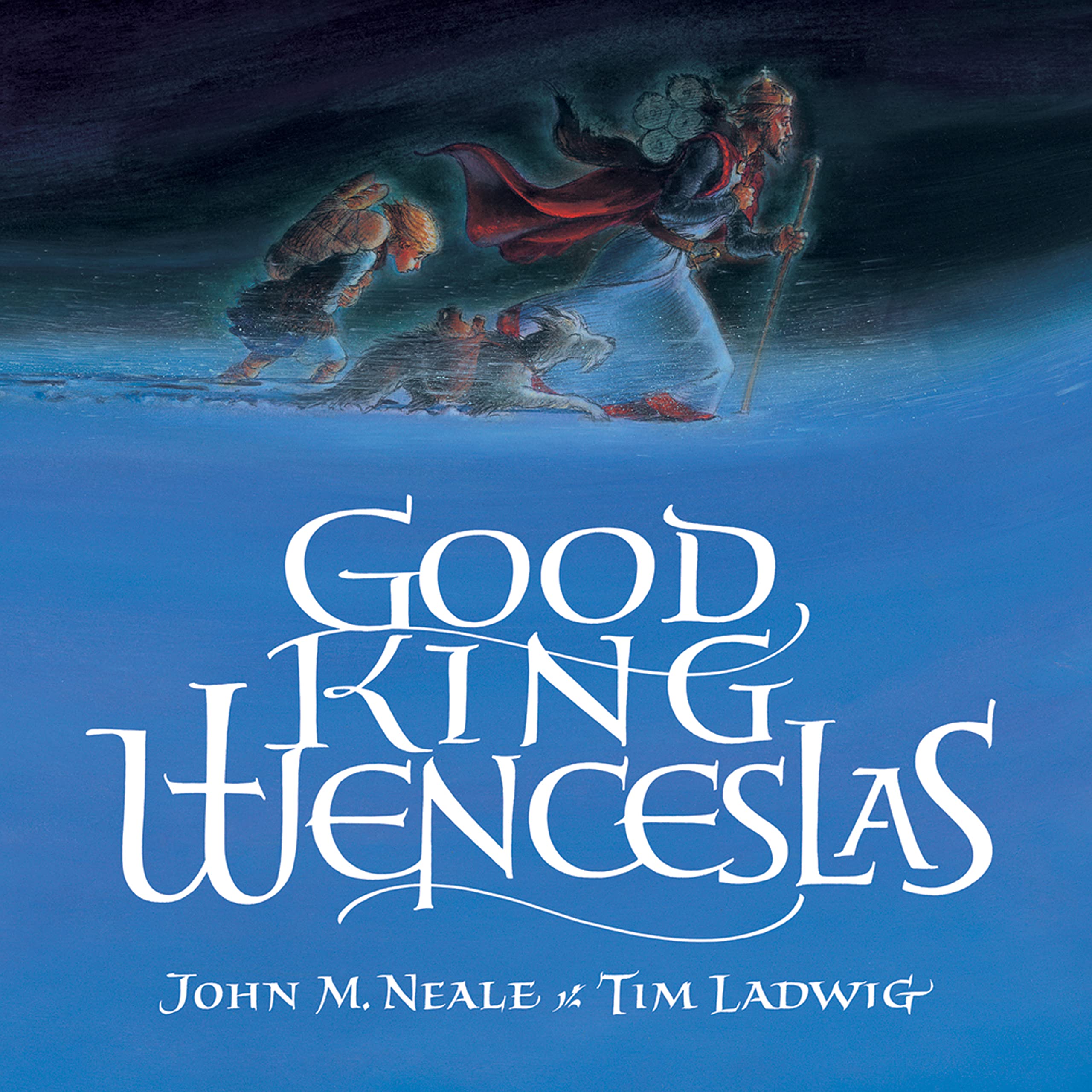



Good King Wenceslas looked out on the Feast of Stephen, when the snow lay round about, deep and crisp and even. Brightly shone the moon that night, though the frost was cruel, when a poor man came in sight, gathering winter fuel. This story, based on actual events that occurred in the tenth century, tells of a kind-hearted king and his page who set out to help a poor man on a cold winter's night and experience a miracle along the way. Tim Ladwig's energetic paintings bring new life to the familiar words and remind readers of all ages that helping others is a blessing. PreS-Gr. 2. In the city of Prague, in the Czech Republic, there is a square, and in the square is a statue of the country's patron saint. So begins this winning tribute to the tenth-century Bohemian King Wenceslas and the popular Christmastime song bearing his name. Ladwig's oversize double-page spreads are engaging and expressive, illustrating and enlivening this slightly adapted story-song from the moment when the king and his page spot the poor man gathering wood in the cold to their dangerous, icy trek to his house through the snow. "Page and monarch forth they went, / forth they went together, / through the rude wind's wild lament / and the bitter weather." A historical note and the musical notation for the song (plus Neale's five original verses) are appended. A holiday treat. Karin Snelson Copyright © American Library Association. All rights reserved AWARDS and RECOGNITIONS ForeWord Magazine Book of the Year Awards , Finalist, Children's Picture Book (2006) Bank Street College , Best Children's Books of the Year (2006) The Horn Book Guide "The visual presentation of this traditional Christmas carol will awaken new readers to its story. . . . The contrast in the mixed-media art between the barren winter landscapes and the hearth-warmed kitchens of cottage and castle is lovely." Booklist "Ladwig's oversize double-page spreads are engaging and expressive. . . . A holiday treat." School Library Journal "The well-known carol about a 10th-century Bohemian king is brought to life through Ladwig's vibrant, realistic paintings. . . [A] lovely book suitable for reading aloud." New York Times Book Review "The carol's lyrics, pleasingly antiquated and rousingly celebratory about the act of giving, offer a challenge to the consumer frenzy that beckons every boy and girl, naughty or nice, each December." Good King Wenceslas looked out on the Feast of Stephen, when the snow lay round about, deep and crisp and even. Brightly shone the moon that night, though the frost was cruel, when a poor man came in sight, gathering winter fuel. This story, based on actual events that occurred in the tenth century, tells of a kind-hearted king and his page who set out to help a poor man on a cold winterâ s night and experience a miracle along the way. Timâ s Ladwigâ s energetic paintings bring new life to the familiar words and remind readers of all ages that helping others is a blessing. "Good King Wenceslas looked out on the Feast of Stephen, when the snow lay round about, deep and crisp and even. Brightly shone the moon that night, though the frost was cruel, when a poor man came in sight, gathering winter fuel." This story, based on actual events that occurred in the tenth century, tells of a kind-hearted king and his page who set out to help a poor man on a cold winter's night and experience a miracle along the way. Tim's Ladwig's energetic paintings bring new life to the familiar words and remind readers of all ages that helping others is a blessing. When he was eight years old, Tim Ladwig lost an eye in an accident. During his recovery, his father gave him oil paints, a couple of brushes, and a small canvas. He painted a clown with colors straight from the tube. Tim's first work was promptly framed, and his love of painting was born. Tim earned a degree in graphic design from Wichita State University and also studied painting and drawing for a semester in Rome. Following school, Tim worked as an associate art director of an advertising design studio in Wichita, Kansas. Then for seventeen years Tim served as a community minister with an inner-city Christian mission organization in Wichita, Los Angeles, and Newark. To help meet the need for children's books that accurately depict urban culture, he created the picture book Psalm Twenty-Three, in which he applied the psalmist David's pastoral words to a normal day of two city children. Tim has illustrated a number of children's books, two of which, The Fear Not Angel and Psalm Twenty-Three were Gold-Medallion Award finalists. Psalm Twenty-Three and Silent Night were also honored with ABA "Pick of the Lists" awards. Tim serves as a graphic artist for World Impact Urban Ministry Institute and lives in Wichita, Kansas. John M. Neale (18181866), an Anglican priest, wrote the words to "Good King Wenceslas" in 1853 to inspire children to be gen