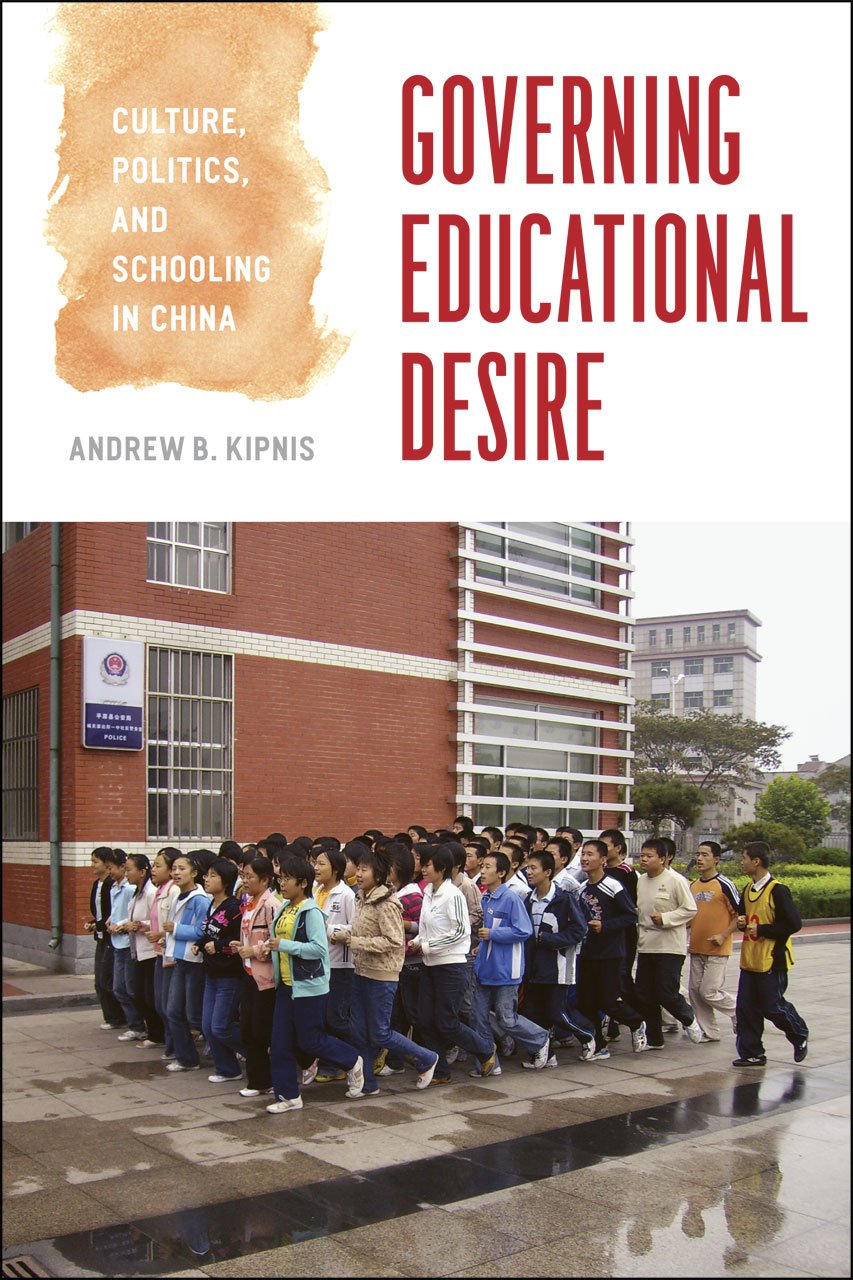
Governing Educational Desire: Culture, Politics, and Schooling in China
$37.00
by Andrew B. Kipnis



Parents in China greatly value higher education for their children, but the intensity and effects of their desire to achieve this goal have largely gone unexamined—until now. Governing Educational Desire explores the cultural, political, and economic origins of Chinese desire for a college education as well as its vast consequences, which include household and national economic priorities, birthrates, ethnic relations, and patterns of governance. Where does this desire come from? Andrew B. Kipnis approaches this question in four different ways. First, he investigates the role of local context by focusing on family and community dynamics in one Chinese county, Zouping. Then, he widens his scope to examine the provincial and national governmental policies that affect educational desire. Next, he explores how contemporary governing practices were shaped by the Confucian examination system, uncovering the historical forces at work in the present. Finally, he looks for the universal in the local, considering the ways aspects of educational desire in Zouping spread throughout China and beyond. In doing so, Kipnis provides not only an illuminating analysis of education in China but also a thought-provoking reflection on what educational desire can tell us about the relationship between culture and government. “Kipnis convincingly demonstrates how crucial education is for shaping the strategies, dreams, and desires of Chinese families. But the main contribution of this book is the way it manages to place this educational desire in a larger context of how China is governed and in a comparative framework that shows Chinese students’ feverish desire for education as part of a global phenomenon that cannot be reduced to Chinese, or even East Asian, cultural peculiarity.” -- Stig Thøgersen, Aarhus University “Kipnis’s broad grasp of Chinese educational history and policy, deeply grounded ethnography of Zouping schools, and innovative use of social science theory to illuminate the desire for education in China will make Governing Educational Desire well received and widely read. The important contribution of this excellent book is to treat as a ‘total social phenomenon’ the ubiquitous artifacts, sentiments, and assumptions related to the powerful desire for education in China. Kipnis’s arguments are suitably complex, carefully and vividly illustrated by field data, persuasive, and theoretically sophisticated.” -- Heidi Ross, Indiana University “Andrew Kipnis provides a fascinating account of educational desire in China. This book makes a contribution to both Chinese studies as well as comparative studies of education. In particular, this book sheds light on the studies of political culture and offers great insights that governing and culture reinforce each other and help maintain regime legitimacy through moderating educational desire. Furthermore, it generates several implications for China’s political development in the future.” -- Xiaobo Lü ― Comparative Political Studies “ Governing Educational Desire is an important book which contributes significantly to the anthropology of education, as well as the anthropology of governing. Providing a wealth of vividly described empirical data, which are very well integrated into complex theoretical discussions about culture and governmentality, the book deserves to be read by scholars, students, and anybody else interested in Chinese education, society, or governmentality in general.” -- Mette Halskov Hansen ― Journal of the Royal Anthropological Institute “The topic of high educational desire in China is very important but has not been systematically or comprehensive examined. Kipnis has done an excellent job exploring this phenomenon. He provides great insights on how this manifests in the family, schools, community, and the government in China. He traces back the history of Chinese government and literary culture and connects the Chinese case to the global situation. Readers will greatly benefit from Kipnis’s rich knowledge about educational tradition, reforms, and social changes in China. Kipnis does a good job of balancing his position as a researcher, teacher, and friend. He employs social science theories to examine culture, politics, economics, demography, and so forth in order to illuminate the phenomenon of high education desire in Zouping and, to a large extent, China innovatively. In sum, this book is an impressive work, a book that provides a good picture of China’s educational changes and society through the lens of a county in Shandong. It is a great book for courses on China, comparative and international education, comparative politics, and/or East Asian studies.” -- Xuan Weng and Jing Lin ― China Review International “This is an erudite and illuminating text. Its portrayal of educational culture in China is detailed and carefully presented. The book’s fundamental assertion, that a high level of educational desire is a central feature