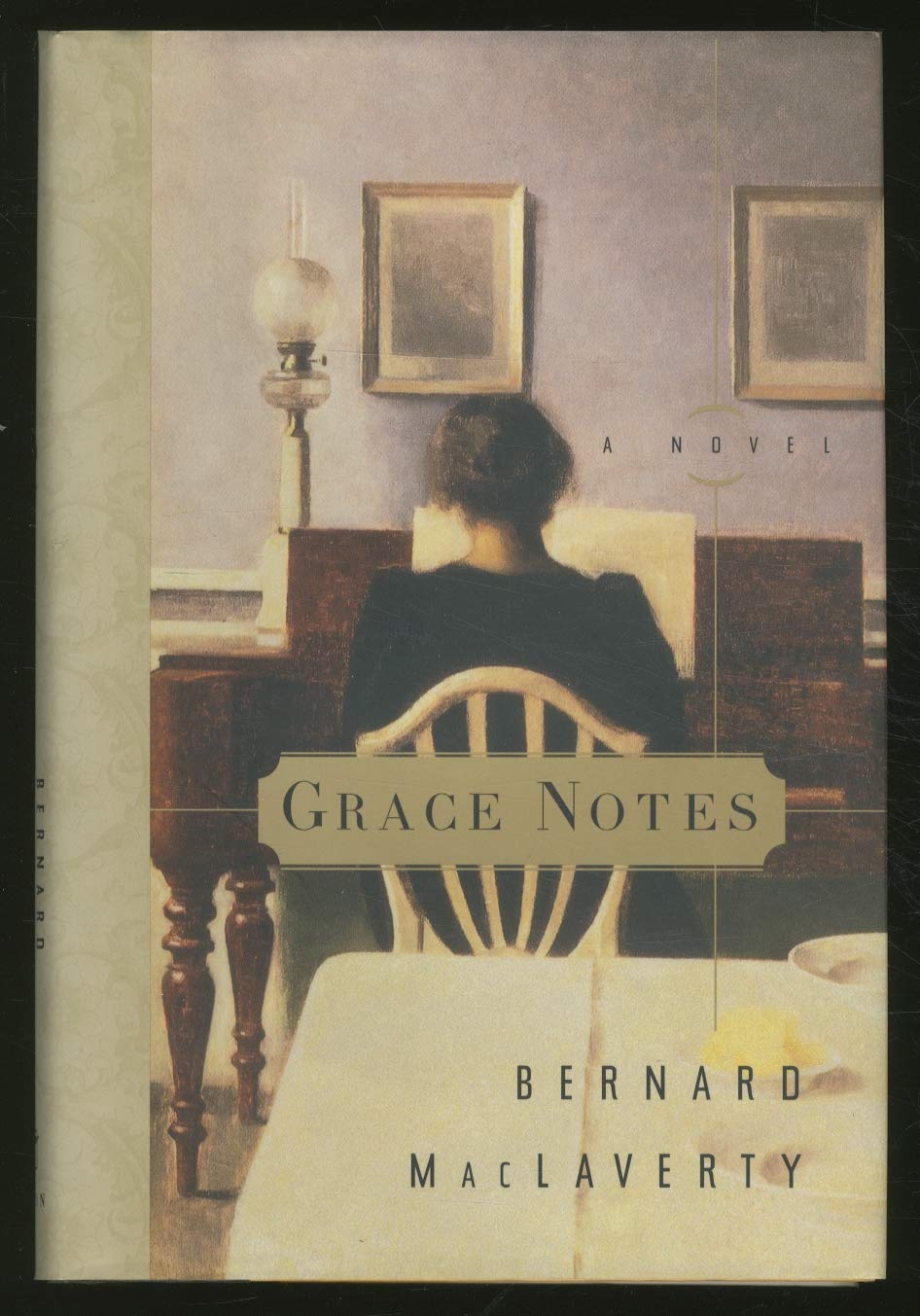



Presents a masterful portrait of Catherine McKenna, an estranged daughter, vexed lover, new mother, and woman composer making her mark in a male-dominated field, and the complex interplay between her life and her art. Composer Catherine McKenna has more of a gift for music than happiness, but she has long been driven beyond harmonies (musical and personal) that her Belfast family can understand. Bernard MacLaverty renders both sides of the equation: Catherine's feminist and aesthetic striving and her mother's more traditional grasp; it's hard not to sympathize with Mrs. McKenna's impatient rejoinder, "You don't cope with music, you listen to it." Grace Notes , MacLaverty's first novel since Cal , is as much about Irish identity--and possibility--as it is about art. Catherine's newest piece, a mass, includes the huge drums Protestants play in parades. "It was a scary sound--like thunder. Like the town was under a canopy of dark noise." Though her fellow Catholics see the drums as instruments of threat, Catherine is determined to integrate them into her composition. Her return to Belfast for her father's funeral brings back several ghosts, among them an influential professor who spoke of grace notes--"the notes between the notes." This novel is full of such instances, wry snatches of conversation and unforgettable observations: the new Chinese restaurant that has had to offer chips to stay in business, or the pub that's "on a slight hill. When dogs pissed at the door the dark lines ran diagonally to the gutter." These transcend the occasional passage in which MacLaverty tries too hard to see into the life and rhythms of a female artist. The final section, however, a live radio concert of Catherine's piece, is a triumph for both woman composer and male author. A lyric novel about music and motherhood. Catherine McKenna is an Irish-born pianist and composer whose emotional turbulence sets the tone for a significant part of the story's soft yet visceral verbal music. Catherine's unusually delicate sense of psychic balance is thrown off by two events in particular: the birth of her first child, Anna, and the sudden death of her estranged yet beloved father. Catherine is not married; her mate is a (mostly) lovable drunkard. As an iconoclastic only child who left her family's home in a small town near Belfast for a university education and career in Scotland, the adult Catherine rarely visits or phones her disappointed parents. Her musical career, though, is flourishing, with the BBC broadcasting her work and commissions coming her way at last. Using flashbacks, interior monologues, and dialogue, MacLaverty very gradually creates a complex, dimensional character, until the third-person narrative seems to speak directly to us from Catherine's struggling soul: ``It gave Catherine a strange feeling, this invisible cascade of darkness. She felt suffocated by it quilting downwards--whatever it was. This diminuendo of light brought about by something intangible--odourless--invisible.'' The drawback of MacLaverty's mildly impressionistic approach is the slow, even anticlimactic pace of some scenes, those portraying the domesticity of Catherine's relatively cloistered life, for example, or those, especially, involving her father's death, which open the story. Catherine's character, as it emerges from the fragmentary narrative, tends to overshadow everyone else in a novel guided less by ``story'' than by musical tides and perturbations. It's clear that MacLaverty (Walking the Dog, 1995, etc.) has tried to do something rather difficult: to suggest the interior life of an artist struggling to balance the urgent demands of creating music and the equally pressing demands of life. Very often, he succeeds in this complex portrait of a woman who is, first and foremost, an artist. -- Copyright ©1997, Kirkus Associates, LP. All rights reserved. ... memories are described in absorbing detail ... transforming what could feel ponderous into something lyrical and hypnotic. In MacLaverty's fictional landscape, it's these inconclusive "grace notes" of life--"neither one thing nor the other"--that are the most enticing. -- The New York Times Book Review, Courtney Weaver Bernard MacLaverty is the author of the novels Lamb and Cal and several short story collections, including Walking the Dog. A native of Northern Ireland, he lives in Glasgow, Scotland.