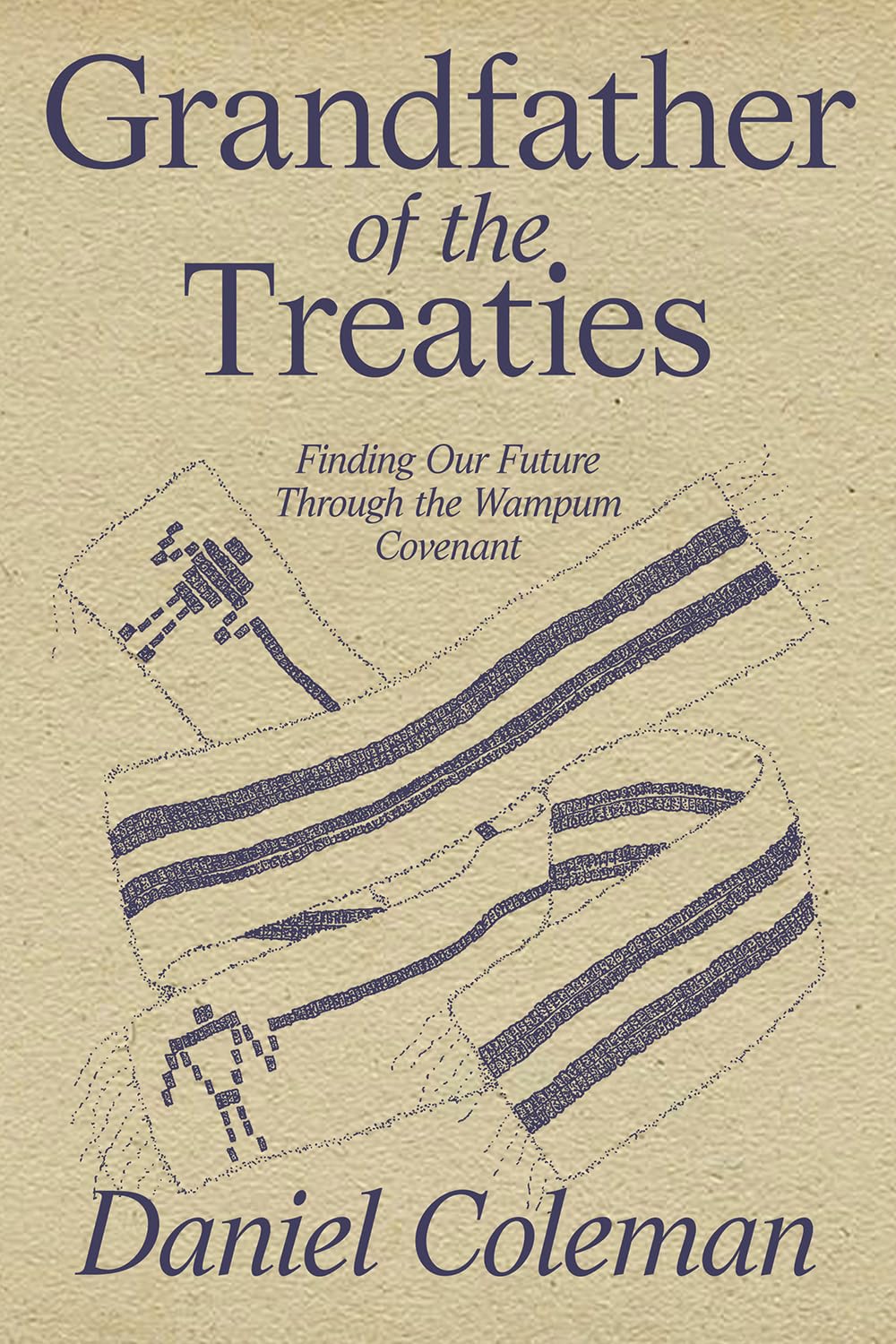
Grandfather of the Treaties: Finding Our Future Through the Wampum Covenant
$24.00
by Daniel Coleman



For decades Daniel Coleman has worked closely with many Indigenous scholars to understand the land he calls home and the complex and painful histories between Indigenous and European nations that have formed Canada. In Grandfather of the Treaties , he has drawn on this experience to craft an extensive study of the wampum covenants that underpin our nations, one that takes readers from wampum’s first emergence among Indigenous nations to how these covenants can help us shape a better future for all. In this wide-ranging book Coleman seeks to fill a deep hole in most Canadians’ knowledge of how our nation was formed. As we relearn our history, we can recommit to our earliest promises, which were meant to last “as long as the sun shines upon this earth, as long as the water still flows and as long as the grass grows green at a certain time of the year.” "The Land Back movement isn’t just about returning land to First Nations, although that’s important, he contends; it’s also about seeing the land itself as a living, agential treaty partner to whom we have obligations, something we can learn from our Indigenous treaty partners. In this time of climate crisis and ecological peril, that’s a vital lesson, one we desperately need to take seriously. Reading The Grandfather of the Treaties is a way to begin that work." -- Ken Wilson ― Miramichi Reader "Does an excellent job detailing the agreement and settler betrayal. While it can be daunting with the academic tone and the massive amount of information, it is definitely worth taking the time to read!" -- Sarah O'Connor “Coleman’s work is well-researched into the local lore of Hamilton, the families who settled there, and the Indigenous people who lived on the land prior to European settlement. He is inclusive of those stories; of recorded family history in old Bibles, the ceremonial and oral narratives of Indigenous peoples.” ― The Goose “The book brims with life, and the family of life – the system of living things which brings the larger city into play. Yardwork has in it some of the sacramental feel, soil sifted through one's fingers, of Thoreau and Annie Dillard . . . His research into the native umbilical here and the Haudenosaunee stories of creation is exhaustive; the distillation of it lyrical.” ― Hamilton Spectator “Daniel Coleman’s analysis of the pervasive metaphor of ‘civility’ in Canadian cultural discourse is a fascinating and eye-opening study that provides a welcome genealogy of this discourse in Canadian literary texts published between 1850 and 1950 . . . It provides a history and critique of the project of normative civility in English Canada, while also highlighting its continuing impact in popular understandings of Canadian identity today.” ― Canadian Literature on White Civility Daniel Coleman is a recently retired English professor who is grateful to live in the traditional territories of the Haudenosaunee and Anishinaabe in Hamilton, Ontario. He taught in the Department of English and Cultural Studies at McMaster University. He has studied and written about Canadian Literature, whiteness, the literatures of Indigeneity and diaspora, the cultural politics of reading, and wampum, the form of literacy-ceremony-communication-law that was invented by the people who inhabited the Great Lakes–St. Lawrence–Hudson River Watershed before Europeans arrived on Turtle Island. Daniel has long been fascinated by the poetic power of narrative arts to generate a sense of place and community, critical social engagement and mindfulness, and especially wonder. Although he has committed considerable effort to learning in and from the natural world, he is still a bookish person who loves the learning that is essential to writing. He has published numerous academic and creative non-fiction books as an author and as an editor. His books include Masculine Migrations (1998), The Scent of Eucalyptus (2003), White Civility (2006; winner of the Raymond Klibansky Prize), In Bed with the Word (2009) and Yardwork: A Biography of an Urban Place (2017, shortlisted for the RBC Taylor Prize). I welcome this publication because I think it will provide great insight for the other people descended from the many ships that arrived on our shores. It might help them rethink what it means to have inherited this Two Row Wampum agreement. It is about maintaining quality relationships and developing true friendship. . . . I hope that Daniel’s words and my drawings help you see what this friendship is like. Look back to look forward. Look at each other to find the real reason that peace, respect and friendship matter. – from the Foreword by Rick Hill (Tuscarora)