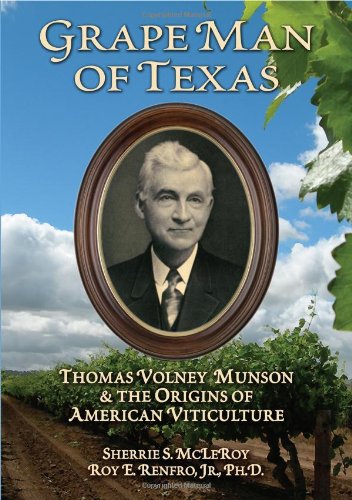
Grape Man of Texas: Thomas Volney Munson & the Origins of American Viticulture
$128.57
by Sherrie S. McLeroy



Grape Man of Texas is the first biography of Thomas Volney Munson (1843-1913), the internationally recognized horticulturist who developed over 300 new varieties of grapes, some of which are still grown today on almost every continent. He is perhaps best known for his work in fighting the phylloxera epidemic of the late nineteenth century, which nearly destroyed the world’s vineyards. His solution—grafting vinifera onto certain resistant native rootstocks from Texas—earned him the Chevalier du Merite Agricole in the French Legion of Honor and numerous accolades. This second edition introduces new insights into the phylloxera period, Munson’s many papers and publications, and his far-sighted grasp of the needs of twentieth century agriculture and transportation. It details the continuing influence of both his research and his hybrid grapes on modern viticulture and new varieties of vitis that have been bred from them around the world. This [is an] important contribution to American wine and grape history. --HUDSON CATTELL, editor, Wine East This well written, easy to ready biography of Thomas Volney Munson (1843-1913) explores not only Munson s life but also a side of the American wine story not often examined. The fact that most of his life was spent in Texas is mere happenstance. He moved to Denison, Texas, because he had family there only after business ventures in Montana and elsewhere were unsuccessful for various reasons. While the book uses Munson as a locus, it is really the story of early years of American viticulture and enology. Munson was a pioneer in these fields. As a horticulturalist, he developed over 300 new grape varieties by crossing native grapes. Some were created for the production of wine, others as table grapes. A fair number of his hybrid grapes are still in use today both in the U.S. and abroad. Munson also traveled widely to examine growing conditions around the country and to find and describe native varieties that had not been found or identified previously and to correct misidentifications in museum collections. He shared his wide knowledge freely with individuals and institutions both in the United States and abroad and his nursery business supported him through the sale of vines and rootstock. The onslaught of phylloxera in French vineyards in the latter part of the 19^th Century is well known. What is not is Munson s part in conquering it. His encyclopedic knowledge of grape varieties, rootstock, and the relationship between rootstocks and growing conditions to match phylloxera resistant native American rootstocks to the soils found in the French vineyards. Where others had failed, his extensive research gave him the insight and understanding necessary to identify rootstocks that were hardy, phylloxera resistant, /and/ compatible with the French soils. For that work he was awarded the /Chevalier du Merite Agricole/ in the French Legion of Honor in 1888. He also benefited by being able to supply those rootstocks to French vineyards. Indeed, the merlot at Chateau Pavie is still growing on Munson supplied rootstock. In spite of his numerous contributions to viticulture, he wrote that the greatest feat of my life was his ascent of Mt. Shasta in 1889. But then he was an unusual man. In addition to his viticulture work, Volney developed various pieces of agricultural machinery and even sketched plans for a Stable, Safety Flying Car, or Machine (a helicopter) with counter-rotating blades to eliminate the effects of torque and a third propeller to provide forward motion. Along with a few other novel attributes, its features presage many current designs. Thomas Volney Munson is not as well known as others such as Luther Burbank but during his lifetime his contributions were judged equal to theirs. Perhaps this book can help redress this oversight. This work by McLeRoy and Renfro has made a valuable contribution to the history of viticulture in the United States and, incidentally, around the world. It is an easy read and should be on the shelf of anyone who wishes to better understand how viticulture developed and continues to develop with new rootstocks and the matching of rootstocks and grape varieties to widely varying growing conditions. --Harold Baer, Jr., Colorado Wine News Twenty-five years ago, I got a call from a client of mine, originally from Bordeaux, who had a wine bar in Dallas, Texas. "My father is visiting from France and would like to go to Denison, Texas, and see where Mr. Munson lived and worked. Would you like to go with us?" My friend's father was Raymond Chandou, who studied and worked under Emile Peynaud, and who ran one of the largest and most successful wine cooperatives in France. "You bet," I said. I was definitely in on this trip. A few years before, while making wine in North Texas purely as an amateur, I had gone to Denison to pick grapes and to find out about some of the hidden Thomas Munson vineyards that were scattered over North Tex