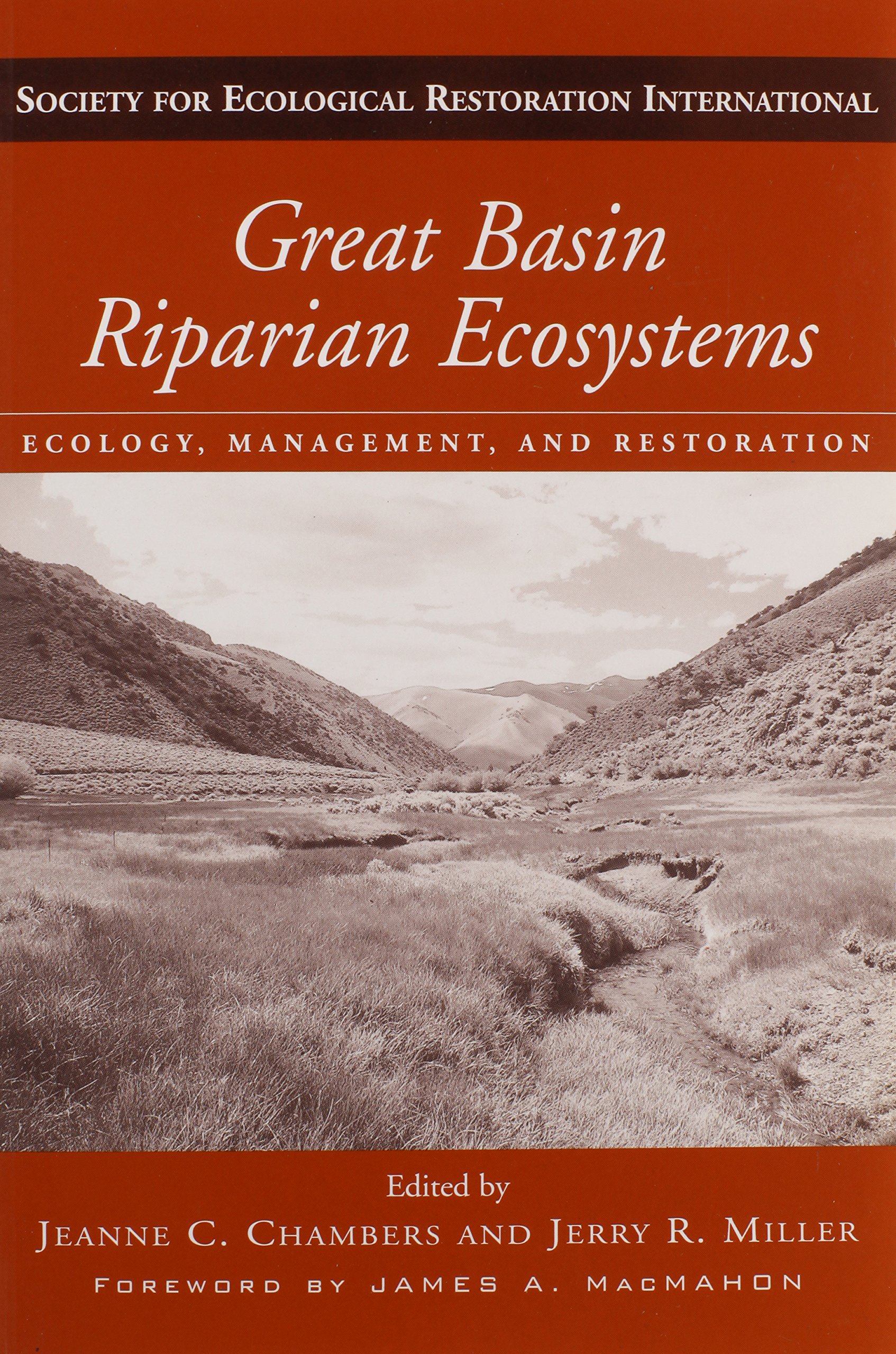
Great Basin Riparian Ecosystems: Ecology, Management, and Restoration (Volume 4) (The Science and Practice of Ecological Restoration Series)
$40.00
by Jeanne C. Chambers



Established by the USDA Forest Service in 1993, the Great Basin Ecosystem Management Project for Restoring and Maintaining Sustainable Riparian Ecosystems is a large-scale research study that uses an interdisciplinary approach to examine the effects of climate change and human disturbance on riparian areas. Structured as a collaborative effort between management and research, the project focuses on understanding the geomorphic, hydrologic, and biotic processes that underlie riparian structure and function and the interrelated responses of those processes to disturbances, both natural and anthropogenic. Great Basin Riparian Ecosystems , edited by Jeanne C. Chambers and Jerry R. Miller, presents the approach used by the researchers to study and understand riparian areas in the Great Basin region. It summarizes the current state of knowledge about those areas and provides insights into the use of the information generated by the project for the restor-ation and management of riparian ecosystems. Because semi-arid ecosystems like the Great Basin are highly sensitive to climate change, the study considered how key processes are affected by past and present climate. Great Basin Riparian Ecosystems also examines the processes over a continuum of temporal and spatial scales. Great Basin Riparian Ecosystems addresses restoration over a variety of scales and integrates work from multiple disciplines, including riparian ecology, paleoecology, geomorphology, and hydrology. While the focus is on the Great Basin, the general approach is widely applicable, as it describes a promising new strategy for developing restoration and management plans, one based on sound principles derived from attention to natural systems. Jeanne C. Chambers is Research Ecologist with the USDA Forest Service at the Rocky Mountain Research Station, Reno, NV. Jerry R. Miller is Whitmore Chair of Environmental Science, Dept. of Geoscience and Natural Resource Management, Western Carolina University. Great Basin Riparian Areas Ecology, Management, and Restoration By Jeanne C. Chambers, Jerry R. Miller ISLAND PRESS Copyright © 2004 Island Press All rights reserved. ISBN: 978-1-55963-987-3 Contents ABOUT ISLAND PRESS, ABOUT THE SOCIETY FOR ECOLOGICAL RESTORATION INTERNATIONAL, Title Page, Copyright Page, FOREWORD, PREFACE, Chapter 1 - Restoring and Maintaining Sustainable Riparian Ecosystems: The Great Basin Ecosystem Management Project, Chapter 2 - Climate Change and Associated Vegetation Dynamics during the Holocene: The Paleoecological Record, Chapter 3 - Fluvial Geomorphic Responses to Holocene Climate Change, Chapter 4 - Basin Sensitivity to Channel Incision in Response to Natural and Anthropogenic Disturbance, Chapter 5 - Geomorphic and Hydrologic Controls on Surface and Subsurface Flow Regimes in Riparian Meadow Ecosystems, Chapter 6 - Effects of Natural and Anthropogenic Disturbances on Water Quality, Chapter 7 - Effects of Geomorphic Processes and Hydrologic Regimes on Riparian Vegetation, Chapter 8 - Explanation, Prediction, and Maintenance of Native Species Richness and Composition, Chapter 9 - Process-Based Approaches for Managing and Restoring Riparian Ecosystems, ABOUT THE EDITORS AND AUTHORS, INDEX, Island Press Board of Directors, CHAPTER 1 Restoring and Maintaining Sustainable Riparian Ecosystems: The Great Basin Ecosystem Management Project JEANNE C. CHAMBERS AND JERRY R. MILLER In the Great Basin, as in other semiarid regions, riparian areas exhibit widespread degradation. It has been estimated that more than 50 percent of the riparian areas (streams and their associated riparian ecosystems) in the Great Basin are currently in poor ecological condition (Jenson and Platts 1990). The ongoing deterioration of these areas is of significant concern to land managers and other stakeholders who value these watersheds for a variety of purposes. Riparian areas are important components of all landscapes, but in the semiarid Great Basin they constitute an especially vital resource. Although they comprise less than 1 percent of the Great Basin, they supply many critical ecosystem services. Riparian areas supply water for both culinary and agricultural uses, forage and browse for native herbivores and livestock, and recreational opportunities. In addition, they serve as the foundation for much of the region's biodiversity. Riparian areas in the Great Basin provide habitat for a wide array of organisms such as butterflies (Fleishman et al. 1999) and Neotropical migrant birds (Martin and Finch 1996), and support a relatively high number of endemic species, including the Lahontan cutthroat trout ( Oncorhynchus clarki henshawi ), which is listed as threatened under the U.S. Endangered Species Act (Dunham et al. 1997). Degradation of riparian areas in the Great Basin is the result of complex and interrelated responses of geomorphic, hydrologic, and biotic processes to climate change and natural