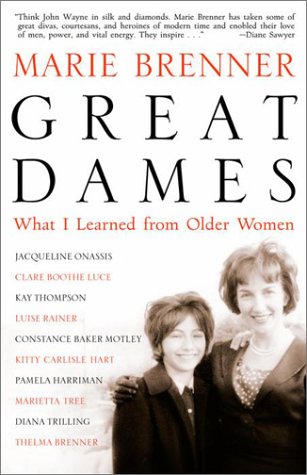



"Fascinating, gossipy, entertaining. . . ." — New York Times Book Review They are ten outstanding women of the century. Each had an aura, including Thelma Brenner, the first great dame her daughter ever knew. Their lives were both gloriously individual and yet somehow universal. They were mighty warriors and social leaders, women of aspiration who persevered. They lived through the Great Depression and a world war. Circumstances did not defeat them. They played on Broadway and in Washington. They had glamour, style, and intelligence. They dressed up the world. "Vivid, intimate portraits . . . a splendid tribute to ten of the century's grandest, most powerful women." — Us "These women were our geishas, whispering in our ears to influence all aspects of American life." —Susan Salter Reynolds, Los Angeles Times "Delectable, classy . . . a runaway hit." —Liz Smith "An engrossing introduction to a way of life that's now extinct, for better or for worse." — Chicago Sun-Times "Fascinating, gossipy, entertaining. . . ." ? New York Times Book Review They are ten outstanding women of the century. Each had an aura, including Thelma Brenner, the first great dame her daughter ever knew. Their lives were both gloriously individual and yet somehow universal. They were mighty warriors and social leaders, women of aspiration who persevered. They lived through the Great Depression and a world war. Circumstances did not defeat them. They played on Broadway and in Washington. They had glamour, style, and intelligence. They dressed up the world. "Vivid, intimate portraits . . . a splendid tribute to ten of the century's grandest, most powerful women." ? Us "These women were our geishas, whispering in our ears to influence all aspects of American life." ?Susan Salter Reynolds, Los Angeles Times "Delectable, classy . . . a runaway hit." ?Liz Smith "An engrossing introduction to a way of life that's now extinct, for better or for worse." ? Chicago Sun-Times MARIE BRENNER is the author of four books, including House of Dreams: The Bingham Family of Louisville . Her numerous articles have been published in the New York Times, The New Yorker , and Vanity Fair , where she is writer at large. From Chapter One: Kitty Carlisle Hart It has always been Kitty Carlisle Hart’s intention not to be defeated by circumstances. The day of our interview, when the weather forecast involves Homeric gales, she has called for her fellow board members at the New York State Council on the Arts to be outside her New York apartment at “eight a.m. sharp.” She has been brisk with me on the telephone: “You can’t ever let the weather slow you down. We have eight arts groups to visit in Brooklyn. We always leave on time.” As chairman of the Council -- a post she held for almost two decades -- Mrs. Hart often roams the state, checking on the Frederic Chopin Singing Society of Buffalo, the Iroquois Indian Museum in Schoharie County, the New York Latvian Concert Choir, Poughkeepsie’s Bardavon 1869 Opera House, the Billie Holiday Theatre in Bedford-Stuyvesant, the Man Fa Center and the Cucaracha Theatre, among thirteen hundred other groups that receive money through the Council. However enervating her rounds might seem to many people, she revels in dank rehearsal halls, watching “glorious” jazz groups that spring up in crack neighborhoods. “I can’t bear to be left out of a thing,” she says. When I arrive at her building, on the East Side, a few moments early for the arts trip, the doorman takes me upstairs to her apartment. The elevator opens directly onto her foyer, a small space with walls covered in red velvet flocked paper, Victorian in its formality. Her apartment is oddly silent; there is no early-morning bustle. Waiting for Mrs. Hart to appear, I look into her living room, an elegant jumble of books, curios, awards, and faded pastel brocade furniture in some need of repair. It is one of those rooms where time appears to have stopped. A celadon-green carpet covers the floor, a grand piano stands beside a far window, and in a bookcase are Meissen and silver pieces, CDs of many operettas she once recorded, and a youthful portrait of Mrs. Hart, her glistening dark hair in a pageboy. As one gazes at her empty living room, it is not difficult to conjure the voices and music of another era: her husband, the playwright and director Moss Hart, trading epigrams and smart remarks with Edna Ferber; Dick Rodgers playing her piano; Mrs. Hart herself rehearsing for her appearances in Die Fledermaus -- the women speaking in sculpted and perfect diction which sometimes hid their modest origins. And then, from another room, I hear Mrs. Hart: “Halloo, darling! I’ll be right there! Oh, you are such a dear to come out on such a day!” Her voice is like a chime, the operetta singer’s voice, actressy yet not artificial, a voice that seeks to charm. For twenty-one years, from 1956 to 1977, Mrs. Hart appeared every week on To Tell the Truth, wh