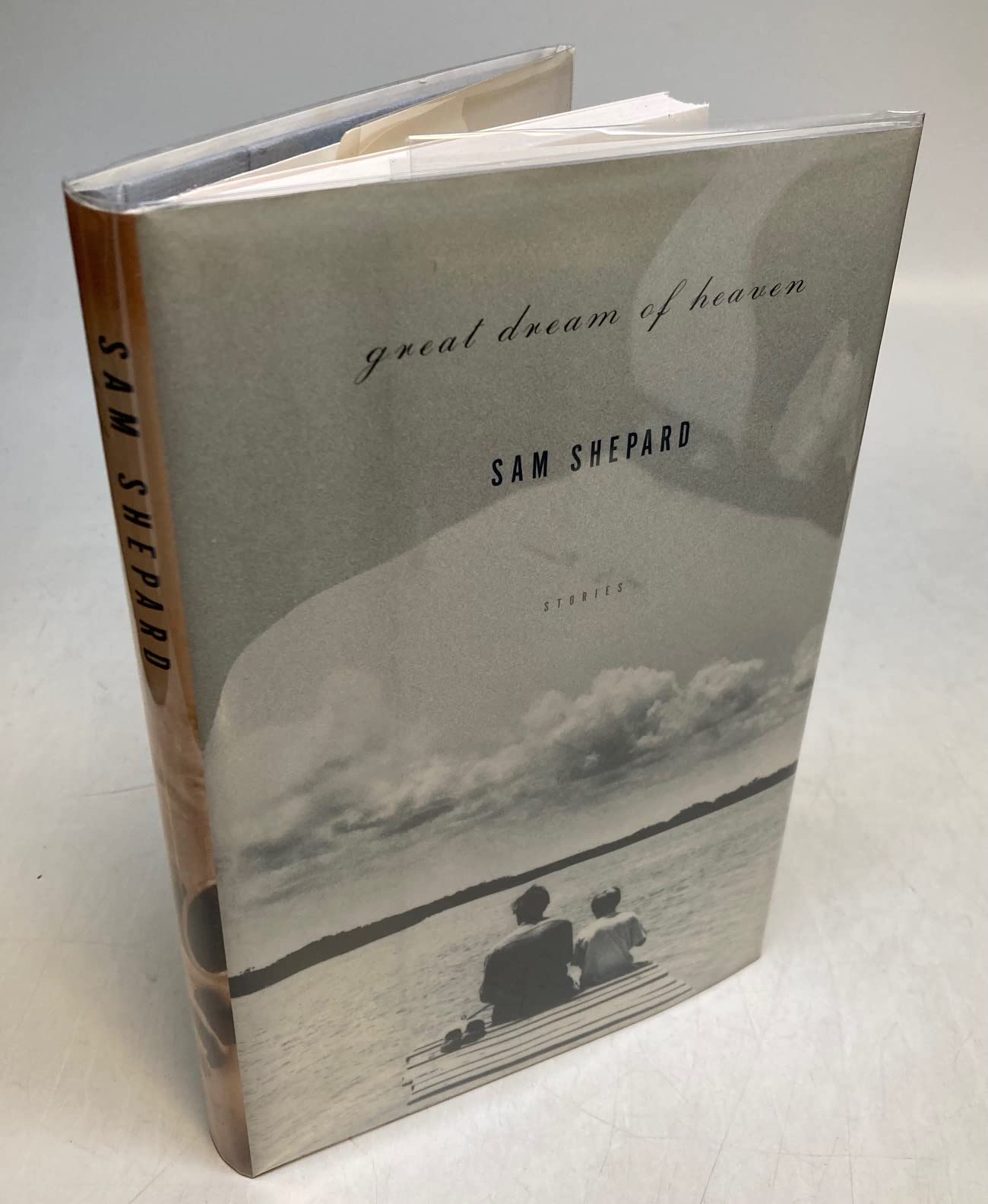



n these eighteen elegantly terse stories, Sam Shepard taps the same wellsprings that have made him one of our most acclaimed—and distinctly American—playwrights: sex and regret, the yearning for a frontier that has been subdivided out of existence, the comic gulf of misapprehension between men and women, and the even deeper gulf that separates men from their true selves. A fascinated boy watches the grim contest between a "remedy man"—a fixer of bad horses—and a spectacularly bad-tempered stallion, a contest that mirrors the boy’s own struggle with his father. A suburban husband starts his afternoon shopping for basil for a party and ends it holding one of the guests at gunpoint in the basement. Two old men, who have lived together companionably since their wives died or left them and their children scattered to “silicon computer hell,” are brought to grief by a waitress at the local Denny’s. Filled with absurdity, sorrow, and flinty humor, Great Dream of Heaven is Shepard at his best, exercising his gifts for diamond-sharp physical description and effortless dialogue in stories that recall the themes he has explored with such singular intensity in his work for the theater. In his second collection of short fiction, Great Dream of Heaven , Pulitzer Prize-winning playwright Sam Shepard offers a resonant examination of interpersonal crisis and revelation in 18 lean tales. At times humorous, tense, and tragic, these stories often focus on the elusive search for connection and understanding, visiting characters at key moments of consciousness or detachment. Seized by compulsion or repression, many in this work disengage from life by assuming familiar roles or patterns. In "The Stout of Heart," a man obsessed with horse breeding locks himself in his room annually to study catalogues, shutting out his family, while in "An Unfair Question," another man's frustration with his role as husband and father surfaces when he engages a party guest in friendly conversation and ends up holding her at gunpoint. These stories achieve an understated impact due in part to Shepard's knack for acute dialogue and descriptions that reveal his dramatist's eye for sparse but evocative detail. In "Living the Sign," a handmade sign in a fast food restaurant inspires a man to self-awareness, though he finds that its teenage creator is only dimly aware of its significance. "The Remedy Man," the collection's first and strongest story, tells of a guarded boy who comes to realize his potential by helping E.V., the road-worn title character (a fixer of bad horses), break a stallion. "Horse is just like a human being," E.V. tells him. "He's just gotta know his limits. Once he finds that out he's a happy camper." Offering many such moments of distilled wisdom, the stories in Great Dream of Heaven are no less brief but memorable encounters. --Ross Doll These 17 new stories from the prize-winning playwright should not be missed. Copyright 2002 Reed Business Information, Inc. *Starred Review* Shepard's mastery as a short story writer reflects his gifts as both playwright and actor. He writes and walks the talk, and he's internalized all that he so perspicaciously observes from tone of voice and shift of eye to the texture of dust lifted by a hot desert wind. Shepard's fiction has evolved since his striking first collection, Cruising Paradise (1996). In these highly concentrated stories, he reaches deep into his characters' conflicted souls, and creates near-hallucinatory confrontations in which they're forced to recognize exactly who they are. Shepard's lonely people are as wild at heart and as in need of rescue as the angry horse a "remedy man" comes to heal, or the injured hawk a young woman stops on a highway to help. A traveler divines the spirit of a fast-food worker; a married couple sit beside a lake and quibble; a grandfather tells his grandson, who is secretly in love, the story of his divorced mother's witty revenge on his father; and two dignified old friends let a waitress come between them. Each involving story is psychologically loaded, but what lassoes the reader is the tension between Shepard's acuity and tenderness, his high regard for the recklessness of life. Donna Seaman Copyright © American Library Association. All rights reserved "These are wonderful stories, by turns intuitive and well-wrought, satisfyingly unpredictable, smart, irreverent, knowledgeable about important human matters, often quite sweet, and at all times a pure pleasure to read. Mr. Shepard absolutely makes the form be his own, and for that reason these stories are irresistible." --Richard Ford n these eighteen elegantly terse stories, Sam Shepard taps the same wellsprings that have made him one of our most acclaimed?and distinctly American?playwrights: sex and regret, the yearning for a frontier that has been subdivided out of existence, the comic gulf of misapprehension between men and women, and the even deeper gulf that separates men from th