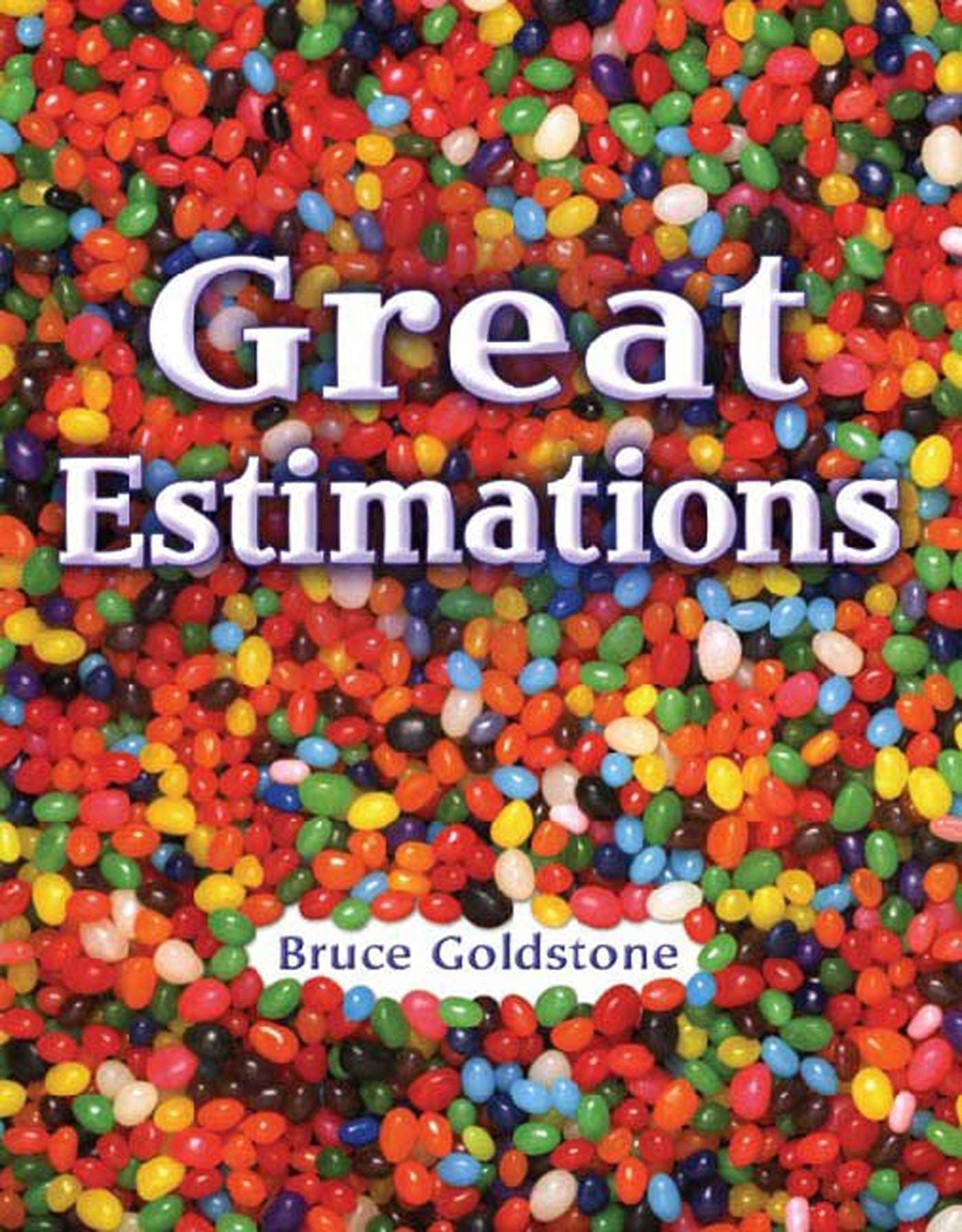



How many jelly beans are on this book’s cover? Don’t count—estimate! If someone handed you a big bowl of jelly beans, how would you figure out how many there are? You could count them, one by one—or you could estimate. Do you see more than five jelly beans? Less than a million? This unique book will show you how to train your eyes and your mind to make really great estimations—by making estimating into a game. Jelly beans are just the beginning! Great Estimations is a 2007 Bank Street - Best Children's Book of the Year. Grade 1-4–Goldstone adds another winner to the growing canon of titles that make learning math concepts both fun and interesting. Combining clear, concise language with colorful photos of countable objects, he introduces estimation, beginning with eye-training exercises to recognize groupings of 10s, 100s, and 1000s. Readers are encouraged to move the book around so they can see the items from varying perspectives. The next few spreads explain how to base an estimate on quantified groups: left-hand pages show clusters of an object (10 cherries, 100 cherries) while right-hand pages present an unidentified amount of the same thing (About how many cherries are in a quart?). The author then shows youngsters how to make reasonable estimates when looking at large quantities using clump counting and box counting. The real standout here is the crisp photography of objects and animals, including everything from google eyes to a penguin colony, set against stark white backgrounds that make them almost seem to leap off the page. This well-designed book will add zing to many a math lesson and attract browsers as well. –Grace Oliff, Ann Blanche Smith School, Hillsdale, NJ Copyright © Reed Business Information, a division of Reed Elsevier Inc. All rights reserved. Estimating techniques introduced in Stuart J. Murphy's MathStart titles Betcha! (1997) and Coyotes All Around (2003) are kicked up a notch here thanks to jaw-dropping color photos. Laying out a mixed assemblage of toys, pipe cleaners, marbles, peanuts, and other small items, Goldstone helps viewers train themselves to estimate the size of groups of about 10 things on sight, then goes on to present similar, often fetchingly arranged, materials by hundreds and (!) thousands. He also describes "clump counting" and "box and count" methods, offering pages chock-full of plastic bugs ("It isn't gross--it's a gross."), dog and cat stamps, a penguin colony, tiny rice grains, a bowl of jellybeans, and more. Including hints for each exercise, and frequent reminders that the goal is a "reasonable estimate," not an exact number, this book lends itself equally well to skill building and to casual reading. John Peters Copyright © American Library Association. All rights reserved "A model of how to do it right." -- New York Times Book Review "A must-have resource for school libraries." -- Kirkus Reviews "Goldstone adds another winner to the growing canon of titles that make learning math concepts both fun and interesting." -- School Library Journal "With jaw-dropping color photos . . . this book lends itself equally well to skill building and to casual reading." -- Booklist Bruce Goldstone is the author of several books, including 100 Ways to Celebrate 100 Days , Greater Estimations and The Beastly Feast . He has worked in educational publishing for nearly twenty years. Growing up in Ohio, Bruce fell in love with reading and the magic of words, and even back then he knew he wanted to be a writer. Books have always been an important part of his life, from buying used paperbacks to his first job, shelving books as a library page. He now lives in New York City with a plethora of pets including one dog, three parakeets, and an aquarium.