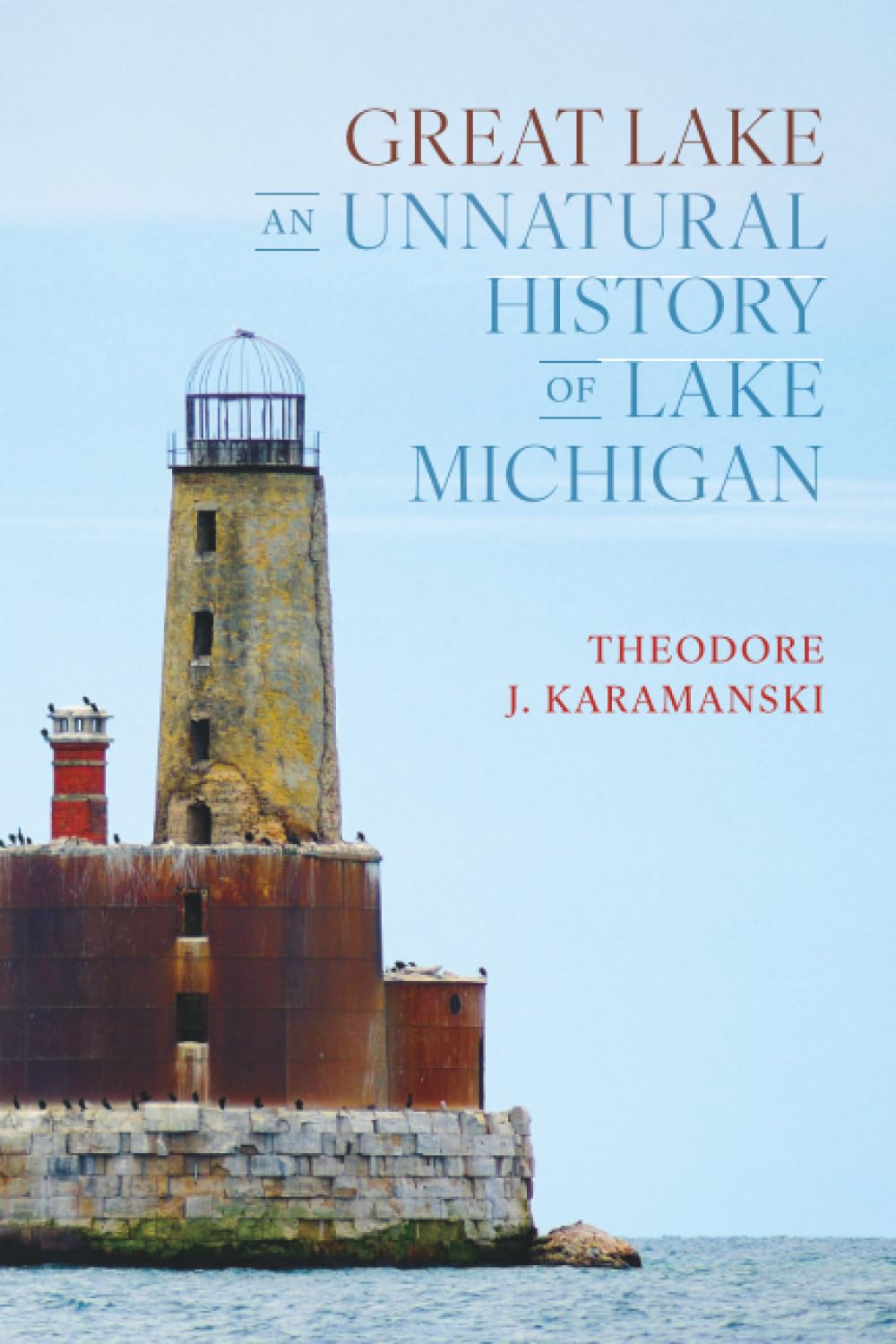



Looking down from outer space a vast expanse of blue appears in the heart of North America. Of the magnificent chain of inland seas, only one of those bodies of water—Lake Michigan—is entirely within the boundaries of the United States. Lake Michigan has been uniquely shaped by its relationship with humans, since its geological evolution took place at the same time as Paleo-Indian peoples interacted with the changing environment. Each generation of humans has altered the lake to suit society’s changing needs, dredging harbors, building lighthouses, digging canals and channels, filling in shallows, and obliterating wetlands. Great Lake is a comprehensive survey of the manifold ways Americans, from the first Native American communities to the present age, have abused, nurtured, loved, and neglected this massive freshwater resource. Extending 307 miles from north to south, the lake cuts across climatic, environmental, and physiographic zones, from the prairies of Illinois to the boreal forests of the north. Bordered by large cities like Chicago and Milwaukee as well as smaller Wisconsin resorts and northern Michigan mines and mill towns, the lake touches people in urban centers and countryside. Thus, the history of Lake Michigan combines the history of frontier resource extraction, agricultural abundance, industrialization, and dense urbanization in the American heartland. Great Lake is the story of the ever-escalating and divergent demands Americans have placed on Lake Michigan, how the lake’s ecosystem responded to those changes, and how together they have shaped the modern American Midwest. "Karamanski (emeritus, history, Loyola Coll.; Mastering the Inland Sea ) offers a thoroughly researched and readable history of the complex history of Lake Michigan. . .This well-researched history will be valuable for most public and academic libraries in the region and elsewhere for its breadth and insight." ― Edwin Burgess, Library Journal “Great Lake: An Unnatural History of Lake Michigan gives a wide-sweeping look at Lake Michigan, starting in prehistoric times when the lake was being created by the glaciers through to the present day. Each chapter is chronological and focuses on how humans have used the lake. As a real treat, he explores Chicago’s lesser-known maritime history, which really is the secret to Chicago’s progress (and the rise and fall of Gary, Indiana).” ― Elisa Shoenberger, Chicago Review of Books “As a historian, Karamanski provides an important perspective on the environmental history of Lake Michigan in a way that other popular works on the subject have not quite tackled. Great Lake offers a timely exploration of America’s Great Lake and the broader ecological and human developments surrounding it.” ― John William Nelson, author of Muddy Ground: Native Peoples, Chicago’s Portage, and the Transformati Theodore J. Karamanski is Professor Emeritus at Loyola University Chicago. His most recent book is Mastering the Inland Sea: How Lighthouses, Navigational Aids, and Harbors Transformed the Great Lakes and America .