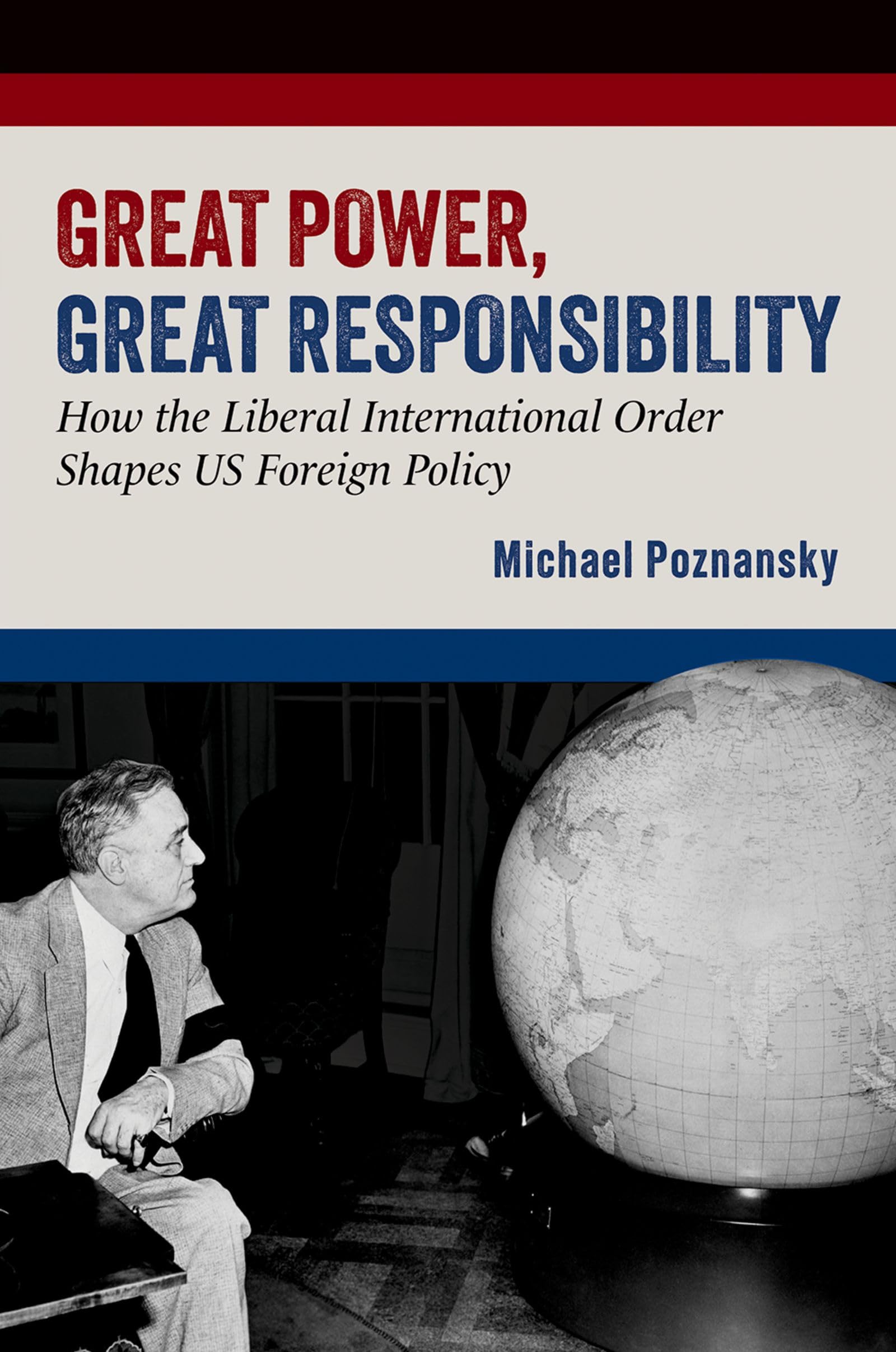
Great Power, Great Responsibility: How the Liberal International Order Shapes US Foreign Policy
$26.36
by Michael Poznansky



In the wake of World War II, the United States leveraged its hegemonic position in the international political system to gradually build a new global order centered around democracy, the expansion of free market capitalism, and the containment of communism. Named in retrospect the "liberal international order" (LIO), the system took decades to build and is still largely with us today even as the US's relative power within it has diminished. In Great Power, Great Responsibility , Michael Poznansky explores how the LIO has influenced US foreign policy from its founding to the present. Proponents argue that its impact has been profound, producing a system that has been more rule-bound and beneficial than any previous order. Critics charge that it has failed to prevent the US itself from consistently violating rules and norms. Poznansky contends that the answer lies in-between. While rule-breaking has been a constant feature of the postwar order, the nature of violations varies in surprising and poorly understood ways. America's approach to compliance with the LIO, including whether leaders feel the need to conceal rule violations at all, is a function of two primary factors: the intensity of competition over international order; and the burden of complying with the liberal order's core tenets in a given case. Drawing on nine case studies, including the Korean War and Iraq War, Great Power, Great Responsibility sheds important light on the future of US foreign policy in an era where American unipolarity has ended and great power rivalry has returned. " Great Power, Great Responsibility is a tour de force in explicating the nuanced impact of the liberal international order (LIO) on elite decision-making. Establishing a clear theoretical basis and employing a structured comparative case study analysis across three eras (before, during, and after the Cold War, including the post-9/11 period), Poznansky (US Naval War College) expertly applies a blended array of primary and secondary sources to conclude that use of force ranges from compliance to brazen noncompliance with the norms and rules of variant LIOs." -- G. Donato, CHOICE Michael Poznansky is an Associate Professor in the Strategic and Operational Research Department and a core faculty member in the Cyber & Innovation Policy Institute at the U.S. Naval War College. Before that, he was an Assistant Professor in the Graduate School of Public and International Affairs at the University of Pittsburgh. Dr. Poznansky is the author of In the Shadow of International Law: Secrecy and Regime Change in the Postwar World (Oxford University Press, 2020). His work has appeared in leading outlets such as the American Journal of Political Science , International Organization , Foreign Affairs , and Security Studies, among others. Dr. Poznansky has held fellowships with the Dickey Center at Dartmouth College, the Belfer Center at Harvard Kennedy School, and the Modern War Institute at West Point. He holds a Ph.D. in Foreign Affairs from the University of Virginia.