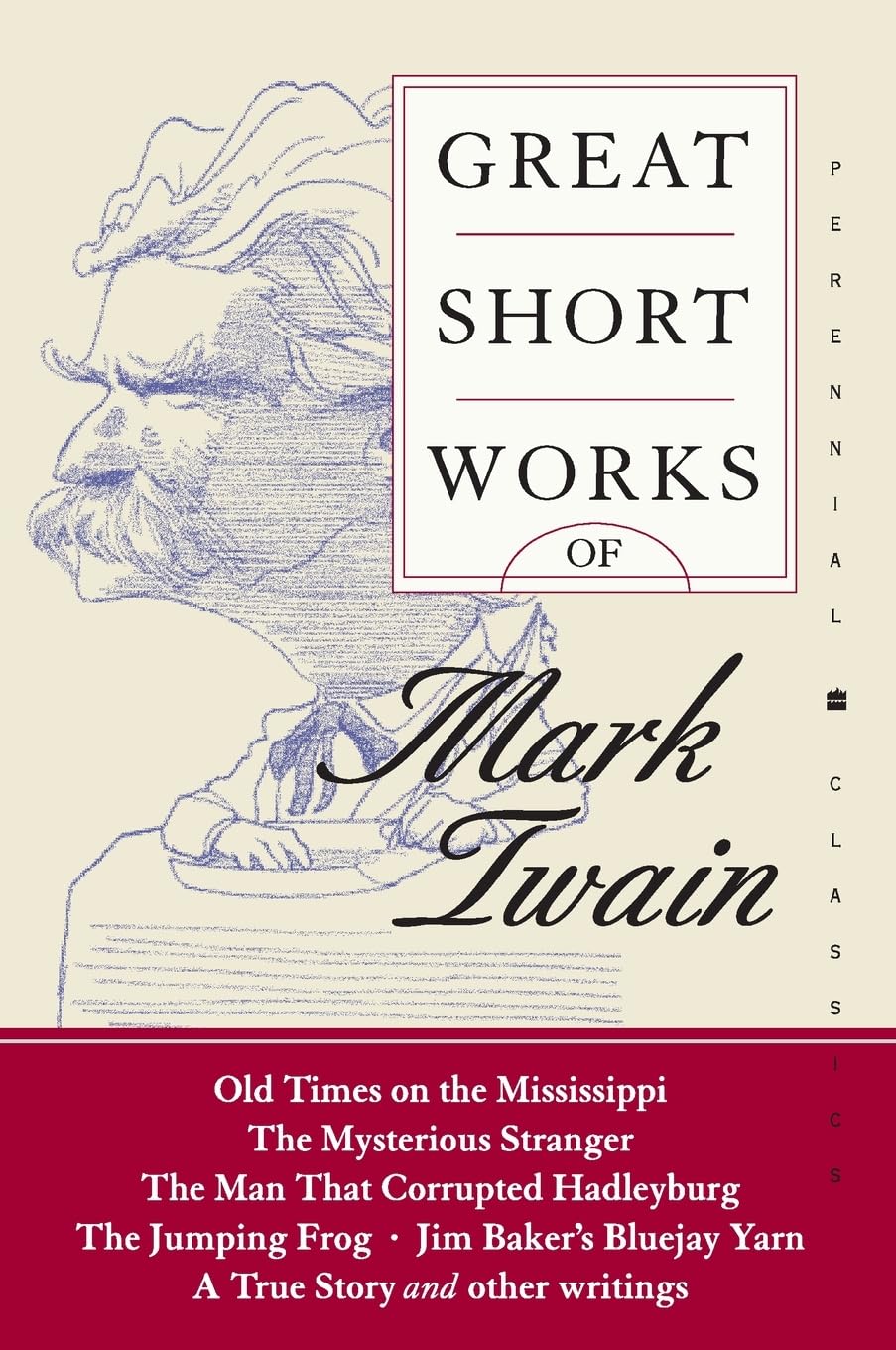
Great Short Works of Mark Twain: Classic 19th Century American Literature – Essential Humor, Essays, and Stories (Perennial Classics)
$14.39
by Mark Twain



Selected short works of humor and criticism by a revered American master Beloved by millions, Mark Twain is the quintessential American writer. More than anyone else, his blend of skepticism, caustic wit and sharp prose defines a certain American mythos. While his novel The Adventures of Huckleberry Finn is still taught to nearly everyone who attends school and is considered by many to be the Great American Novel, Twain’s shorter stories and criticisms have unequalled style and bite. In a review that’s less than kind to the writing of James Fenimore Cooper, Twain writes: “Every time a Cooper person is in peril, and absolute silence is worth four dollars a minute, he is sure to step on a dry twig. There may be a hundred handier things to step on, but that wouldn’t satisfy Cooper. Cooper requires him to turn out and find a dry twig; and if he can’t do it, go and borrow one.” It’s difficult to imagine anyone else writing in quite this style, though many have tried, which is why Twain’s legacy only continues to grow. The collection includes 20 works, including: Old Times on the Mississippi - The Mysterious Stranger - The Man That Corrupted Hadleyburg - The Jumping Frog - Jim Baker's Bluejay Yarn - A True Story - Letter to the Earth - The War Prayer Selected works of humour and criticism by a revered American master. Beloved by millions, Mark Twain is the quintessential American writer. More than anyone else, his blend of scepticism, caustic wit and sharp prose defines a certain American mythos. While his novel The Adventures of Huckleberry Finn is still taught to anyone who attends school and is considered by many to be the Great American Novel, Twain's shorter stories and criticisms have unequalled style and bite. In a review that's less than kind to the writing of James Fenimore Cooper, Twain writes: "Every time a Cooper person is in peril, and absolute silence is worth four dollars a minute, he is sure to step on a dry twig. There may be a hundred handier things to step on, but that wouldn't satisfy Cooper. Cooper requires him to turn out and find a dry twig; and if he can't do it, go and borrow one." It's difficult to imagine anyone else writing in quite this style, which is why Twain's legacy only continues to grow. Mark Twain , who was born Samuel L. Clemens in Missouri in 1835, wrote some of the most enduring works of literature of American fiction, including The Adventures of Tom Sawyer and The Adventures of Huckleberry Finn . He died in 1910. Great Short Works of Mark Twain By Twain, Mark Perennial ISBN: 0060727861 Chapter One Old Times On The Mississippi When I was a boy, there was but one permanent ambition among my comrades in our village on the west bank of the Mississippi River. That was, to be a steamboatman. We had transient ambitions of other sorts, but they were only transient. When a circus came and went, it left us all burning to become clowns; the first negro minstrel show that came to our section left us all suffering to try that kind of life; now and then we had a hope that if we lived and were good, God would permit us to be pirates. These ambitions faded out, each in its turn; but the ambition to be a steamboatman always remained. Once a day a cheap, gaudy packet arrived upward from St. Louis, and another downward from Keokuk. Before these events had transpired, the day was glorious with expectancy; after they had transpired, the day was a dead and empty thing. Not only the boys, but the whole village, felt this. After all these years I can picture that old time to myself now, just as it was then: the white town drowsing in the sunshine of a summer's morning; the streets empty, or pretty nearly so; one or two clerks sitting in front of the Water Street stores, with their splint-bottomed chairs tilted back against the wall, chins on breasts, hats slouched over their faces, asleep -- with shingle-shavings enough around to show what broke them down; a sow and a litter of pigs loafing along the sidewalk, doing a good business in water-melon rinds and seeds; two or three lonely little freight piles scattered about the "levee;" a pile of "skids" on the slope of the stone-paved wharf, and the fragrant town drunkard asleep in the shadow of them; two or three wood flats at the head of the wharf, but nobody to listen to the peaceful lapping of the wavelets against them; the great Mississippi, the majestic, the magnificent Mississippi, rolling its mile-wide tide along, shining in the sun; the dense forest away on the other side; the "point" above the town, and the "point" below, bounding the river and glimpse and turning it into a sort of sea, a withal a very still and brilliant and lonely one. Presently a film of dark smoke appears above one of those remote "points;" instantly a negro drayman, famous for his quick eye and prodigious voice, lifts up the cry, "S-t-e-a-m-boat a-comin!'" and the scene changes! The town drunkard stirs, the clerks wake UP, a furious clatter o