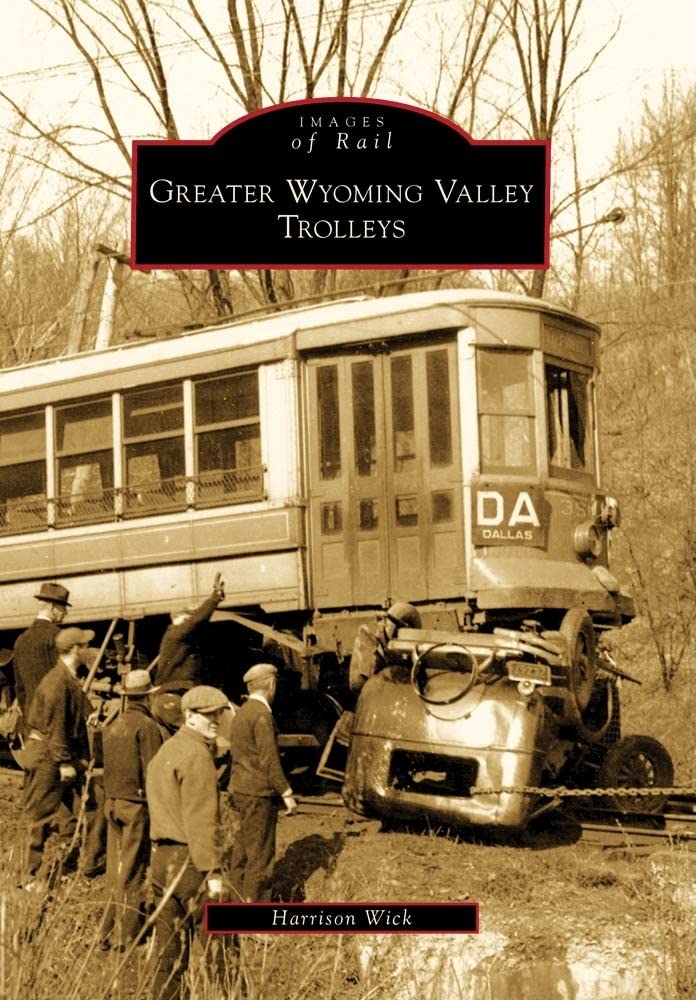



The Wyoming Valley is nestled among the Endless Mountains in Luzerne County with the scenic Susquehanna River meandering through it. Best known for its rich deposits of anthracite coal, the Wyoming Valley was first colonized by Connecticut settlers in 1769. Electric trolleys served many urban centers in Pennsylvania. Trolley service in the Wyoming Valley started in 1888 and lasted for more than 60 years. Trolley lines went through the boroughs and townships of Ashley, Courtdale, Edwardsville, Forty Fort, Hanover, Kingston, Larksville, Miners Mills, Nanticoke, Parsons, Pittston, Plains, Plymouth, Sugar Notch, West Pittston, West Wyoming, Wilkes-Barre, and Wyoming. Greater Wyoming Valley Trolleys features rare photographs dating from the 1890s to 1950 documenting the trolley system and the communities of the Wyoming Valley. Title: New book on Wyoming Valley Trolleys by local author Author: Staff Writer Publisher: Back Mountain Community News Date: August 2009 Harrison Wick will have a book signing and presentation for his new book, Greater Wyoming Valley Trolleys, at the book fair fundraiser for the NEPA Genealogy Society on Friday, August 28 th at 7 p.m. at Barnes & Noble. Greater Wyoming Valley Trolleys is part of the Images of Rail series by Arcadia Publishing, and the book is available now at local retailers, including Barnes & Noble, and online. Greater Wyoming Valley Trolleys offers many rare Wyoming Valley photographs from the 1880's to 1950 of streetcars, and images of businesses, churches, homes, railroads, roads, and buildings along the trolley lines from the collections of rail enthusiasts including photographers Edward S. Miller and the late Michael J. Lavelle, Sr. Electric trolley service in the Wyoming Valley, which replaced horse drawn streetcars, began in 1888, and lasted for more than 60 years. Greater Wyoming Valley Trolleys chronicles the electric trolley system, and the communities of the Wyoming Valley. The trolleys were a clean, efficient, and easy way to get around. Trolley lines went through Ashley, Edwardsville, Forty Fort, Hanover, Kingston, Miners Mills, Nanticoke, West Nanticoke, Parsons, Pittston, West Pittston, Plains, Plymouth, Sugar Notch, Wyoming, West Wyoming, and Wilkes-Barre. Harrison Wick, the author of Pennsylvania's Back Mountain, which chronicles the communities of Kingston Township, Trucksville, Shavertown, Dallas, Lehman, and Harvey's Lake. He is the Special Collections Librarian and University Archivist at Indiana University of Pennsylvania. Harrison Wick earned his undergraduate degree in history from Washington College, and graduate degrees in history and library science from Indiana University in Bloomington, Indiana. For three years, he was the Archivist at Misericordia University. Harrison Wick serves on the Back Mountain Historical Association steering committee, which sponsors local history presentations at Misericordia University in Dallas. Title: Book puts history on track Author: Andrew M. Seder Publisher: Times Leader Date: 7/28/09 Harrison Wick loves trolleys and he loves history. So he combined the two and has published "Greater Wyoming Valley Trolleys." click image to enlargeThe cover of 'Greater Wyoming Valley Trolleys,' a 128-page book on the history of trolley system, along with 200 photos of cars. Select images available for purchase in the Times Leader Photo StoreThe 128-page, soft-cover book has more than 200 photos dating from the 1890s to the 1950s. The book gives readers a rare glimpse into the Wyoming Valley's history and the role the trolley system played in it. Broken into four chapters - the upper valley, the lower valley, the West Side and Wilkes-Barre - Wick uses a photo of an individual trolley car and captions it with the history of the car, usually detailing who manufactured it, where the line ran and when it ceased operation. Besides great views of the trolley cars, some photos also show great streetscapes from yesteryear, and longtime local residents will surely get a kick out of seeing long-gone businesses including Fairmont's Ice Cream on South Hancock at East Market Street in Wilkes-Barre; Lehigh Beef Co. at the east end of the Fort Jenkins Bridge in Pittston; The Public Square Motel in Wilkes-Barre; and Smolok's Grocery Store at East Main and West Cherry streets in Plymouth. The majority of the photographs were snapped by Edward S. Miller and Michael J. Lavelle Sr., with others through various collections including the National Railway Historical Society and the Misericordia University archives. "There's a lot of local history in this book," said Wick, 32. "It's not just a book on trolleys but of the area and how it's changed." Wick said trolleys began in the 1860s as horse-drawn streetcars and the first electrified trolley in Wilkes-Barre ran on March 19, 1888. Wick said trackless trolleys and buses doomed the trolley system in the 1940s, and the last lines, those in Hanover and Nanticoke, ceased operations in 1950