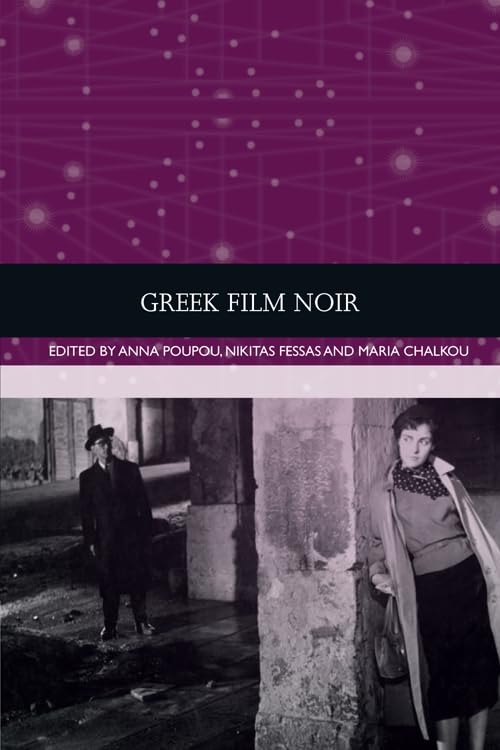



Offering the first comprehensive study of Greek film noir, this book explores the reception and influence of U.S. and European film noir and neo-noir in Greece and their effect on Greek filmmaking. Employing theoretical frameworks from New Film History, it offers a fresh look at underrated or neglected cultural products to provide insights into Greek modernity and reveal the affinities of established Greek auteurs with the film-noir tradition. Firmly establishing Greece on the film noir cinematic map, it provides a panoramic overview of leading Greek auteurs, from Nikos Koundouros and Maria Plyta to Theo Angelopoulos and Nikos Nikolaidis, whose work is innovatively viewed from an angle of film-noir style and thematics. An impressive array of scholarship on a topic that a few years ago would have been deemed inconceivable. While, as the authors and editors demonstrate, noir sensibility is evident in Greek cinema as early as the 1950s, its trajectory developed in the critical shadows. This collection honours this elusive breed of films, reassessing established accounts of Greek film history and firmly placing the cinema of this small nation within broader transnational contexts. -- Lydia Papadimitriou, Liverpool John Moores University The trio of scholars who have put together “Greek Film Noir,” Anna Poupou, Nikitas Fessas, and Maria Chalkou, are keenly aware of what the critic and historian Robert Hughes referred to as “cultural cringe” ― the perception that one’s own culture is somehow behind the curve of other countries or peoples. “The study of Greek film noir,” the trio write, “is directly linked to how Greeks see themselves as part of an increasingly dystopian landscape.” In so many words: The world’s going to hell and we want in. -- Mario Naves ― The New York Sun Greek Film Noir offers a fresh look at underrated and neglected cultural products that provide insights into the workings of the genre within the Greek context, while simultaneously revealing the affinities between established Greek auteurs and the tradition of film noir.This collection explores the influence of American and European film noir in Greece, discussing noir and neo-noir within Mediterranean and European cinematic framework, with the aim of putting Greece on the international film noir map. Readers will enrich their knowledge of Greek cinema, while confirming the long-lasting influence of a genre that transcends national and cultural boundaries.Anna Poupou teaches film history and theory at the National & Kapodistrian University of Athens. She is co-editor of three collective volumes: City and Cinema: Theoretical and Methodological Approaches (2011), Athens: World Film Locations (2014), The Lost Highway of Greek Cinema 1960–1990 (2019). Her research interests focus on the history of Greek cinema, film and history, urban spaces and cinema, and film noir.Nikitas Fessas holds a PhD in Political and Social Sciences: Communication Sciences from Ghent University, Belgium. He has published numerous cultural criticism essays in both Greek and English-language media, as well as academic articles on Greek film noir in peer-reviewed journals.Maria Chalkou is the principal editor of Filmicon: Journal of Greek Film Studies. She holds a PhD in film theory and history from University of Glasgow. She is currently a post-doctoral researcher at Panteion University, while teaching film history, theory and documentary at Ionian University. She has published on Greek cinema, film censorship, film criticism and cinematic representations of the past. Dr Anna Poupou teaches film history and theory at the National & Kapodistrian University of Athens. She is co-editor of three collective volumes: City and Cinema: Theoretical and Methodological Approaches (2011), Athens: World Film Locations (2014), The Lost Highway of Greek Cinema 1960–1990 (2019). Her research interests focus on the history of Greek cinema, film and history, urban spaces and cinema, and film noir. Nikitas Fessas holds a PhD in Political and Social Sciences: Communication Sciences from Ghent University, Belgium. He has published numerous cultural criticism essays in both Greek and English-language media, as well as academic articles on Greek film noir in peer-reviewed journals. Dr Maria Chalkou is the principal editor of Filmicon: Journal of Greek Film Studies. She holds a PhD in film theory and history from University of Glasgow. She is currently a post-doctoral researcher at Panteion University, while teaching film history, theory and documentary at Ionian University. She has published on Greek cinema, film censorship, film criticism and cinematic representations of the past.