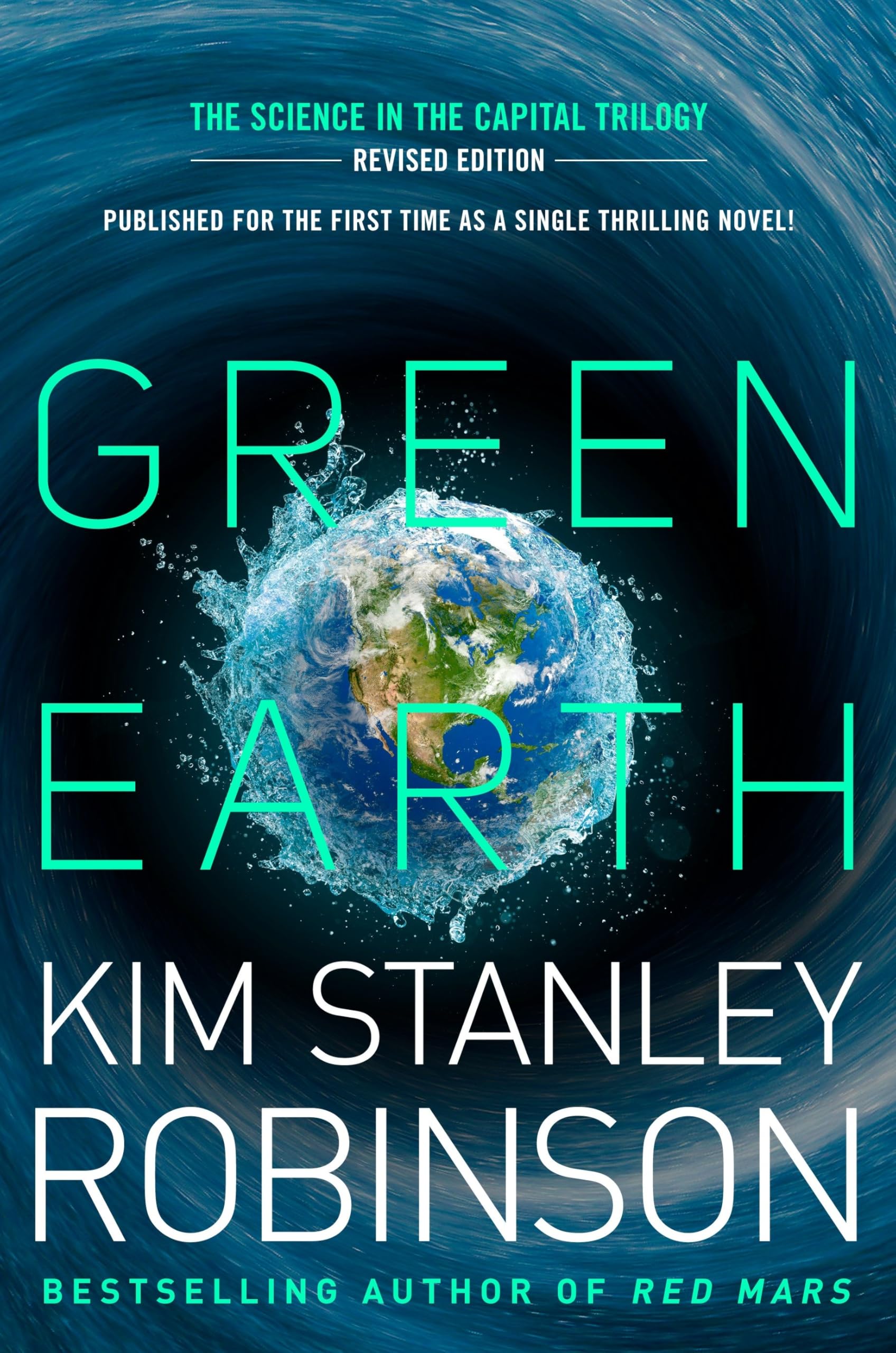



The landmark trilogy of cutting-edge science, international politics, and the real-life ramifications of climate change—updated and abridged into a single novel More than a decade ago, bestselling author Kim Stanley Robinson began a groundbreaking series of near-future eco-thrillers— Forty Signs of Rain, Fifty Degrees Below, and Sixty Days and Counting —that grew increasingly urgent and vital as global warming continued unchecked. Now, condensed into one volume and updated with the latest research, this sweeping trilogy gains new life as Green Earth, a chillingly realistic novel that plunges readers into great floods, a modern Ice Age, and the political fight for all our lives. The Arctic ice pack averaged thirty feet thick in midwinter when it was first measured in the 1950s. By the end of the century it was down to fifteen. One August the ice broke. The next year the breakup started in July. The third year it began in May. That was last year. It’s a muggy summer in Washington, D.C., as Senate environmental staffer Charlie Quibler and his scientist wife, Anna, work to call attention to the growing crisis of global warming. But as they fight to align the extraordinary march of modern technology with the awesome forces of nature, fate puts an unusual twist on their efforts—one that will pit science against politics in the heart of the coming storm. Praise for the Science in the Capital trilogy “Perhaps it’s no coincidence that one of our most visionary hard sci-fi writers is also a profoundly good nature writer—all the better to tell us what it is we have to lose.” — Los Angeles Times “An unforgettable demonstration of what can go wrong when an ecological balance is upset.” — The New York Times Book Review “Absorbing and convincing.” — Nature Praise for the Science in the Capital trilogy “Perhaps it’s no coincidence that one of our most visionary hard sci-fi writers is also a profoundly good nature writer—all the better to tell us what it is we have to lose.” — Los Angeles Times “An unforgettable demonstration of what can go wrong when an ecological balance is upset.” — The New York Times Book Review “Absorbing and convincing.” — Nature Kim Stanley Robinson is a winner of the Hugo, Nebula, and Locus awards. He is the author of more than twenty books, including the bestselling Mars trilogy and the critically acclaimed Forty Signs of Rain, Fifty Degrees Below, Sixty Days and Counting, The Years of Rice and Salt, and Galileo’s Dream . In 2008 he was named one of Time magazine’s “Heroes of the Environment.” He serves on the board of the Sierra Nevada Research Institute. He lives in Davis, California. Chapter 1 The Buddha Arrives The Earth is bathed in a flood of sunlight. A fierce inundation of photons—on average, 342 joules per second per square meter. 4185 joules (one Calorie) will raise the temperature of one kilogram of water by one degree C. If all this energy were captured by the Earth’s atmosphere, its temperature would rise by ten degrees C in one day. Luckily much of it radiates back to space. How much depends on albedo and the chemical composition of the atmosphere, both of which vary over time. A good portion of Earth’s albedo, or reflectivity, is created by its polar ice caps. If polar ice and snow were to shrink significantly, more solar energy would stay on Earth. Sunlight would penetrate oceans previously covered by ice, and warm the water. This would add heat and melt more ice, in a positive feedback loop. The Arctic Ocean ice pack reflects back out to space a few percent of the total annual solar energy budget. When the Arctic ice pack was first measured by nuclear submarines in the 1950s, it averaged thirty feet thick in midwinter. By the end of the century it was down to fifteen. Then one August the ice broke up into large tabular bergs, drifting on the currents, colliding and separating, leaving broad lanes of water open to the continuous polar summer sunlight. The next year the breakup started in July, and at times more than half the surface of the Arctic Ocean was open water. The third year, the breakup began in May. That was last year. Weekdays always begin the same. The alarm goes off and you are startled out of dreams that you immediately forget. Predawn light in a dim room. Stagger into a hot shower and try to wake up all the way. Feel the scalding hot water on the back of your neck. Fragment of a dream, you were deep in some problem set now escaping you, just as you tried to escape it in the dream. Duck down the halls of memory—gone. Dreams don’t want to be remembered. Evaluate the night’s sleep: not so good. Anna Quibler was exhausted already. Joe had cried twice, and though it was Charlie who had gotten up to reassure him, as part of conveying to Joe that Mom would never again visit him at night, Anna had of course woken up too, and vaguely heard Charlie’s reassurances: “Hey. Joe. What’s up. Go back to sleep, b