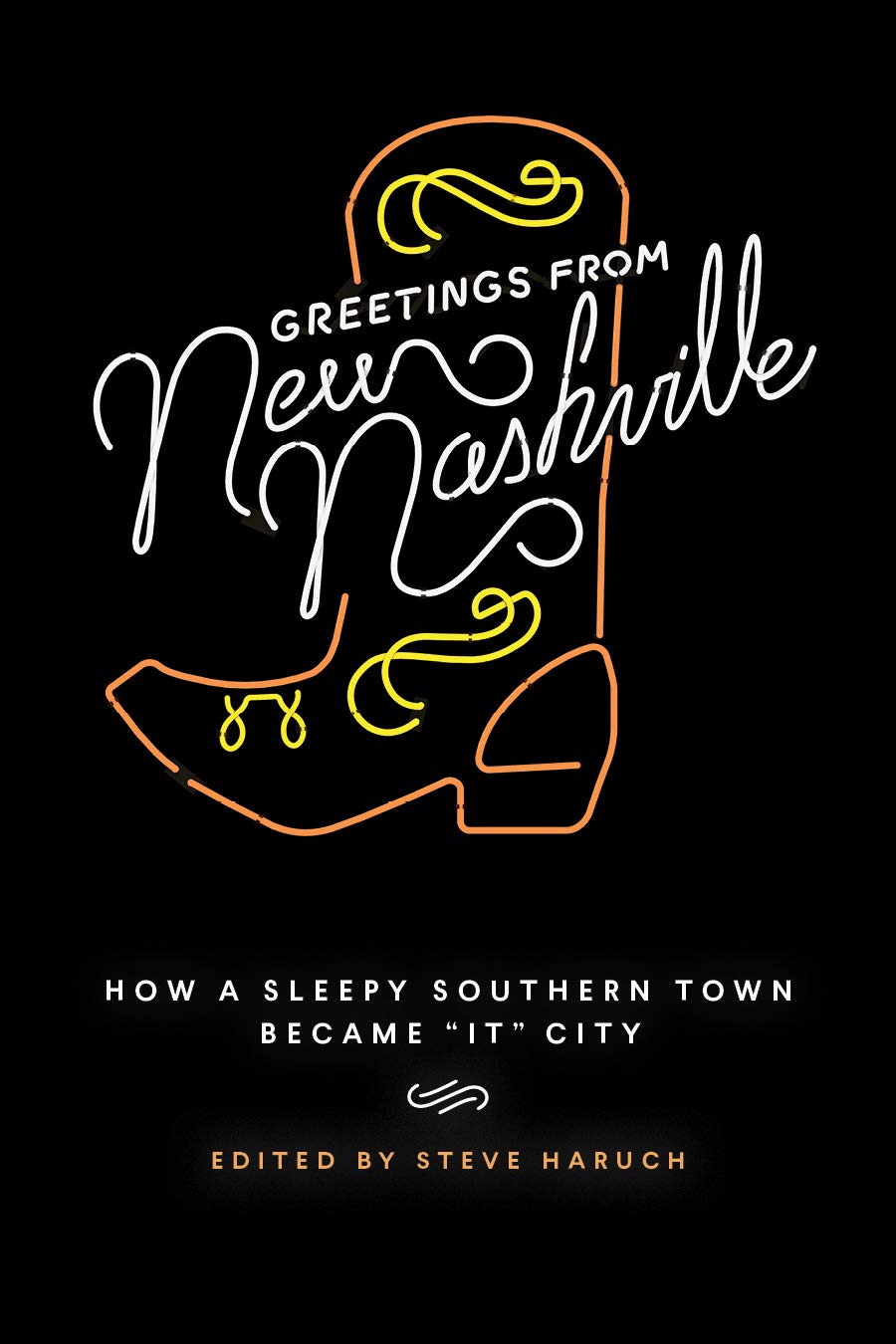
Greetings from New Nashville: How a Sleepy Southern Town Became "It" City
$24.95
by Steve Haruch



In 1998, roughly 2 million visitors came to see what there was to see in Nashville. By 2018, that number had ballooned to 15.2 million. In that span of two decades, the boundaries of Nashville did not change. But something did. Or rather, many somethings changed, and kept changing, until many who lived in Nashville began to feel they no longer recognized their own city. And some began to feel it wasn't their own city at all anymore as they were pushed to its fringes by rising housing costs. Between 1998 and 2018, the population of Nashville grew by 150,000. On some level, Nashville has always packaged itself for consumption, but something clicked and suddenly everyone wanted a taste. But why Nashville? Why now? What made all this change possible? This book is an attempt to understand those transformations, or, if not to understand them, exactly, then to at least grapple with the question: What happened? "An invaluable text for understanding Nashville's rise." — Frank Shyong , Los Angeles Times "Consider this fascinating encapsulation of time and place a must-read—not only for Nashvillians seeking self-awareness as a community, but for leaders of every growing city in America." — Mary Laura Philpott , author of I Miss You When I Blink "Consider this fascinating encapsulation of time and place a must-read—not only for Nashvillians seeking self-awareness as a community, but for leaders of every growing city in America." — Mary Laura Philpott , author of I Miss You When I Blink -- Mary Laura Philpott Steve Haruch is a writer, editor, and filmmaker in Nashville. He is the editor of People Only Die of Love in Movies , also published by Vanderbilt University Press. Introduction In 1998, roughly two million visitors came to see what there was to see in Nashville. By 2018, the annual number had ballooned to 15.2 million. On some level, Nashville has always packaged itself for consumption, but suddenly everyone wanted a taste. In that span of two decades, the physical boundaries of Nashville did not change. (The city and county governments had long ago consolidated.) But something did. Or rather, many somethings changed, and kept changing, until many who lived here began to feel they no longer recognized their own city. And some began to feel it wasn't their own city at all anymore, as they were pushed to its fringes by rising housing costs. Between 1998 and 2018, the population of Nashville grew by 150,000. The greater metropolitan statistical area grew by a half-million people, and is expected to cross the two million mark some time in 2020. But why Nashville? Why now? This book is an attempt to grapple with those questions without offering pat answers. Cities and histories are complex, and there is no single event or factor to credit. What we offer is a series of dispatches aimed at showing the contours, identifying turning points, and more urgently, giving a sense of texture to the life of a place in flux. Roughly half of the chapters are reprints, snapshots of a particular moment in the fast, messy evolution of the city. Others are new essays, written for this book with the benefit of at least some hindsight. In 2001, the late John Egerton, along with fellow journalist E. Thomas Wood, assembled Nashville: An American Self-Portrait , which looked back on recent developments and forward to a new and perhaps newly prosperous century. This collection functions in much the same way Egerton describes his work in relation to the 1979 book Nashville: The Faces of Two Centuries : "This is not a sequel to the prior volume, not a direct descendant or even a close relative-but it is a companion, and a kindred spirit." It is also incomplete, as any document of a transformation still in progress must be. "It's hard to pinpoint the exact moment the sleepy town of Nashville became a real city, but I'll go with 1998-the year the NHL Nashville Predators and NFL Houston Oilers (now the Tennessee Titans) moved here," the singer and songwriter Marshall Chapman writes in a 2011 story for W magazine. "Suddenly everything exploded. You'd look out over the city, and all you'd see were construction cranes." Like all narrative starting points, 1998 is to some extent arbitrary. But Chapman reminds us that what is old is new again-the construction cranes are back, piercing the sky in every direction, their silhouettes now emblazoned half-jokingly on everything from rock show flyers to public radio station pledge-drive socks. The starting point isn't random, either. 1998 is the year the Owen Bradley dies. As much as any artist and producer, Bradley helped define the Nashville Sound, and Music Row was more or less built around the Quonset Hut Studio he operated with his brother Harold on 16th Avenue South where Patsy Cline, Red Foley, Brenda Lee, Marty Robbins, Sonny James, and countless others recorded. Still, as much as the Nashville Sound is now synonymous with what we now might call classic countr