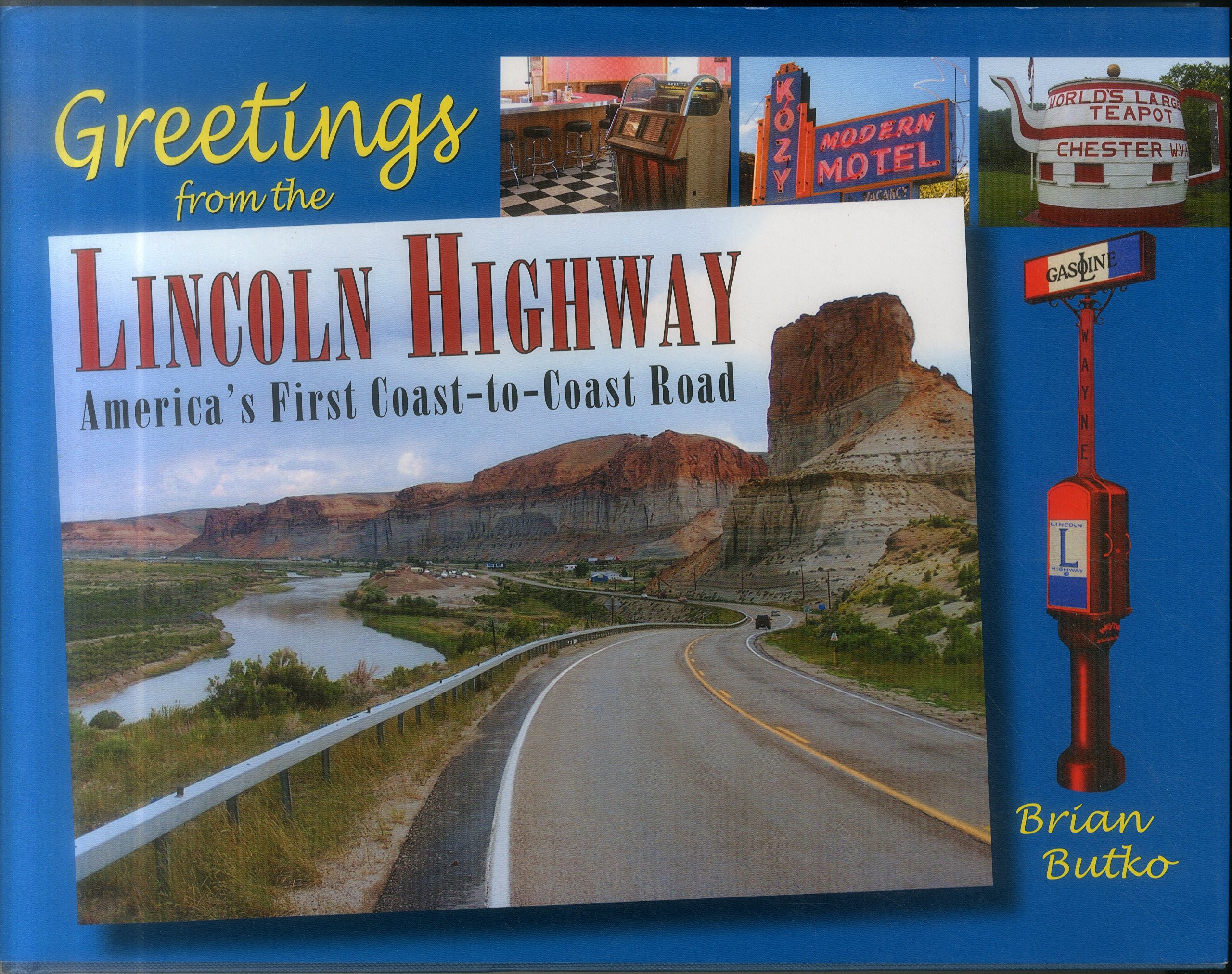
Greetings from the Lincoln Highway: America's First Coast-To-Coast Road
$72.78
by Brian Butko



The Lincoln Highway preceded Route 66 by a dozen years, runs a third longer than the famed highway, and crosses the country from Atlantic to Pacific. Traversing fourteen states from Times Square in New York to Lincoln Park in San Francisco, this large-format book follows the highway in both space and time to diners, gas stations, ice cream stands, tourist cabins, historic landmarks, and roadside attractions. Excerpts from memoirs and old postcards give a feel for what early motoring was really like--the good, the bad, and the muddy. PBS MOTORS ALONG LINCOLN HIGHWAY Rick Sebak was producing a tv documentary called "The Pennsylvania Road Show" for Pittsburgh's PBS, WQED-TV, when he first heard about the Lincoln Highway. I had met this guy named Brian Butko, Sebak says by telephone from WQED-TV in Pittsburgh. I don t think he had written his first book yet, but as we were driving, he kept pointing to these offshoots saying, See that? That s the old Lincoln Highway. I said Well, what s the Lincoln Highway? Butko, who has now published eight books, including three about the Lincoln Highway, is among the historians, motor court operators, restaurateurs and travelers featured in Sebak s latest television documentary, A Ride Along The Lincoln Highway, which airs Wednesday on PBS stations nationwide. The one-hour special uncovers the history, nostalgia and renewed interest in the route first mapped out in 1913 as the fastest, smoothest and most direct path from New York City to San Francisco. There's still a lot people who have no idea that it exists. Sebak says. The Lincoln Highway was created when Carl Fisher, founder of the Indianapolis Motor Speedway and the Prest-O-Lite headlamp company, combined resources with fellow titans Henry Joy, president of the Packard Motor Car Co., and Frank Seiberling, president of Goodyear, to create a cement roadway that would make cross-country automobile travel a legitimate option. By 1915, cars were able to make the 3,389-mile journey that cut through Indiana near Fort Wayne, traveling northwest into Elkhart, Osceola, Mishawaka and South Bend before reaching New Carlisle, LaPorte, Valparaiso and westward. In 1928, the northern Indiana section was abandoned for a more direct route that connected Fort Wayne and Valparaiso through Columbia City, Warsaw and Plymouth. But like so many other two-lane highways, the Lincoln fell out of fashion in the 1950s, giving way to sleeker, faster interstates. Since 1992, however, with the formation of the new Lincoln Highway Association, roadway preservationists have shown a renewed interest in the routes. The best part of the whole cross-country experience is that you get to see everything, Sebak says. You see everyday America in incredible detail. You see Main Streets and beauty shops, ball fields and cemeteries. Not just roadside relics like diners and motels although they can be cool but everything. For A Ride Along The Lincoln Highway, Sebak and his crew traveled from Pittsburgh to San Francisco twice and once from Pittsburgh to New York City and back in 2007 and 2008. They stopped to have coffee at the Brick Street Station in Woodbine, Iowa; discovered an unusual independent gas station in Grand Island, Neb.; and attended the 2008 Lincoln Highway Convention in Evanston, Wyo. Our first trip, in August 2007, we took off not knowing what we would see, Sebak says. The only thing I had set up was a meeting with David Hay in South Bend. Hay, a LaPorte man who was the executive director of the Lincoln Hwy Assn at the time, is among the historians featured in the program. It's a historical road, but it's also something we use everyday, Hay says. It's not like going to a museum where we must keep our distance. The road is something we can put our feet on, put our tires on and experience. It's history is all around us, and it's not something we should take for granted. In fact, Sebak says it was Hay who directed his crew to what would become a favorite destination during their cross-country treks. There's this place (in LaPorte) called B&J's American Cafe, Sebak says. We ate there three times. In the entire country, I don't think we ate at any other place twice. I said it at the time, but I dare say it again: This was the best road trip we've ever taken. --Jeremy D. Bonfiglio; South Bend Tribune "Traveling the Lincoln Highway through the eyes, heart, and spirit of Brian Butko brings back an important part of America we yearn to keep, which this book does triumphantly with color, zeal, and fortitude." --JOHN BAEDER, author of Diners, Sign Language, and Gas, Food, & Lodging "A valid and important contribution to a growing body of works about this nation's most valued highways. Anyone who has an interest in open road travel and appreciates an objective examination of one of the country's most important transportation links needs to read Brian Butko's book. Bravo!" --MICHAEL WALLIS, author of Route 66: The Mother Road "The Lincoln Highway i