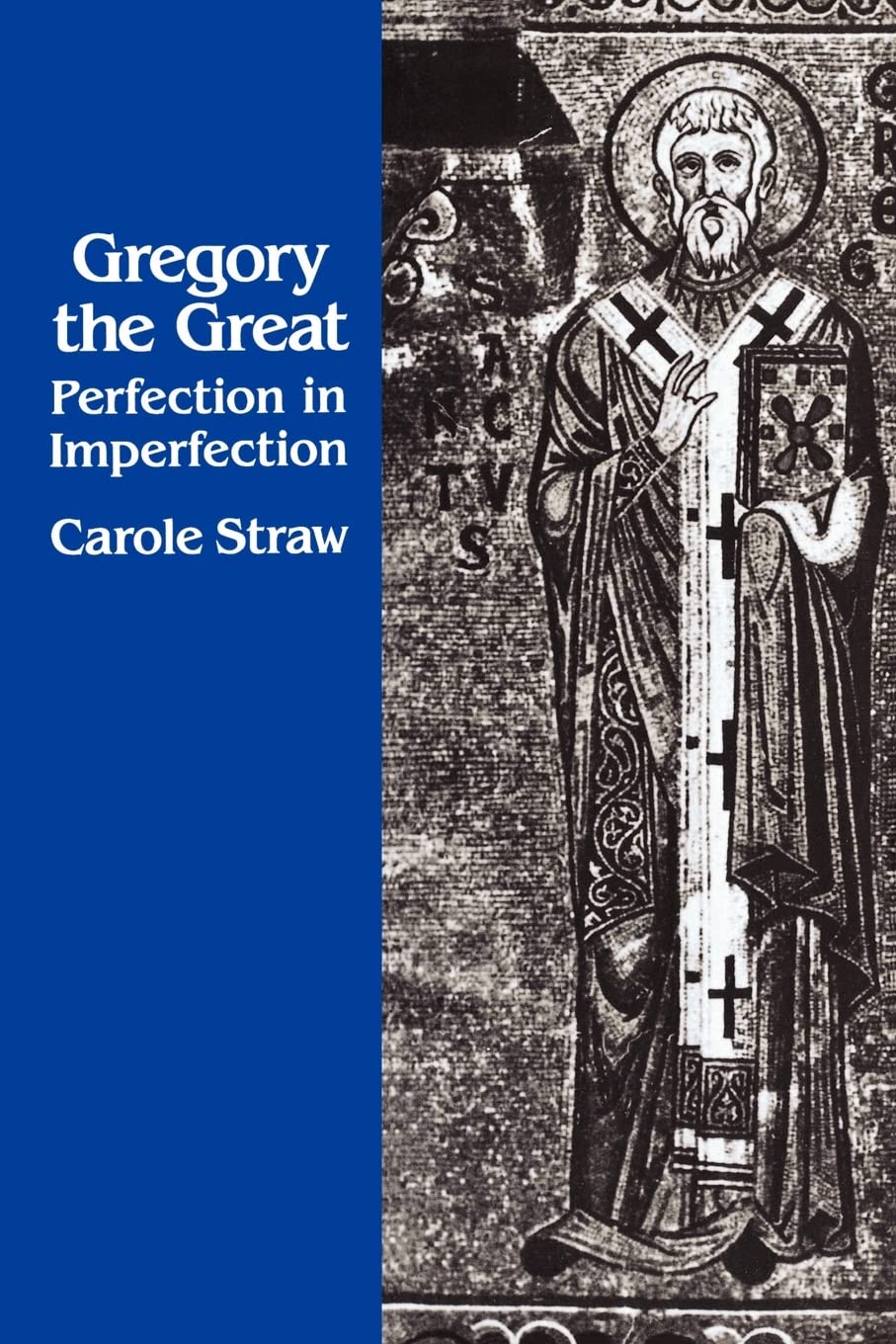
Gregory the Great: Perfection in Imperfection (Transformation of the Classical Heritage) (Volume 14)
$33.95
by Carole Straw



Gregory I (590-604) is often considered the first medieval pope and the first exponent of a truly medieval spirituality. Carole Straw places Gregory in his historical context and considers the many facets of his personality―monk, preacher, and pope―in order to elucidate the structure of his thought and present a unified, thematic interpretation of his spiritual concerns. "This is a first rate study of the elusive character of the preoccupations and assuptions of one of the most influential of the early Popes and, after Augustine, perhaps the most important of the Western Fathers."--"Journal of Theological Studies Carole Straw is Associate Professor of History at Mount Holyoke College. Gregory the Great: Perfection in Imperfection By Carole E. Straw University of California Press Copyright © 1991 Carole E. Straw All right reserved. ISBN: 0520068726 Introduction On meeting St. Anthony, the old hermit Paul recalls the world, and for all his years of isolation in the desert he cannot quite forsake the fortunes of cities and empires: "Because true love embraces all things, please tell me how the human race is getting along: whether new roofs rise in the ancient cities, whose empire now rules the world, and whether any still exist, snared in the error of demons."1 The life of perfection includes charity for others; indeed, it is nothing without such charity. Though a thousand reasons bid the monk to leave the world, polluted as it is with enticements of demons, those who escape are never wholly comfortable about the fate of those left behind, imperiled and perhaps lost. Even in its most ascetic expression, late antique Christianity is never a flat rejection of the world. The gnawing recollection of Christ's lament cannot be dispelled, "O, Jerusalem, Jerusalem, the city that murders the prophets and stones the messengers sent to her! How often have I longed to gather your children, as a hen gathers her brood under her wings; but you would not let me. Look, look, there is your temple forsaken by God" (Mt 23:37–38). To see this temple forsaken and destroyed is to witness God's justice, but one testifies to God's terrible vengeance with grief for those lost, for the suffering of people and the decline of cities once great. Apocalypticism is woven of bereavement as well as anticipation.2 Is there more one Hier. vita Pauli 10 (PL 23, 25). Cf.Ep. 3.29 (CCL 140, 175); Ep. 3.61 (CCL 140, 209–11); Ep. 11.37 (CCL 140A, 931–32). For Gregory's apocalypticism see Claude Dagens, "La Fin des temps et l'église selon saint Grégoire le Grand," RecSR 58 (1970): 273–88, and Saint Grégoire le Grand (Paris, 1977), 345–430; René Wasselynck, "L'Orientation eschatologique de la vie chrétienne d'après saint Grégoire le Grand," in Assemblées du Seigneur 2 (1962): 66–80. See two articles by Raoul Manselli, "Escatologismo di Gregorio Magno," in Atti del Primo Congresso Internazionale di Studi Longobardi , 383–87; and "L'escatologia di S. Gregorio Magno," in RStR 1 (1954): 72–83; and Paulo Siniscalco, "Le età del mondo in Gregorio Magno," Jacques Fontaine, Robert Gillet, and Stan Pellestrandi, eds., Grégoire le Grand , Colloques Internationaux du Centre National de la Recherche Scientifique, Chantilly 15–19 September 1982 (Paris, 1982), 377–387. See also Brian Daley, Eschatologie in der Schrift und Patristik , in Handbuch der Dogmengeschichte vol. 4, fasc. 7a, ed. Michael Schmaus et al. (Freiburg, Basel, Vienna, 1986): 245–47. A modern trend is to downplay the severity of the crisis that Gregory considers catastrophic; cf. Michel Rouche, "Grégoire le grand face à la situation économique de son temps," in Fontaine et al., eds., Grégoire le Grand , 41–57. could do? "Age quod agis! "3 Get on with business, do what you must do. Never cease to work, do all you can. Such is the advice in the late sixth century of Gregory I, gazing from the see of Peter at so many adumbrations of the end. Gregory responds with remarkable energy and imagination to work in his dying world, feeling a duty to serve others despite the perils to his own soul.4 Gregory is often credited with founding the medieval papacy; and for many, his literary works mark the beginning of a truly medieval spirituality. Gregory achieved much, then, despite the disorders of the sixth century. Gregory's times were the stuff of apocalyptic dreams and visions to impressionable minds such as his. The last western Roman emperor was deposed in 476, an event not particularly noticed, but by this time almost the whole of the Western empire was ruled by German kings. Italy's first rex , Odoacer, lasted less than twenty years and was replaced by the Ostrogoth Theodoric in 493. Theodoric ruled conscientiously for thirty-three years, although he could not remedy the structural weaknesses of the Italian economy. A shortage of manpower, high taxes, and low productivity continued to thwart capital formation, and the countryside drifted further toward a natural economy.5