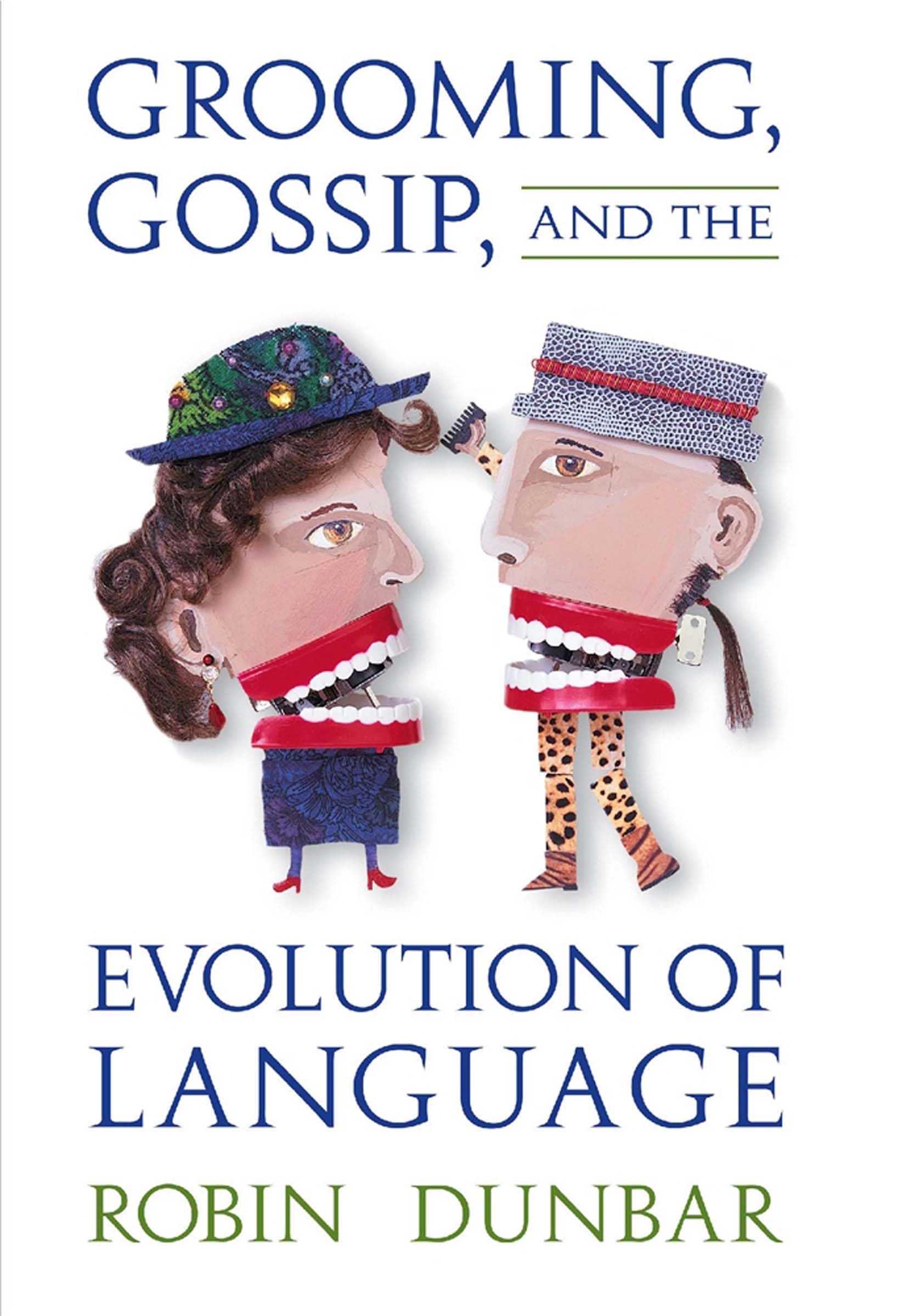



What a big brain we have for all the small talk we make. It's an evolutionary riddle that at long last makes sense in this intriguing book about what gossip has done for our talkative species. Psychologist Robin Dunbar looks at gossip as an instrument of social order and cohesion--much like the endless grooming with which our primate cousins tend to their social relationships. Apes and monkeys, humanity's closest kin, differ from other animals in the intensity of these relationships. All their grooming is not so much about hygiene as it is about cementing bonds, making friends, and influencing fellow primates. But for early humans, grooming as a way to social success posed a problem: given their large social groups of 150 or so, our earliest ancestors would have had to spend almost half their time grooming one another--an impossible burden. What Dunbar suggests--and his research, whether in the realm of primatology or in that of gossip, confirms--is that humans developed language to serve the same purpose, but far more efficiently. It seems there is nothing idle about chatter, which holds together a diverse, dynamic group--whether of hunter-gatherers, soldiers, or workmates. Anthropologists have long assumed that language developed in relationships among males during activities such as hunting. Dunbar's original and extremely interesting studies suggest otherwise: that language in fact evolved in response to our need to keep up to date with friends and family. We needed conversation to stay in touch, and we still need it in ways that will not be satisfied by teleconferencing, email, or any other communication technology. As Dunbar shows, the impersonal world of cyberspace will not fulfill our primordial need for face-to-face contact. From the nit-picking of chimpanzees to our chats at coffee break, from neuroscience to paleoanthropology, Grooming, Gossip, and the Evolution of Language offers a provocative view of what makes us human, what holds us together, and what sets us apart. “At the heart of this fresh and witty book is the thesis that gossip is the human version of primate grooming... Grooming, Gossip, and the Evolution of Language is in many ways a wonderful book, and its ideas deserve an airing. Mr. Dunbar is a clear thinker and a polymath, marshaling evidence for his thesis from such varied fields as primatology, linguistics, anthropology and genetics.” ― Natalie Angier , New York Times Book Review “If you've ever wondered why we gossip, read Dr. Robin Dunbar's Grooming, Gossip, and the Evolution of Language . Humans are the only primates that use language, and Dunbar theorizes that we gossip to strengthen our social status because we can't groom each other.” ― Johanna Huden , New York Post “Dunbar asks interesting questions, provides a fresh perspective on an old problem and gives readers a zippy intellectual ride.” ― Jo Ann C. Gutin , The Nation “[Dunbar's] is an intoxicating idea, somewhere between brilliant and loopy. On the way to fleshing out this bracing thesis, Dunbar gives us what he calls a 'magical mystery tour' of scientific disciplines, including neurology, linguistics, evolution and more...[H]is ideas and language can be delightful.” ― John Schwartz , Washington Post Book World “We're chatterers and snoops, every one of us, according to this fresh, witty book, and there's an evolutionary reason: gossip, like primate grooming, helps cement social ties.” ― New York Times “This book, which gives a deep insight into the emerging field of evolutionary psychology, is about as smart as they come. It tackles the related questions of brain size and the evolution of language, and relates our love of gossip and small talk to the endless grooming routines of other primates. It's 'Dilbert' for those who want to know why .” ― David Warsh , Boston Globe “Robin Dunbar's Grooming, Gossip, and the Evolution of Language , is a highly enjoyable speculation, in Neo-Darwinian mode, of how and why humans came to have language. The argument of the book is the now not unfamiliar argument that the point of talking is being able to make small talk (the 'gossip' of the title), and that small talk produces social cohesion and mitigates social conflict. In other words, it does what primatologists have long claimed grooming does for non-human primates...The book is frequently humorous and charming, always readable, and often modest in tone...The citations to his own and others' original research and the review of the literature on non-human primate language and grooming practices, are part of what make this book well suited for a general readership, but also appropriate for a more specialized academic and student readership.” ― Charis Cussins , Journal of the History of the Behavioral Sciences “Dunbar has written provocative book about the sociology of language use...[A] fascinating study.” ― Library Journal “It may seem a stretch to connect the origin of speech with the grooming beh