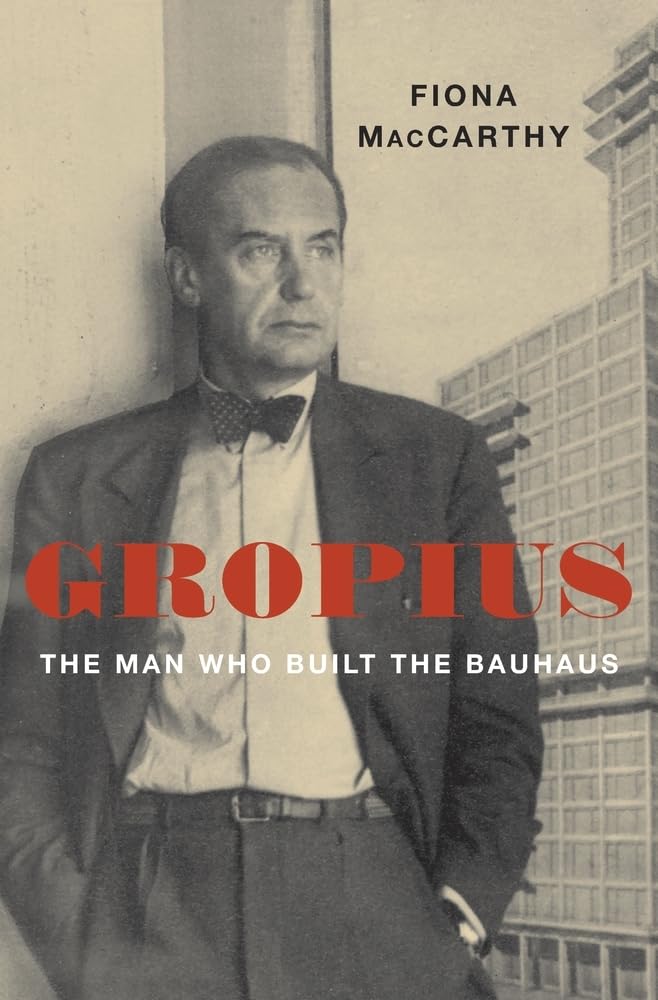



“This is an absolute triumph―ideas, lives, and the dramas of the twentieth century are woven together in a feat of storytelling. A masterpiece.” ―Edmund de Waal, ceramic artist and author of The White Road The impact of Walter Gropius can be measured in his buildings―Fagus Factory, Bauhaus Dessau, Pan Am―but no less in his students. I. M. Pei, Paul Rudolph, Anni Albers, Philip Johnson, Fumihiko Maki: countless masters were once disciples at the Bauhaus in Berlin and at Harvard. Between 1910 and 1930, Gropius was at the center of European modernism and avant-garde society glamor, only to be exiled to the antimodernist United Kingdom during the Nazi years. Later, under the democratizing influence of American universities, Gropius became an advocate of public art and cemented a starring role in twentieth-century architecture and design. Fiona MacCarthy challenges the image of Gropius as a doctrinaire architectural rationalist, bringing out the visionary philosophy and courage that carried him through a politically hostile age. Pilloried by Tom Wolfe as inventor of the monolithic high-rise, Gropius is better remembered as inventor of a form of art education that influenced schools worldwide. He viewed argument as intrinsic to creativity. Unusually for one in his position, Gropius encouraged women’s artistic endeavors and sought equal romantic partners. Though a traveler in elite circles, he objected to the cloistering of beauty as “a special privilege for the aesthetically initiated.” Gropius offers a poignant and personal story―and a fascinating reexamination of the urges that drove European and American modernism. “A riveting book about a man who nurtured a vastly ambitious project through extraordinary times.” ― The Economist “A comprehensive biography of the figure whom the painter Paul Klee, a teacher at the Bauhaus, called ‘the silver prince.’” ― Dan Chiasson , New Yorker “MacCarthy transforms [Gropius] from a dull institutionalist―head of the Bauhaus and, later, prominent professor at the Harvard Graduate School of Design―into a stylistic rebel who lived and loved in an exuberant community of artist outcasts that would be scattered across the world after Weimar Germany became the Third Reich. Whereas critics of the Bauhaus have seen it as the harbinger of giant faceless office towers and superhighways slicing through cities, MacCarthy presents the school as a fount of idealism: both an artistic collective, surging with creative energy, and a political project briefly filled with the angst and élan of a lost generation soon to be crushed by Hitler. Most of all, MacCarthy shows that Gropius’s true legacy was the talent he nurtured in others―I. M. Pei, Philip Johnson, Paul Klee, Marcel Breuer, and Wassily Kandinsky, to name but a few.” ― New Republic “MacCarthy’s book doesn’t claim to offer deep analysis of all of Gropius’s or the Bauhaus’s artistic output. But, as a way of bringing the human stories of this extraordinary phenomenon to life, it’s hard to beat.” ― The Guardian “MacCarthy’s enjoyable biography is an impressive achievement, finally giving us not just Gropius the architect in black and white, but the human being in full color.” ― Evening Standard “MacCarthy makes a compelling case for the architect as an impassioned idealist and romantic…An incredibly readable and rounded biography and gives credit where it’s due to the formidable women who shaped him.” ― Literary Review “[A] revelatory biography…Strikingly readable…Gropius emerges here as a kind of obsessive, passionate genius…Transforms our understanding of the history and significance not only of Gropius but of the group of 1930s innovators who comprised the movement.” ― The Arts Desk “[A] meticulously researched, balanced and brilliantly written biography…MacCarthy refuses the often ill-researched reductionist characterizations of Gropius as the arrogant, dour modernist. Instead, she passionately weaves a gripping and powerful narrative deserving of a wide audience while also making for essential reading for anyone studying architecture and design.” ― Irish Times “A complex narrative about a complex man. Fiona MacCarthy’s richly detailed biography of Walter Gropius, one of the twentieth century’s most influential architects, reads like a detective story.” ― Moshe Safdie, founding principal of Moshe Safdie Architects “Saint or sinner? Visionary or myopic? In the century since the Bauhaus opened, its founder Walter Gropius has been lionised and demonised. Did Gropius inspire the world’s most influential and humane art school, or was he the evil genius of miserable industrial culture? Fiona MacCarthy is Britain’s first and best writer on design. She rescues Gropius’s reputation in a book full of learning, insight, dry wit, and belief. Just like the man himself.” ― Stephen Bayley, cofounder of the Design Museum, London, and author of Taste “This is an absolute triumph―ideas, lives, and the dramas of the twentieth ce