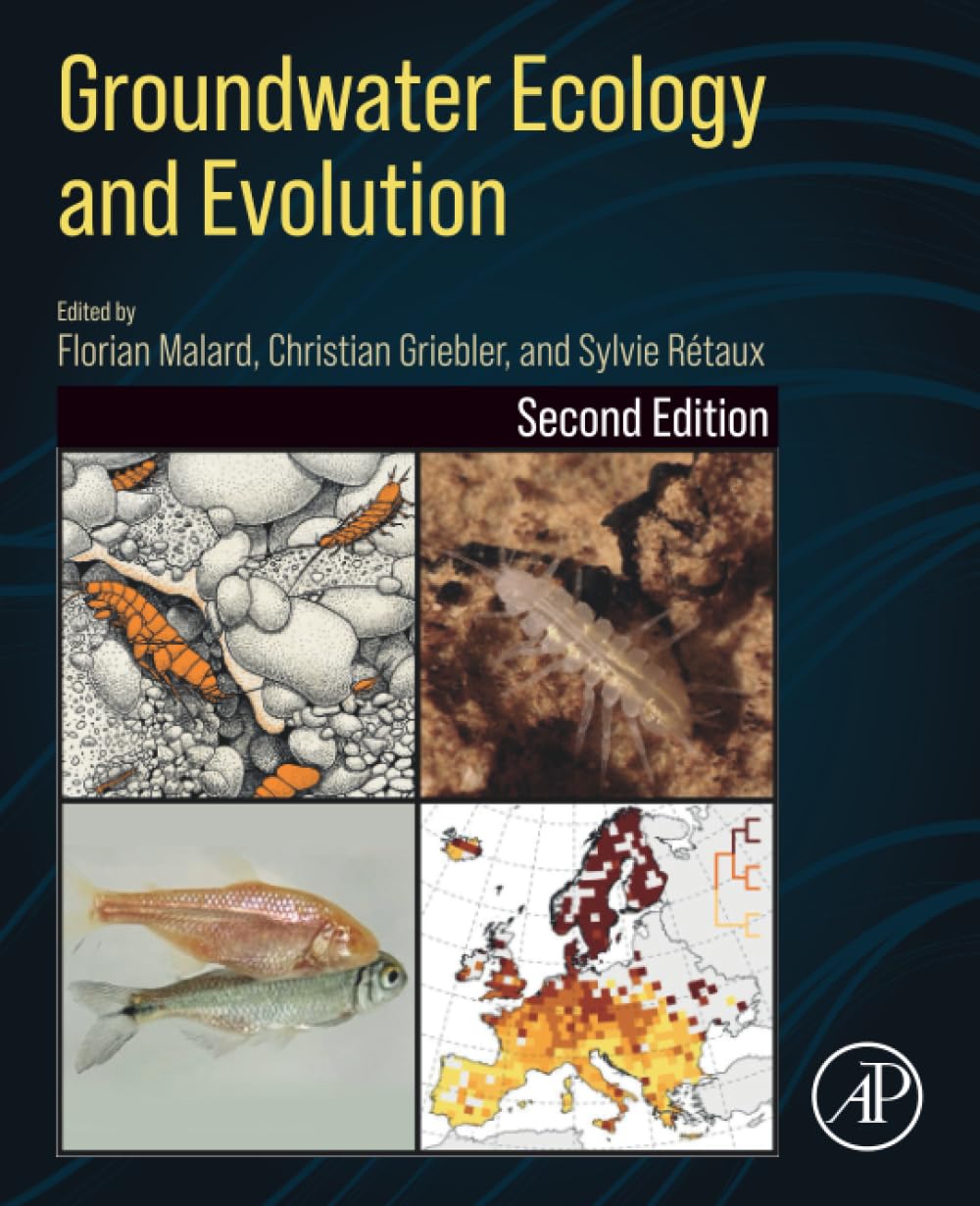



Groundwater Ecology and Evolution, Second Edition is designed to meet a multitude of audience needs. The state of the art in the discipline is provided by the articulation of six sections. The first three sections successively carry the reader into the basic attributes of groundwater ecosystems (section 1), the drivers and patterns of biodiversity (section 2), and the roles of organisms in groundwater ecosystems (section 3). The next two sections are devoted to evolutionary processes driving the acquisition of subterranean biological traits (section 4) and the way these traits are differently expressed among groundwater organisms (section 5). Finally, section 6 shows how knowledge acquired among multiple research fields (sections 1 to 5) is used to manage groundwater biodiversity and ecosystem services in the face of future groundwater resource use scenarios. Emphasis on the coherence and prospects of the whole book is given in the introduction and conclusion. Provides a modern synthesis of research dedicated to the study of groundwater biodiversity and ecosystems - Bridges the gap between community ecology, evolution, and functional ecology, three research fields that have long been presented isolated from each other - Explains how this trans-disciplinary integration of research contributes to understanding and managing of groundwater ecosystem functions - Reveals the contribution of groundwater ecology and evolution in solving scientific questions well beyond the frontiers of groundwater systems Edited by a new, but equally impressive team, this is the much sought after and fully updated new edition of this groundwater text Groundwater Ecology and Evolution, Second Edition is designed to meet a multitude of audience needs. The state-of-the-art in the discipline is provided by the articulation of 6 sections which successively carry the reader into the basic attributes of groundwater ecosystems (section 1), the processes shaping patterns of species diversity (i.e. diversification and dispersal in section 2), the evolutionary forces driving the acquisition of subterranean biological traits (section 3), the way these traits are differently expressed among groundwater organisms (section 4), and the role of organisms in maintaining biogeochemical processes (section 5). Finally, section 6 shows how knowledge acquired among multiple research fields (sections 1 to 5) is used to manage groundwater biodiversity and ecosystem services in the face of future groundwater resource use scenarios (section 6). Section 6 is an applied outreach from basic knowledge gained through the book; yet, many of the applications covered in this section are briefly introduced in sections 2 to 5 with reference to section 6. Emphasis on the coherence and prospects of the whole discipline is made in introduction and conclusions of the book. Groundwater Ecology and Evolution, Second Edition is primarily intended for an audience of graduate students, post-graduate students and academic researchers involved in the study of groundwater ecosystems. Florian Malard works at CNRS (French National Centre for Scientific Research) and University Claude Bernard Lyon 1, France. Dr Florian Malard is a groundwater evolutionary ecologist. Over the last ten years, his research focus has been on understanding patterns of groundwater biodiversity at regional to continental scales. He has led the “Ecology, Evolution and Groundwater Ecosystems research group, formerly headed by Professor Janine Gibert, the lead editor of the first edition of the Groundwater Ecology book published in 1994. Christian Griebler works at the University of Vienna, Austria. Dr Christian Griebler is a functional ecologist with a broad research interest stretching from the roles of microorganisms to metazoans in groundwater ecosystems. Rooted in aquatic microbial ecology and biogeochemistry, his research group tackles groundwater biodiversity, cycling of carbon and nutrients, effects of climate and global change, as well as the assessment of groundwater systems in terms of ecological status. Sylvie Rétaux works at CNRS and University Paris-Saclay, France. Dr Sylvie Rétaux is a neuroscientist and developmental biologist whose interests have shifted to evolutionary biology about 20 years ago. Her laboratory works on ecological evolutionary developmental biology of a cave-dwelling organism, the blind cavefish Astyanax mexicanus. Using an integrated approach combining embryology, neuroscience, behavior, and population genetics, she aims at discovering the mechanisms of adaptation to life in the dark.