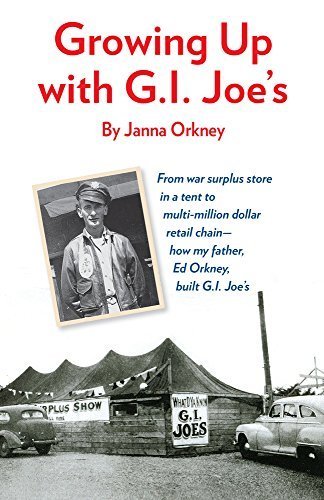



How did Ed Orkney build a large retail chain from a small war surplus store named G.I. Joe's, housed in a G.I. hospital tent? Ed's daughter, Janna, recounts the history of this favorite Northwest store in a classic "rags to riches" story. From Ed flying bombers in World War II, to selling war surplus bayonets and canteens, to creating a beloved general retail chain - it is all in the book. And the G.I. Joe's story continues with the expansion over 57 years to become the largest Northwest sporting goods store chain by 2000. G.I. Joe's growth continued to 31 stores with 2 sales of the business and finally, its bankruptcy in 2009 under the new name Joe's Sports, Outdoor and More. In addition, while the G.I. Joe's store is central to the book, Janna tells of her own growing up in mid-20th century Portland, Oregon, including the impact of the Columbia River's destructive Vanport Flood of 1948. Janna Orkney describes her book as a love letter to a store, to the land and people of the Pacific Northwest, and a tribute to America as the land of opportunity. Wanting to ensure history is not forgotten, former Lake Oswego resident Janna Orkney has published Growing Up with G. I. Joe s, the story of how her father, Ed Orkney, built G.I. Joe s from a war surplus store housed in a tent into a multi-million dollar retail chain. My impetus for writing the book came from the concern that history was being forgotten, Orkney said. Surplus stores played an interesting role in the development of general retail and my dad played an important role in that development. Orkney was born in Aberdeen, Wash., in 1944, while her father was serving as a bomber pilot in New Guinea in World War II. When he returned to civilian life in 1946, be began selling army surplus in Portland street corners, and soon after, was able to start a small war surplus store in Salem. That was the beginning of the involvement of the Orkney family with retail in the Pacific Northwest that lasted for more than 60 years. Life was exciting after WW II, said Orkney. People were building new lives. She said success looked different in that era. Success was having enough to lead a secure life. My dad had been a pilot, and a squadron leader during the war, and felt a responsibility to his crew. He brought that sense of responsibility to his business. Building the business was a team effort and all shared in the success, she said. She shares that her father did not experience success immediately or continually, but made a practice of selling what he knew people would buy. She shares how he looked for the holes in what other retailers were selling to find his niche in selling sports, outdoor and automotive supplies. When he died in 1976, Ed Orkney had built G.I. Joe s into a chain of seven stores in five cities. I tell the inside story of G.I. Joe s and also look at local historical events, including the Portland area Vanport Flood in 1948 and the inundation of Celilo Falls by The Dalles Dam in 1957, Orkney said. Growing Up with G. I. Joe s is a personal history, but with research about these events and about the early days of selling sporting goods in the Pacific Northwest. By Barbara Randall -- Lake Oswego Review , Dec. 3, 2015 The daughter of G.I. Joe's founder Ed Orkney tells the inside story of what it took to build the iconic sports retail business, from its origins as a war-surplus store and growth into a big box chain to the company's sudden bankruptcy in 2009l -- Oregon Business Magazine , "Hard Drive," January 2016 Before REI, there was a store on North Vancouver Avenue where people loved to scour the bins and hunt for deals on tents, rubber rafts and cigarettes. G.I. Joe s was a family business that enveloped the lives of author Janna Orkney, her mother, and her brother David. Janna Orkney has written Growing Up with G.I. Joe s (Columbia Press, $14.95). The store her father Ed Orkney founded, she writes, was like the fifth member of their family. They even named the family dog Tarps. She learned her first lesson in retail from him to wipe and clean up the small bottles of insect repellant that packed the bins and then gently stir them around to make it looked like shoppers had been scooping them up. Her dad spent evenings sketching out merchandise layouts and displays, she recalls. It s a picture of a different Portland, closer to nature and the mighty Columbia River, which overflowed its banks in the great Vanport Flood of 1948. She recalls taking a trip to the Columbia Gorge with her family and seeing the Native Americans fishing there during the last spring salmon run of 1957. She learned to swim at Jantzen Beach and ate at Waddles Restaurant. The family eventually moved to Northeast Portland to Sacramento Street near 82nd Avenue, where she and her brother attended Gregory Heights Grade School and Madison High School. From 1961 to 1970, her father shifted the store away from military surplus to general retail, carrying everything from sporting go