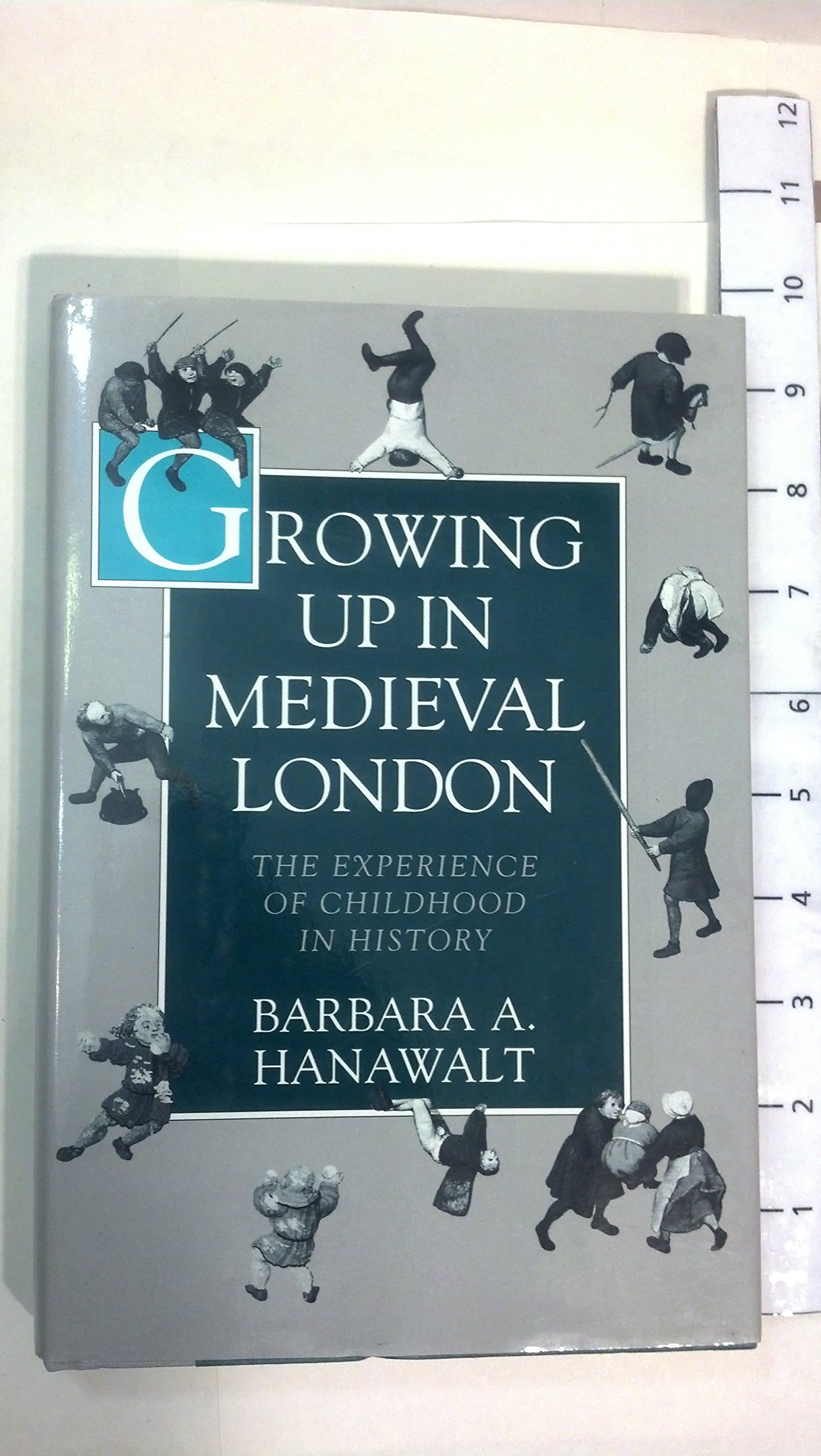
Growing Up in Medieval London: The Experience of Childhood in History
$57.00
by Barbara A. Hanawalt



When Barbara Hanawalt's acclaimed history The Ties That Bind first appeared, it was hailed for its unprecedented research and vivid re-creation of medieval life. David Levine, writing in The New York Times Book Review , called Hanawalt's book "as stimulating for the questions it asks as for the answers it provides" and he concluded that "one comes away from this stimulating book with the same sense of wonder that Thomas Hardy's Angel Clare felt [:] 'The impressionable peasant leads a larger, fuller, more dramatic life than the pachydermatous king.'" Now, in Growing Up in Medieval London , Hanawalt again reveals the larger, fuller, more dramatic life of the common people, in this instance, the lives of children in London. Bringing together a wealth of evidence drawn from court records, literary sources, and books of advice, Hanawalt weaves a rich tapestry of the life of London youth during the fourteenth and fifteenth centuries. Much of what she finds is eye opening. She shows for instance that--contrary to the belief of some historians--medieval adults did recognize and pay close attention to the various stages of childhood and adolescence. For instance, manuals on childrearing, such as "Rhodes's Book of Nurture" or "Seager's School of Virtue," clearly reflect the value parents placed in laying the proper groundwork for a child's future. Likewise, wardship cases reveal that in fact London laws granted orphans greater protection than do our own courts. Hanawalt also breaks ground with her innovative narrative style. To bring medieval childhood to life, she creates composite profiles, based on the experiences of real children, which provide a more vivid portrait than otherwise possible of the trials and tribulations of medieval youths at work and at play. We discover through these portraits that the road to adulthood was fraught with danger. We meet Alison the Bastard Heiress, whose guardians married her off to their apprentice in order to gain control of her inheritance. We learn how Joan Rawlyns of Aldenham thwarted an attempt to sell her into prostitution. And we hear the unfortunate story of William Raynold and Thomas Appleford, two mercer's apprentices who found themselves forgotten by their senile master, and abused by his wife. These composite portraits, and many more, enrich our understanding of the many stages of life in the Middle Ages. Written by a leading historian of the Middle Ages, these pages evoke the color and drama of medieval life. Ranging from birth and baptism, to apprenticeship and adulthood, here is a myth-shattering, innovative work that illuminates the nature of childhood in the Middle Ages. YA-To refute the notion that childhood and adolescence were unknown as distinct stages in the 13th and 14th centuries, Hanawalt has mined evidence from public documents, wills, advice manuals, and literary works that children were treasured, protected, and allowed to pursue youthful pastimes-at least in medieval London. Education was a priority as the guilds often required literacy. Girls were not excluded; widows carried on their merchant husband's affairs and educated women were desirable as marriage partners. Some youngsters, particularly vulnerable females, were at risk from unscrupulous adults, but the records suggest that a clever adolescent often outwitted an evil master. The author embellishes court documents to create engaging narratives of the lives of individual children in a manner so alive and illuminating that even the most bored history students will be enthralled. Jackie Gropman, Kings Park Library, Burke, VA Copyright 1994 Reed Business Information, Inc. In a densely informative, fluid, and often charming study, Hanawalt (History/University of Minnesota) dashes the widely accepted notions that medieval society lacked the concepts of childhood and adolescence as we understand them, and that it disallowed the cultural space for the expression of these states of development. Received wisdom has long dictated that in the brutal world of the ``Dark Ages,'' high rates of infant and child mortality hardened hearts to the young, and that society thrust adulthood upon children as soon as they were large enough to complete a day's hard labor. Turning to the rich court documentation available in London (coroners' rolls; wills and bequests; records of orphans; business disputes, etc.) and relying on a technique that includes ``fictional'' portraits and scenarios to illustrate her more conventional expository narrative, Hanawalt paints a convincing picture of a 14th- and 15th-century London in which parents cherished their children no less than we do. In the author's London, people felt responsible for the welfare of neighborhood children, often risking their lives in their defense; upwardly mobile parents took immense pride in a well-schooled son; and those charged with the care of orphans were monitored to ensure that designated funds were not misspent. These were harsh times, of c