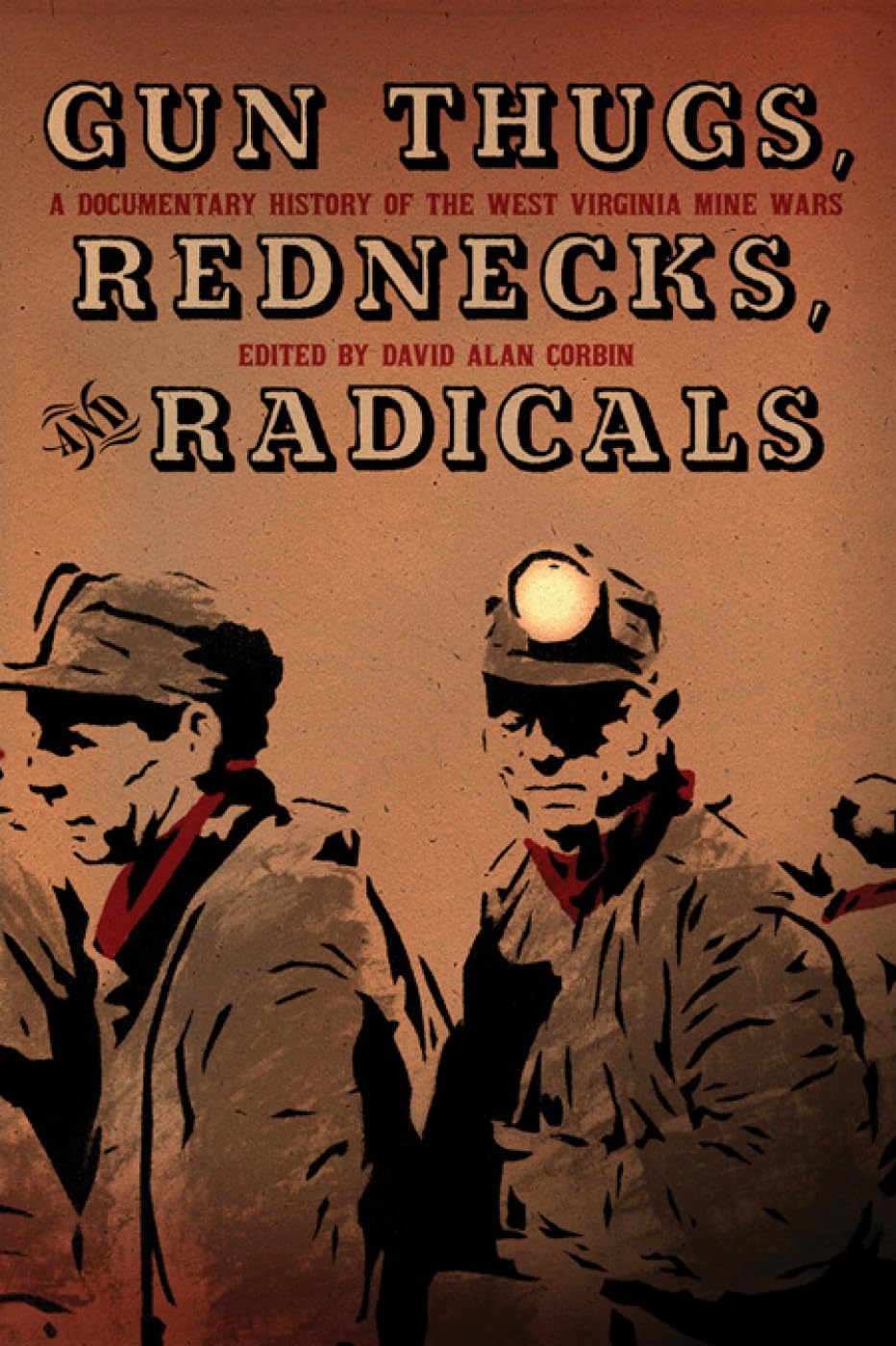
Gun Thugs, Rednecks, and Radicals: A Documentary History of the West Virginia Mine Wars
$13.50
by David Alan Corbin



Strikes and union battles occurred throughout American industry during the early part of the twentieth century, but none of these stories compare to the West Virginia Mine Wars of 1912 and 1921. These two workers’ rebellions quickly drew national attention to an area known principally for its “black gold,” the coal that was vital for U.S. factories, power plants, and warships of that age. In 1912, miners struck against the harsh conditions in the work camps of Paint and Cabin Creeks and coal operators responded with force. The ensuing battles caused the West Virginia governor to declare martial law, prompting Samuel Gompers to dub the state “Russianized West Virginia [where] the people can be naught but serfs.” There was little improvement in working conditions by 1921, when another army—thousands of union miners—went up against similar numbers of state police, local deputies, and paid company guards. The weeklong Battle of Blair Mountain ended only after President Warren Harding sent 2,000 U.S. troops and a small unit of bombers to pacify the region Gun Thugs, Rednecks, and Radicals tells the story of these union battles as seen by the leaders, rank-and-file participants, and the journalists who came to West Virginia to cover them for papers including The Nation and the New York Times . Union leaders like Gompers, Frank Keeney, Fred Mooney, Bill Blizzard, and Mother Jones discuss the lives and struggles of the miners for their union. The book also contains articles, speeches, and personal testimony heard by two U.S. Senate committees sent to investigate West Virginia’s labor problems. In this testimony, miners and their family members describe life and work in the coal camps, telling why they participated in these violent episodes in West Virginia history. Special attention is given to the role of Huntington’s own radical newspaper, The Socialist and Labor Star , a forgotten monument in the history of American heresy and radicalism. " Gun Thugs, Rednecks, and Radicals is a unique documentation of the West Virginia mine wars, using speeches, written testimony, and newspaper articles from Union newspapers to tell the story of the conflict in the voices of those involved." —www.RazorCake.org "The story of the Mine Wars is shocking." —resolutereader.blogspot.co.uk Dr. David A. Corbin, a native West Virginian, received his AB and MA degrees in history from Marshall University, and his PhD from the University of Maryland. He has taught history at the University of Maryland and has published extensively on West Virginia coal miners, including Life, Work, and Rebellion in the Coal Fields (U. of Illinois). Dr. Corbin has received state, regional, and national awards for his writings on coal mining history, and has appeared on public television, C-Span, and in documentary films discussing the history of West Virginia coal miners. Gun Thugs, Rednecks, and Radicals A Documentary History of the West Virginia Mine Wars By David Alan Corbin PM Press Copyright © 2011 PM Press All rights reserved. ISBN: 978-1-60486-452-6 Contents Preface by Gordon Simmons, Introduction, CHAPTER I A Complete and Ruthless Rule: Emergence of the Company Town, CHAPTER II Revolution: The Paint Creek-Cabin Creek Strike, CHAPTER III Battle Weaponry: The Bull Moose Special, CHAPTER IV The Organizers, CHAPTER V The Shootout: The Matewan Massacre, CHAPTER VI The Hit: The Killing of Sid Hatfield and Ed Chambers, CHAPTER VII Civil War: The March on Logan, CHAPTER VIII Treason, CHAPTER IX James M. Cain: Novelist and Journalist, CHAPTER X Victory: The UMWA Comes to Southern West Virginia, CHAPTER XI The History of The Socialist and Labor Star: Huntington, W. Va. 1912–1915, Notes, Bibliography, INDEX, CHAPTER 1 A Complete and Ruthless Rule: Emergence of the Company Town The southern West Virginia Mine Wars of 1912-1921 drew scores of newspaper reporters to the Mountain State to inform America about what was going on in this seemingly primitive and violent Appalachian backcountry. Upon their arrival, the savviest journalists quickly discovered that the Mine Wars were more than brief, episodic outbreaks of hostility between inherently violent people. They were the culmination of decades of exploitation and oppression, an inevitable result of a brutal way of industrial life and work that had evolved in the coal fields. Foremost, the battles were part of a decades-long struggle for dignity and political and social rights in southern West Virginia. The intensity of the violence in southern West Virginia can be traced to the oppressive, exploitative nature of life and work in the coal fields there. The heart of that authoritarian system was the company town. Ownership of the land and resources gave the coal companies enormous social control over the miners. "You didn't even own your own soul in those damnable places," recalled one elderly miner. "The company owned everything, the houses, the schools