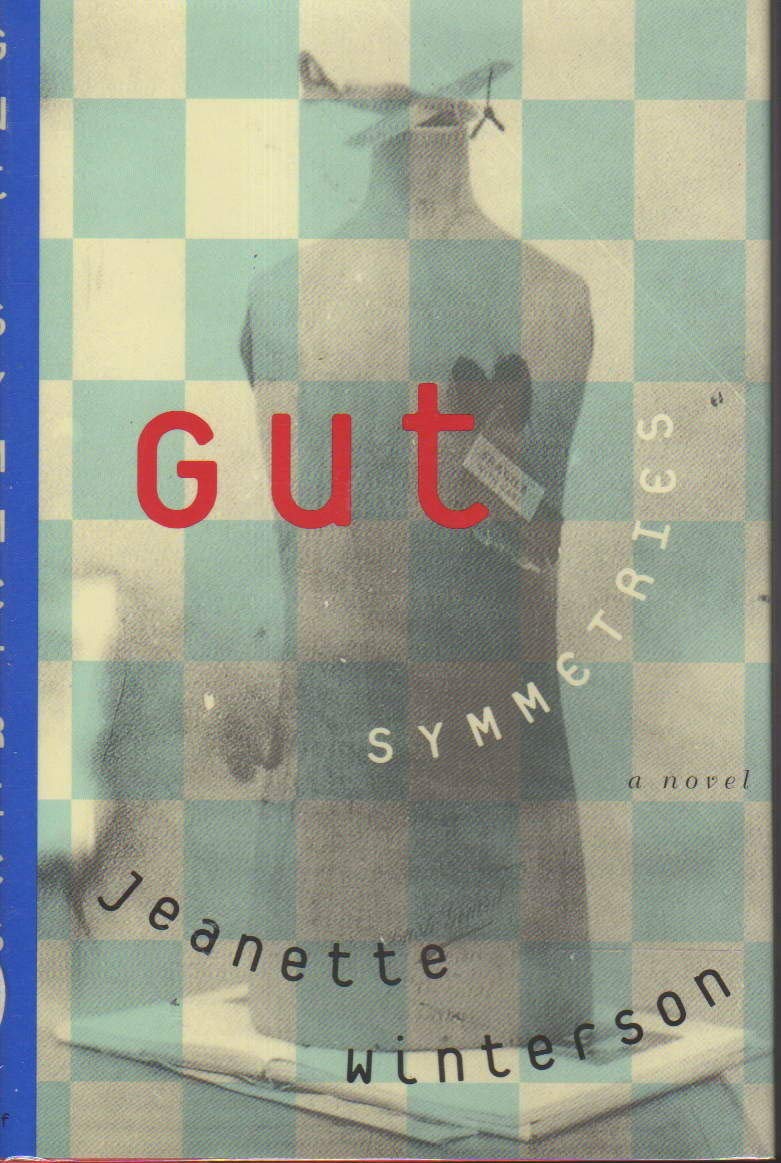



ailed in the Washington Post as "one of our most important writers in English, " Jeanette Winterson has firmly established her reputation as an extraordinarily daring and original novelist. In Gut Symmetries, lives and universes run parallel in a complex contemporary love story set in New York and Liverpool, and aboard the QE2. Physics seems to have become the new language of love in the 1990s, and Jeanette Winterson is not the first writer to make a major character a physicist. Jonathan Lethem mined similar territory earlier this year in his delightful book, As She Climbed Across the Table , and now Winterson enters the lists with not one, but two physicists populating the pages of her equally wonderful book, Gut Symmetries . If you think about it, physics does make a good metaphor for love, encompassing as it does the principles of attraction, the exchange of energy, and unification. At the center of this meditation on "the intelligence of the universe" and "the stupidity of humankind" are Jove, a married physicist; Alice, a single physicist who becomes his mistress; and Stella, Jove's wife and later, Alice's lover. They meet on the QE2 and from there the three participants in the story take turns telling their versions of it. Gut Symmetries is a collage of memories, snippets of scientific theory, meditations on abstract concepts like truth, and the events surrounding Jove, Alice, and Stella's affair. This is a book that demands your attention, jumping as it does from one seemingly tangential topic to another; but whereas physics still seeks a grand unification theory (GUT) to explain how everything in the universe fits together, Winterson actually finds one of her own in this satisfyingly complete fictional world. "Forgive me if I digress," says one character in this latest effort from the author of brilliant works like Written on the Body (LJ 2/15/93)?but you can't. The premise is so promising?the QE2 is sailing from Southampton to New York, and with the narrator lecturing on board about Paracelsus and the new physics, the reader naturally expects the sort of time-bending episodes and cool cultural assessment at which Winterson excels?that her failure to launch her own Ship of Fools is especially disappointing. A typically sharp-tongued and ambiguous Winterson character, the narrator conducts affairs with a husband and wife simultaneously (the husband, in fact, is a lecturer on time travel) but remains irksome and dull in the numerous platidinous observations that litter the page. Heavy-handed, humorless, and structurally fragmented, this is a grave disappointment from the talented Winterson. Buy only where her works are popular.?Barbara Hoffert, "Library Journal" Copyright 1997 Reed Business Information, Inc. Given the title, it's no surprise to discover that bizarre acts of eating are key plot elements in Winterson's new novel about a love triangle, but "gut" is also linked with "instinct" and "GUT" is an acronym for Grand Unified Theories, the gold physicists seek through the alchemy of their lovely speculations. And speaking of physicists, two of Winterson's embroiled lovers are such, and questions of matter, energy, and flux are mirrored in conflicts of love, desire, and guilt (that's where the symmetry comes in). The physicists--Alice, and Jove, who is married to a poet named Stella (stars, too, are important)--begin their affair on board the QE2 , another significant clue since ships of fools figure prominently in this cosmic drama. Such details point to Winterson's cleverness, but they can't begin to convey the soulfulness of this masterfully written, highly suspenseful, and penetrating bisexual love story. Winterson, ever innovative and unnerving even as she is enchanting, dives to remarkable emotional depths as she moves toward the revelation that "total beauty" is what makes life worth living. Donna Seaman Always a narrative daredevil and linguistic voluptuary, Winterson (Art and Lies, 1995, etc.) sustains a level of writing here that's at once incantatory, discursive, and passionate: a breath-taking Joycean romp that explores the mysteries of love in a world freed from common sense by the wonders of modern math and physics. Winterson's story is, in part, about a love triangle. Two physicists meet on the QE2 en route to New York: He's an Italian- American from the Lower East Side whose mother made a fortune as an importer. Now a physicist at the Institute for Advanced Study, Giovanni Baptiste Rossetti (nicknamed ``Jove'') revels in his literary forerunners, from the mythic King of Gods to Mozart's seduced. His fantasies of primacy and potency express themselves in his affair with Alice (short for Alluvia) Fairfax, an English scientist on her way to the Institute--herself in the grip of a millennial fever, and willing to entertain the alchemical and religious dimensions of her work. But the neat symmetry of things is changed when Alice meets Stella, Jove's wife. Expecting a dumpy ha