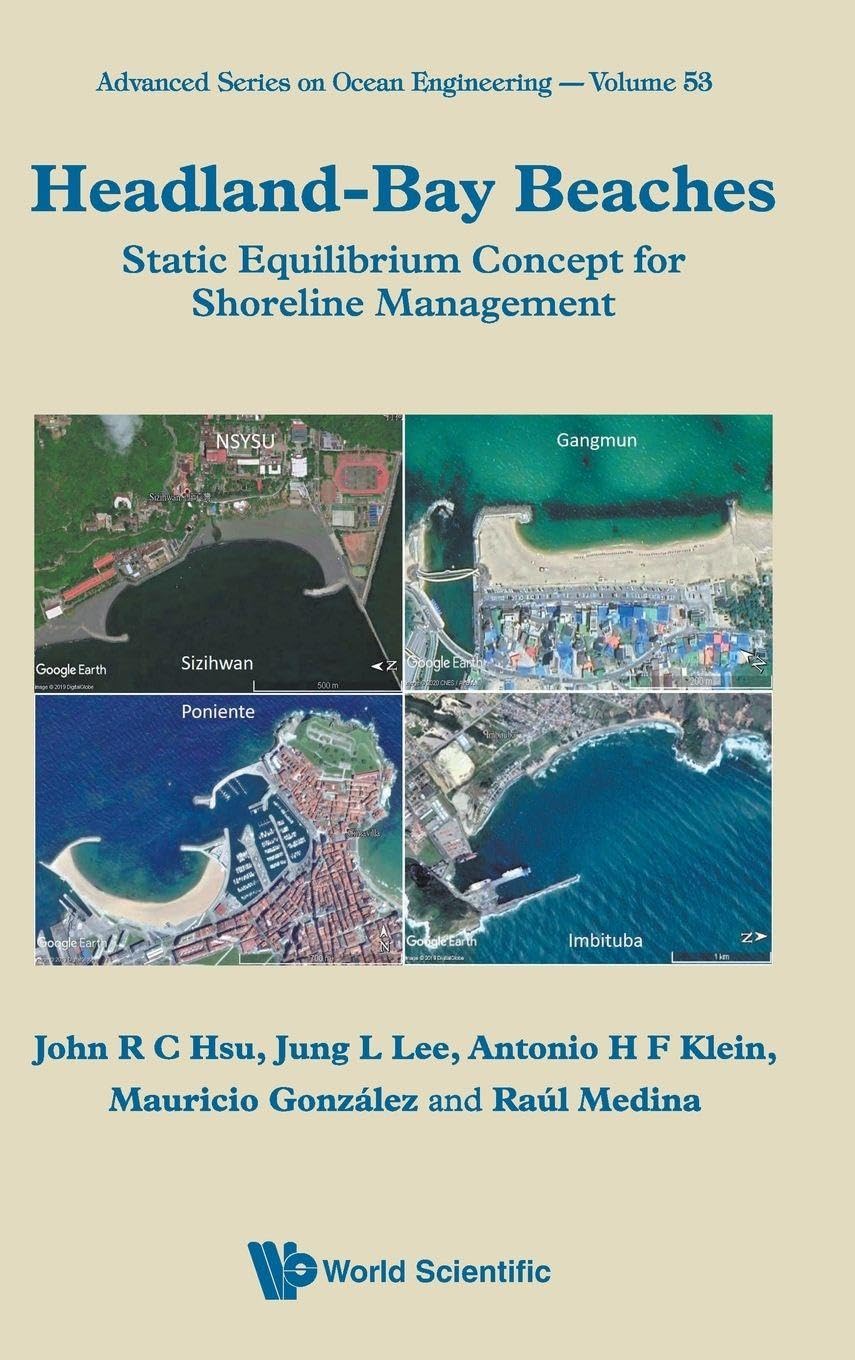



Headland-bay beaches (HBBs) are ubiquitous in coastal environment. They exist around the world naturally or artificially as byproduct of engineering project. Though in various shapes, sizes and stability, a HBB in static equilibrium not only is a delight for visitors, but also offers hope for better beach protection, restoration, recreation, and shoreline management. With an empirical parabolic model now available, the stability of an existing HBB can be verified, the future bay shape downdrift of a harbor can be predefined, and a stable HBB can be designed. Although a plethora of books are available for coastal and ocean engineering and geomorphology, only a countable few have covered engineering applications of HBBs. On the contrary, this book with focus on the HBBs in static equilibrium aims to offer a comprehensive volume with knowledge and applications for coastal scientists, engineers, managers, students, and the general public interested in HBBs. Useful software tools for HBBs (MEPBAY, MeePaSoL, and SMC) are introduced in the book to aid in applications. The authors have set out to make this book the first unique publication on HBBs, by bringing together the old coastal geomorphic knowledge and new concepts for static bay beaches. This book also provides numerous examples using the static bay beach concept to assist coastal scientists and engineers on planning and pre-design of a stable HBB, and for experimentalists, consultants, and numerical modelers to alleviate the burden of comparing planning options and conducting laborious physical experiments on coastal sedimentation problems. Headland-bay beaches (HBBs) are ubiquitous in coastal environment. They exist around the world naturally or artificially as byproduct of engineering project. Though in various shapes, sizes and stability, a HBB in static equilibrium not only is a delight for visitors, but also offers hope for better beach protection, restoration, recreation, and shoreline management. With an empirical parabolic model now available, the stability of an existing HBB can be verified, the future bay shape downdrift of a harbor can be predefined, and a stable HBB can be designed. Although a plethora of books are available for coastal and ocean engineering and geomorphology, only a countable few have covered engineering applications of HBBs. On the contrary, this book with focus on the HBBs in static equilibrium aims to offer a comprehensive volume with knowledge and applications for coastal scientists, engineers, managers, students, and the general public interested in HBBs. Useful software tools for HBBs (MEPBAY, MeePaSoL, and SMe are introduced in the book to aid in applications. The authors have set out to make this book the first unique publication on HBBs, by bringing together the old coastal geomorphic knowledge and new concepts for static bay beaches. This book also provides numerous examples using the static bay beach concept to assist coastal scientists and engineers on planning and pre-design of a stable HBB, and for experimentalists, consultants, and numerical modelers to alleviate the burden of comparing planning options and conducting laborious physical experiments on coastal sedimentation problems. John Rong-Chung Hsu is Honorary Research Fellow at University of Western Australia, Australia, and Emeritus Professor at National Sun Yat-sen University in Taiwan. He obtained his PhD from the University of Western Australia in 1980. Professor Hsu has served the Board of Advisory Editors, Coastal Engineering (1996 2017) and on Editorial Board, Coastal Engineering Journal, Japan Society of Civil Engineers (1997 2013). With Professor Richard Silvester, he co-authored a 578-page book "Coastal Stabilization: Innovative Concept" by Prentice-Hall in 1993, with reprint by World Scientific in 1997. He and Antonio Klein were Guest Editors of a special issue on "Hydrodynamics and Applications of Headland-Bay Beaches" for Coastal Engineering in 2010. Jung Lyul Lee is Professor and the Director of Beach and Shore Management Center at Sungkyunkwan University (SKKU - Suwon campus), Korea. After obtaining his PhD from the University of Florida (Gainesville) in 1993, he was appointed as a professor at SKKU in 1995. Professor Lee has taught and researched at SKKU ever since 1995. During this period, Professor Lee has supervised many research students (undergraduate, Master's and PhD) and published a large volume of papers in national and international referred journals and conference proceedings. Antonio Henrique da Fontoura Klein completed his PhD in Marine Sciences from the University of Algarve, Portugal in 2004. He is currently Associate Professor of the Special Oceanography Coordination in Physical and Mathematical Science Center, Federal University of Santa Catarina (UFSC). He was a Senior Lecturer at the University of the Vale do Itajaí in Santa Catarina State, for 16.5 years. During 2014 2019, he was Coordinator of the Master's Degree in Oc