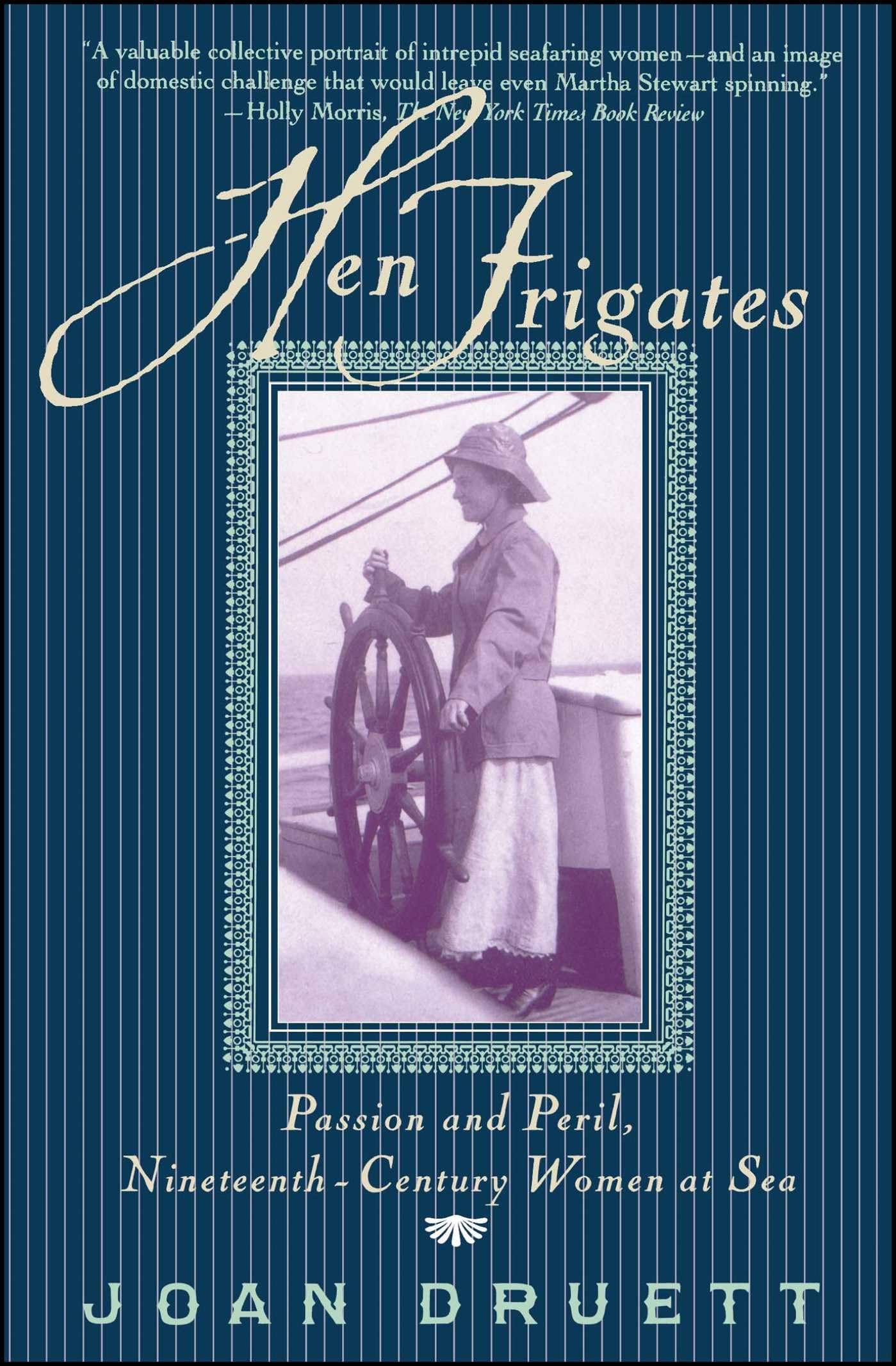



A "hen frigate," traditionally, was any ship with the captain's wife on board. Hen frigates were miniature worlds -- wildly colorful, romantic, and dangerous. Here are the dramatic, true stories of what the remarkable women on board these vessels encountered on their often amazing voyages: romantic moonlit nights on deck, debilitating seasickness, terrifying skirmishes with pirates, disease-bearing rats, and cockroaches as big as a man's slipper. And all of that while living with the constant fear of gales, hurricanes, typhoons, collisions, and fire at sea. Interweaving first-person accounts from letters and journals in and around the lyrical narrative of a sea journey, maritime historian Joan Druett brings life to these stories. We can almost feel for ourselves the fear, pain, anger, love, and heartbreak of these courageous women. Lavishly illustrated, this breathtaking book transports us to the golden age of sail. Holly Morris The New York Times Book Review A valuable collective portrait of intrepid seafaring women -- and an image of domestic challenge that would leave even Martha Stewart spinning. Judith Dunford Newsday Great fun, exhilarating as a cruise on a windjammer, and no Dramamine required. Michael Kenney The Boston Globe An altogether fascinating account...lively and...poignant. Michelle Green The Wall Street Journal Riveting history. A "hen frigate", traditionally, was any ship with the captain's wife on board. Hen frigates were miniature worlds -- wildly colorful, romantic, and dangerous. Here are the dramatic, true stories of what the remarkable women on board these vessels encountered on their often amazing voyages: romantic moonlit nights on deck, debilitating seasickness, terrifying skirmishes with pirates, disease-bearing rats, and cockroaches as big as a man's slipper. And all of that while living with the constant fear of gales, hurricanes, typhoons, collisions, and fire at sea. Interweaving first-person accounts from letters and journals in and around the lyrical narrative of a sea journey, maritime historian Joan Druett brings life to these stories. We can almost feel for ourselves the fear, pain, anger, love, and heartbreak of these courageous women. Lavishly illustrated, this breathtaking book transports us to the golden age of sail. Joan Druett, an award-winning writer of nautical nonfiction, is the author of numerous works, including Hen Frigates and In the Wake of Madness. She lives in New Zealand. Visit her website at www.joan.druett.gen.nz. Introduction History, I often think, is like a tap on the shoulder. This story of what it was like to be a captain's wife or daughter at sea is eloquent evidence of this, for the writing involved a whole series of nudges from the past. The research for Hen Frigates was an ever-evolving process, which included the discovery of a long-hidden nineteenth-century gravestone, a wedding portrait that returned home, and diaries hidden in an attic. Like many a good yarn, this one begins with a discovery made on a tropical isle. The year was 1984. My husband, Ron, and I were cycling around the island of Rarotonga, one of the Cook Islands scattered across Polynesia in the South Pacific. Rarotonga is not a large island, as can be judged by the fact that it takes just two hours to ride completely around it, but it is definitely beautiful. In the middle is a tall, green-clothed mountain, and plantations of oranges, pawpaw, and avocado trees sweep down the slopes to the narrow, potholed road that rims the island beside the sea. On the other side of the road there is a strand of coral rubble where straggly mallows and great Wellingtonia trees grow, surrounded by thick weeds. And, beyond the trees, white sand rakes down to the turquoise lagoon, the reef, and the sparkling blue sea. We arrived at a certain place on the beach that is known as Ngatangiia at noon. It was very hot, and we expected it to be deserted, but to our surprise a young man was working away in the littoral rubble, hacking away at the weeds. It seemed such a pointless task that we became curious. Why was he working so hard to clear land that would never produce a crop? When we asked around, however, we found he did have a good reason. An ancestor ghost had come to him in a dream, and had commanded him to do this, because this bit of land was a graveyard. This explanation was rather hard to credit, for Rarotongans do not neglect graves. As it turned out, the explanation was valid, however: this was a graveyard for outsiders. A long time ago, a sailing ship had called with a dead seaman on board, and the captain had asked the queen of the island -- the pa-ariki -- for permission to bury the boy on land, a burial at sea not being considered desirable back then. The ariki thought deeply about it, for the rule was that only native Rarotongans could be buried on the island, but then she relented, and had this piece of ground set aside, as a burying place for foreigners. And