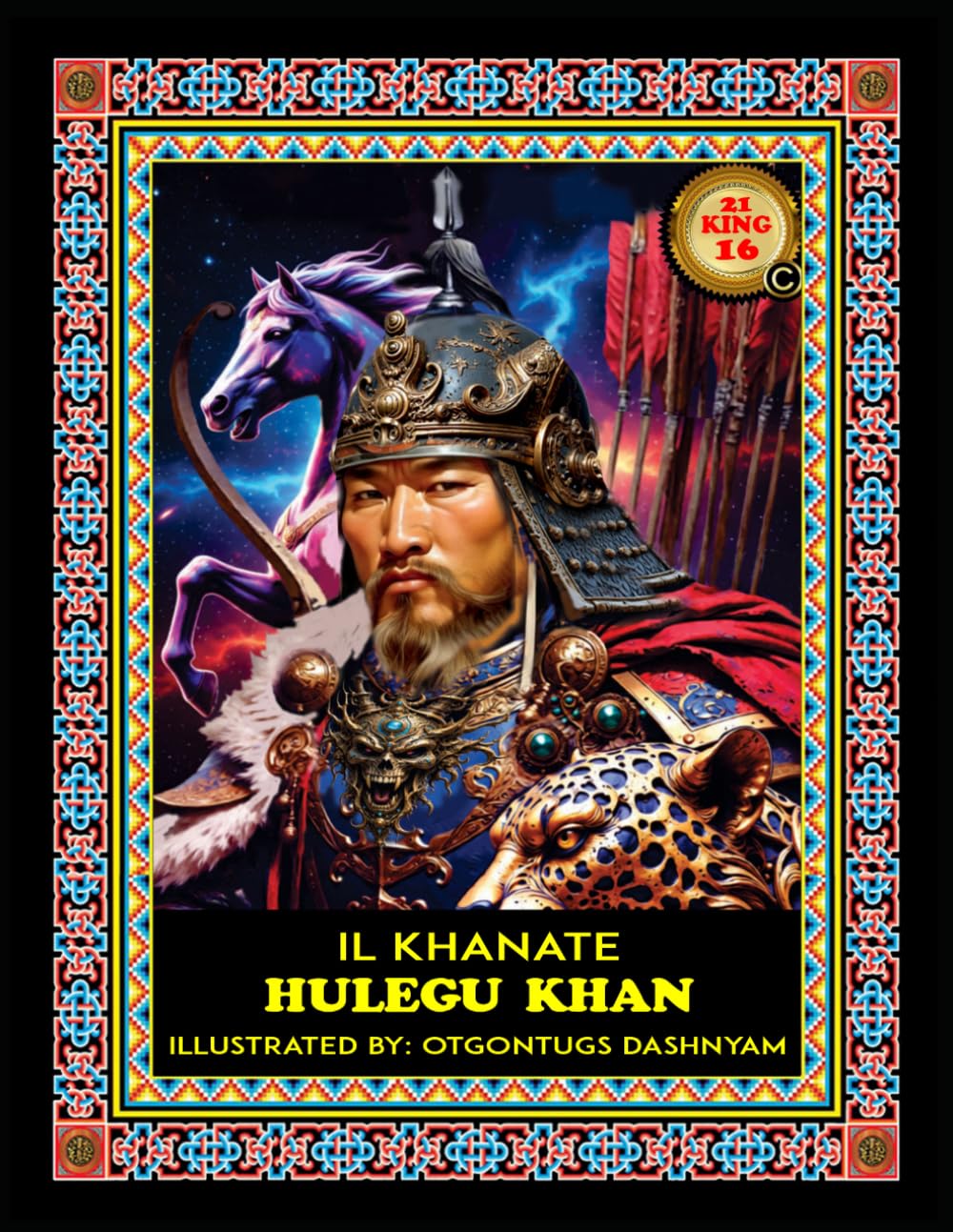
HULEGU KHAN. 1256-1265. IL KHANATE. LEGEND MONGOL 21 KHANS: ILLUSTRATED BY: TOM DASHNYAM OTGONTUGS (LEGEND MONGOL EMPIRE 21 KHANS)
$9.99
by OTGONTUGS DASHNYAM



Hulegu Khan, also known as Hülegü or Hulagu (c. 1217 – 8 February 1265), was a Mongol ruler who conquered much of Western Asia. As a son of Tolui and the Keraite princess Sorghaghtani Beki, he was a grandson of Genghis Khan and brother of Ariq Böke, Möngke Khan, and Kublai Khan. Hulegu's army greatly expanded the southwestern portion of the Mongol Empire, founding the Ilkhanate in Persia. Under Hulegu's leadership, the Mongols sacked and destroyed Baghdad, ending the Islamic Golden Age and the Abbasid dynasty. They also weakened Damascus, causing a shift of Islamic influence to the Mamluk Sultanate in Cairo. Background Mongol invasions and conquests Hulegu was born to Tolui, one of Genghis Khan's sons, and Sorghaghtani Beki, an influential Keraite princess and a niece of Toghrul in 1217. Not much is known of Hulegu's childhood except of an anecdote given in Jami' al-Tawarikh and he once met his grandfather Genghis Khan with Kublai in 1224. Military campaigns The siege of Alamût in 1256 A Mughal painting of Hulegu's siege of Alamut Hulegu's brother Möngke Khan had been installed as Great Khan in 1251. Möngke charged Hulegu with leading a massive Mongol army to conquer or destroy the remaining Muslim states in southwestern Asia. Hulegu's campaign sought the subjugation of the Lurs of southern Iran, the destruction of the Nizari Ismaili state (the Assassins), the submission or destruction of the Abbasid Caliphate in Baghdad, the submission or destruction of the Ayyubid states in Syria based in Damascus, and finally, the submission or destruction of the Bahri Mamluke Sultanate of Egypt. Möngke ordered Hulegu to treat kindly those who submitted and utterly destroy those who did not. Hulegu vigorously carried out the latter part of these instructions. Hulegu marched out with perhaps the largest Mongol army ever assembled – by order of Möngke, two-tenths of the empire's fighting men were gathered for Hulegu's army in 1253. He arrived at Transoxiana in 1255. He easily destroyed the Lurs, and the Assassins surrendered their impregnable fortress of Alamut without a fight, accepting a deal that spared the lives of their people in early 1256. He chose Azerbaijan as his power base, while ordering Baiju to retreat to Anatolia. From at least 1257