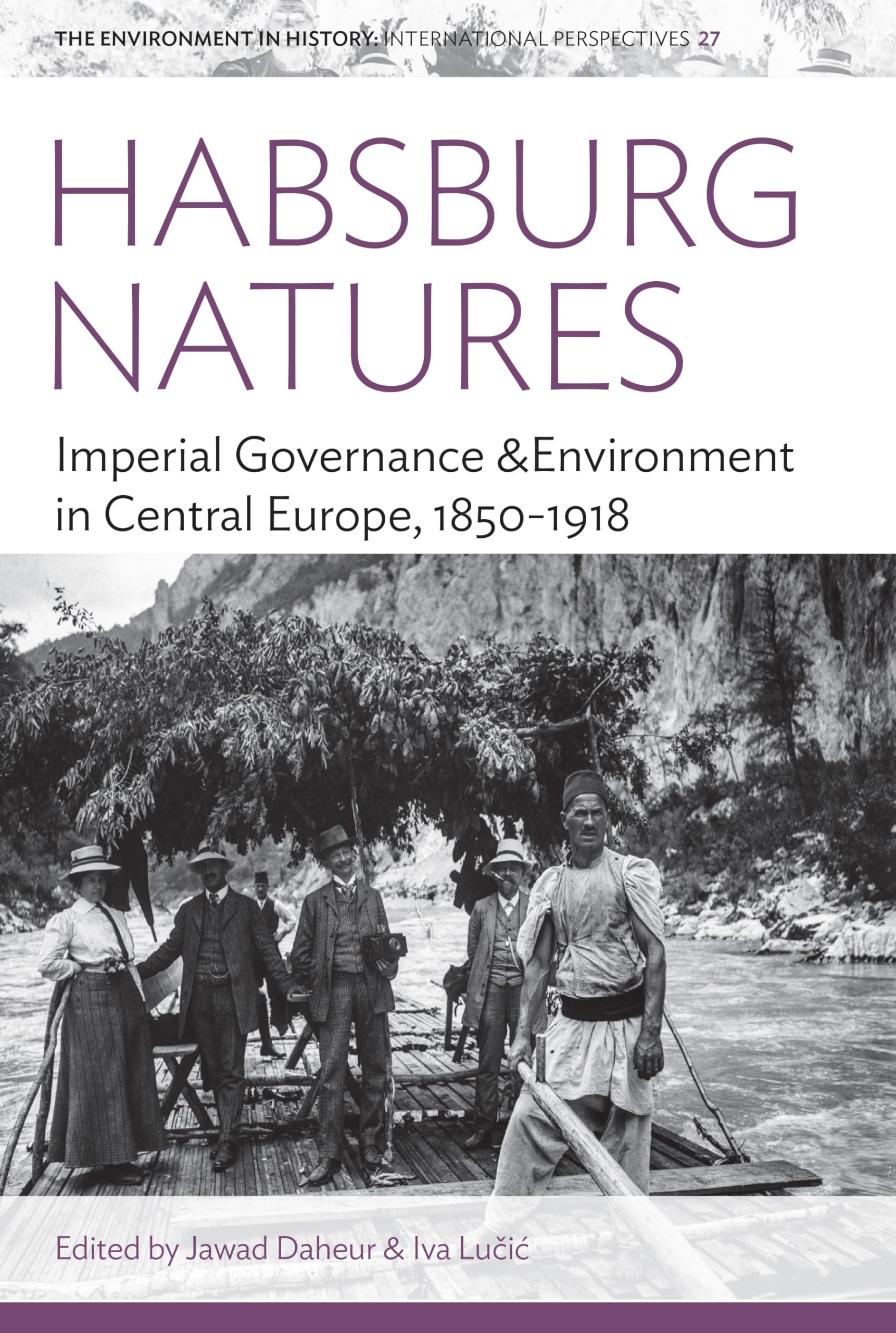
Habsburg Natures: Imperial Governance and Environment in Central Europe, 1850-1918 (Environment in History: International Perspectives, 27)
$150.00
by Jawad Daheur



Within the Habsburg Empire of the late nineteenth century, nature became a central focus of political, economic, and scientific attention. A source of valuable natural resources and a platform for consolidating wider, territorial rule, its management and control was subsumed into a broader system of imperial governance. In this exacting analysis of the correlation between the environment and power, Habsburg Natures explores how the natural world fundamentally shaped the political and economic landscape within the Austro-Hungarian Empire from 1850 to 1918. Ranging from forestry and coal-mining to river politics and natural disasters, this volume spotlights how deeply intertwined the histories of environmentalism and empire are. “[This] is the first book that I am aware of that explicitly intends to explore the relationship between the Habsburgs as an empire and environmental history. The synthesis of the new imperial history, new Habsburg history, and environmental history in the introduction is very useful and should serve as a departure point for future environmental histories of the Habsburg Empire.” • Marc Landry , The University of New Orleans Iva Lučić is an associate professor of history at Stockholm University and a Pro Futura Scientia Scholar at the Swedish Collegium for Advanced Studies. Previously, she held a postdoctoral position at the Institute for Human Sciences in Vienna and a Linneaus-Palme Fellowship with Kolkata University. Lučićs first and award-winning monograph Im Namen der Nation (Harrassowitz Verlag, 2018) examines the mobilization process for the political elevation of Muslims in Socialist Yugoslavia. Her second monograph, Gebrochenes Brot (Anton Pustet Verlag, 2020), analyzes the role of religion as a social practice among Roman Catholic noblewomen after the dissolution of the Habsburg Monarchy. Jawad Daheur is a senior researcher at the French National Centre for Scientific Research (CNRS), focusing on economic and environmental history. His main interest is the interaction between human societies and nature in nineteenth-century Central Europe, with a particular focus on the German-speaking regions (Prussia, Austria-Hungary) and Poland. His recent publications include a special issue of Global Environment , entitled ‘Extractive Peripheries in Europe: Quest for Resources and Changing Environments (15th-20th centuries)’ (2022), and the article ‘Cheap Labour on the Timber Frontier: Migration of Forestry Workers from Austria-Hungary to Southeast Europe, ca. 1880–1914’ ( Jahrbuch für Wirtschaftsgeschichte 2024). Iva Lučić is an associate professor of history at Stockholm University and a Pro Futura Scientia Scholar at the Swedish Collegium for Advanced Studies. Previously, she held a postdoctoral position at the Institute for Human Sciences in Vienna and a Linneaus-Palme Fellowship with Kolkata University. Lučićs first and award-winning monograph Im Namen der Nation (Harrassowitz Verlag, 2018) examines the mobilization process for the political elevation of Muslims in Socialist Yugoslavia. Her second monograph, Gebrochenes Brot (Anton Pustet Verlag, 2020), analyzes the role of religion as a social practice among Roman Catholic noblewomen after the dissolution of the Habsburg Monarchy.