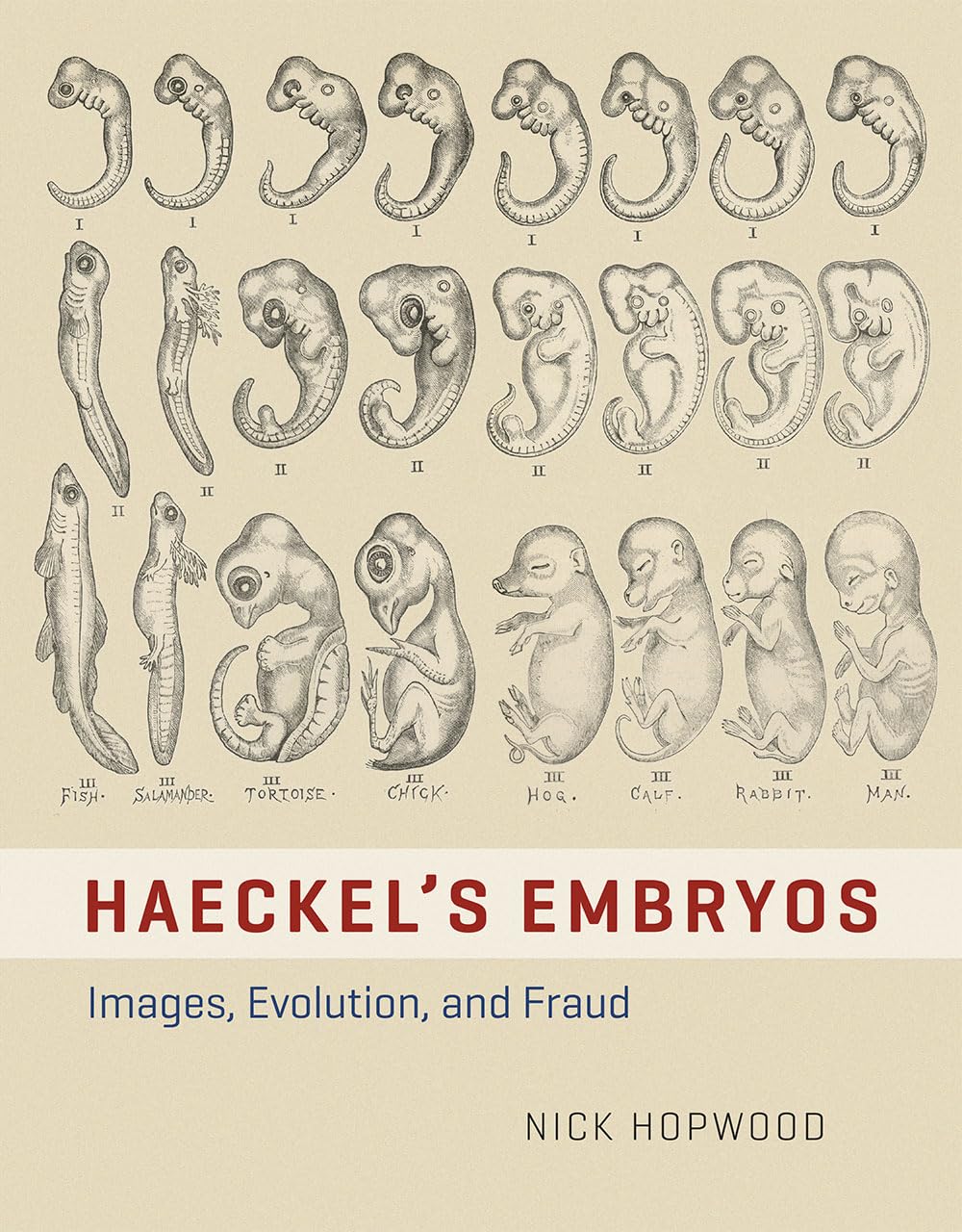



Pictures from the past powerfully shape current views of the world. In books, television programs, and websites, new images appear alongside others that have survived from decades ago. Among the most famous are drawings of embryos by the Darwinist Ernst Haeckel in which humans and other vertebrates begin identical, then diverge toward their adult forms. But these icons of evolution are notorious, too: soon after their publication in 1868, a colleague alleged fraud, and Haeckel’s many enemies have repeated the charge ever since. His embryos nevertheless became a textbook staple until, in 1997, a biologist accused him again, and creationist advocates of intelligent design forced his figures out. How could the most controversial pictures in the history of science have become some of the most widely seen? In Haeckel’s Embryos , Nick Hopwood tells this extraordinary story in full for the first time. He tracks the drawings and the charges against them from their genesis in the nineteenth century to their continuing involvement in innovation in the present day, and from Germany to Britain and the United States. Emphasizing the changes worked by circulation and copying, interpretation and debate, Hopwood uses the case to explore how pictures succeed and fail, gain acceptance and spark controversy. Along the way, he reveals how embryonic development was made a process that we can see, compare, and discuss, and how copying―usually dismissed as unoriginal―can be creative, contested, and consequential. With a wealth of expertly contextualized illustrations, Haeckel’s Embryos recaptures the shocking novelty of pictures that enthralled schoolchildren and outraged priests, and highlights the remarkable ways these images kept on shaping knowledge as they aged. "Hopwood’s book is a richly illustrated and staggeringly detailed story of how Haeckel’s embryo pictures came to be, how they were mobilised as resources in scientific and ideological causes, how versions of the grid picture were copied, recopied and modified, how their accuracy was vigorously disputed by some and defended by others, and how they continue to circulate—still relevant and still contentious—today....There is no more focused account of the subtle and complex relationships between scientific images and what they represent." ― London Review of Books "Rarely have images proved so incendiary as the embryo drawings of nineteenth-century experimental zoologist Ernst Haeckel. In this lavishly illustrated volume, Hopwood traces the chequered history of the sketches, which showed similarities between embryos of higher and lower vertebrates, including humans, at particular points in their development. Haeckel intended the images as support for Charles Darwin's evolutionary theory, but under attack revealed that they were schematics. Hopwood meticulously charts how, despite the controversy, the drawings took on a life of their own." ― Nature "Sumptuous. . . . Hopwood's excellent, thought-provoking book makes us ponder how these erroneous illustrations acquired their iconic status, and, above all, it shines a spotlight on the power of drawings to influence our thinking." ― New Scientist "Hopwood raises important questions (particularly pertinent to the modern era of viral memes) about the teaching of empirical science and the bringing of complex scientific ideas to the public, the 'boundary of popular literature and specialist work,' the relationship between the observer as accurate reporter and as artist, and the line beyond which schematization for didactic or rhetorical effect becomes deliberately misleading." ― Publishers Weekly " Haeckel's Embryos is a magnificent scholarly tour de force ...an outstanding piece of work and a delight to study." ― Medical History "[E]very historian of science dreams of writing a book like Haeckel’s Embryos ...[T]his is not only a book about the history of a classic scientific image, but a book about survival and power of images in science, even today." ― Public Understanding of Science "Detailed, well documented, and rich with illustrations. It is likely to be of most value to those with interests in developmental biology, embryology, the history of attacks on evolution, or the history of scientific publication." ― Library Journal “This book is fun to read, chock-full of exhaustive detail made palatable by entertaining turns of phrase, word pictures, and puns.… I found myself fully engaged and repeatedly chuckling over Hopwood’s wordsmithery. Then, on practically every page, I was forced to loiter and savor the beauty of the historical plates and images. Through it all, I learned so much. Haeckel’s Embryos is a wonderful book.” ― American Biology Teacher " Haeckel’s Embryos is a big book bursting with ideas about visuality, scientific images, evidence, hypotheses, objectivity, and controversy, with striking pictures...on nearly every page. An important contribution to t