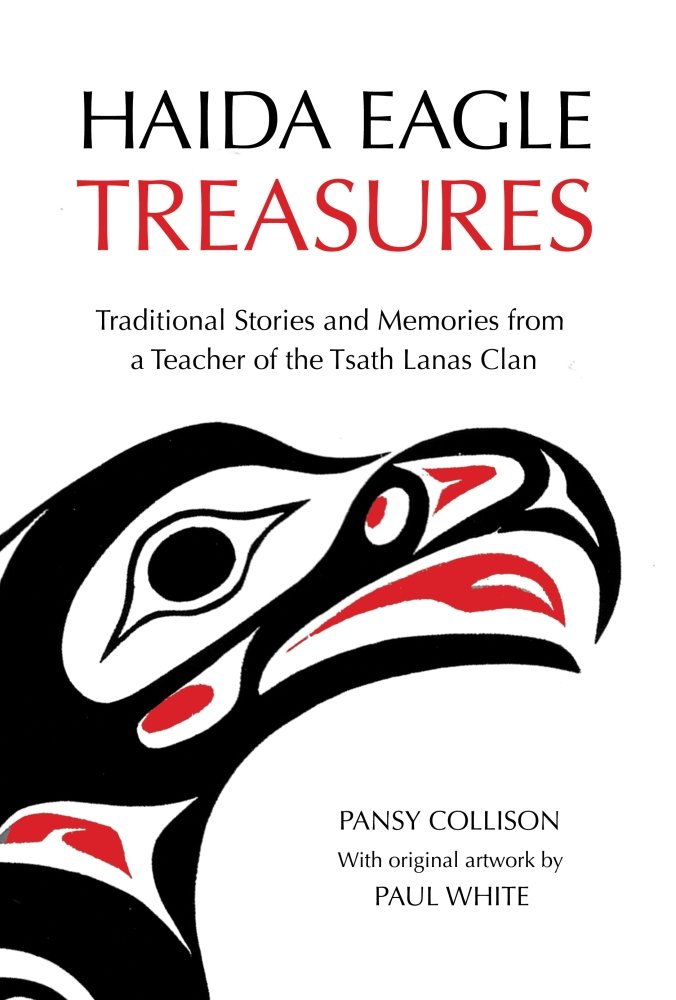
Haida Eagle Treasures: Traditional Stories and Memories from a Teacher of the Tsath Lanas Clan
$24.95
by Pansy Collison



Take a journey into the heart of Haida culture as it is lived and experienced by an extraordinary woman of the Tsath Lanas Eagle Clan. Pansy Collison, a Haida woman born and raised in Old Massett on Haida Gwaii, tells stories of her clan and community, as well as personal narratives about her history and family. Haida Eagle Treasures embodies a strong Haida woman’s voice, offering a rare glimpse inside Haida culture. Each story and memory is a treasure that captures part of the beauty of the Haida worldview and way of life. Now retired, Pansy taught for 23 years at elementary, secondary, and college levels. From these experiences, she describes some of the challenges and contradictions of living between two worlds. Pansy’s teaching skills, artistic talents, and political affiliations keep her involved in politics and education on Haida Gwaii. Thirteen original illustrations by Pansy’s brother, Paul White, a gifted artist, teacher, pole carver and designer, provide the guideposts within Haida Eagle Treasures . Pansy Collison is a Haida woman born and raised in Old Massett, BC. As a teacher, singer, and storyteller, she shares her extensive knowledge of Haida traditions and culture with the younger generations. Pansy is active in band politics, having spent 12 years as a council member and four years as the Deputy Chief Councillor for the Old Massett Band. Now residing in Prince Rupert, Pansy teaches at an elementary school also leads adult workshops in the art of drums, weaving, and traditional regalia. Introduction: Celebrating Haida Culture through Storytelling The greatest gift a person can have is to know their identity and their culture. Who are you? Where do you come from? When you know your own history, culture, stories, crests, names, and songs, you are proud of who you are. When you know who you are, you have respect for yourself. You will have a positive attitude towards life and towards other people. You will have empowerment and ambition to pursue your goals. These accomplishments build your self-esteem. I am a Haida woman. I know who I am. I know where I come from. I am proud of my culture and heritage. Born and raised in the beautiful mystical Islands of Haida Gwaii, this is my home where my family and I grew up. This is where my husband and I go to dig razor clams, and where my children and I go to swoop for crabs with our nets on the exquisite sandy beaches at Tow Hill. This is where my sister Adeline Penna and I go beach combing along the shores collecting gorgeous colorful agates, picking abalone and clams after a big North windstorm. I remember the exciting and challenging times when my sister Rose Bell and I travelled up to the Yakoun River to set up our nets across the river to catch our own sockeye, and this is where Rose and I courageously went out hunting for deer along the roads at Juskatla. I was taught all my life to listen and learn from our Elders. We were brought up in a gentle, but disciplined manner and we were taught at a young age how to work, maintain our integrity, and learn our culture. Children were encouraged to assume responsibility early in life and to work with and learn from adults. In a society in which individual experience was particularly valued, elders were expected to pass their knowledge on to younger people, both orally and by demonstration (Cruikshank, 1995, p. 10). These Islands are our ancient home where our great powerful ancestors have lived since time immemorial. The Haida have lived on Haida Gwaii (formerly known as Queen Charlotte Islands) for the last nine millennia, according to the curator of Canada’s National Museum (Johnson, 1987). Our Elders always tell us that we have lived here from the beginning of time. This book is a personal account of Haida history and culture that blends my personal voice with the Elder’s voices, especially my mother’s and grandmother’s. My book is the first of its kind to be told and written by a Haida woman. Frederick White, Ph.D., a tall, good-looking, intelligent Haida, also wrote a book called Ancestral Language Acquisition among Native Americans: A study of a Haida Language Class , published in 2008. Dr. White teaches composition, linguistics, and literature in the English department at Slippery Rock University, Pennsylvania. His research interests are vast, but he also has a major focus on linguistic and literacy fields, including Native American and First Nations cultural issues such as history, identity, Haida language revitalization, oral literature, education, and contact narratives. Dr. White is from the Tsath Lanas Eagle Clan. His mother’s name is Margaret Bernhard. His grandfather’s name is Clement White. Clement and my dad, Paul White, are brothers. Dr. White travels all over Canada and United States sharing his knowledge in education and First Nations culture to professional teachers at workshops and as a keynote speaker in education conferences. As teachers, Frederick and I are role models for th