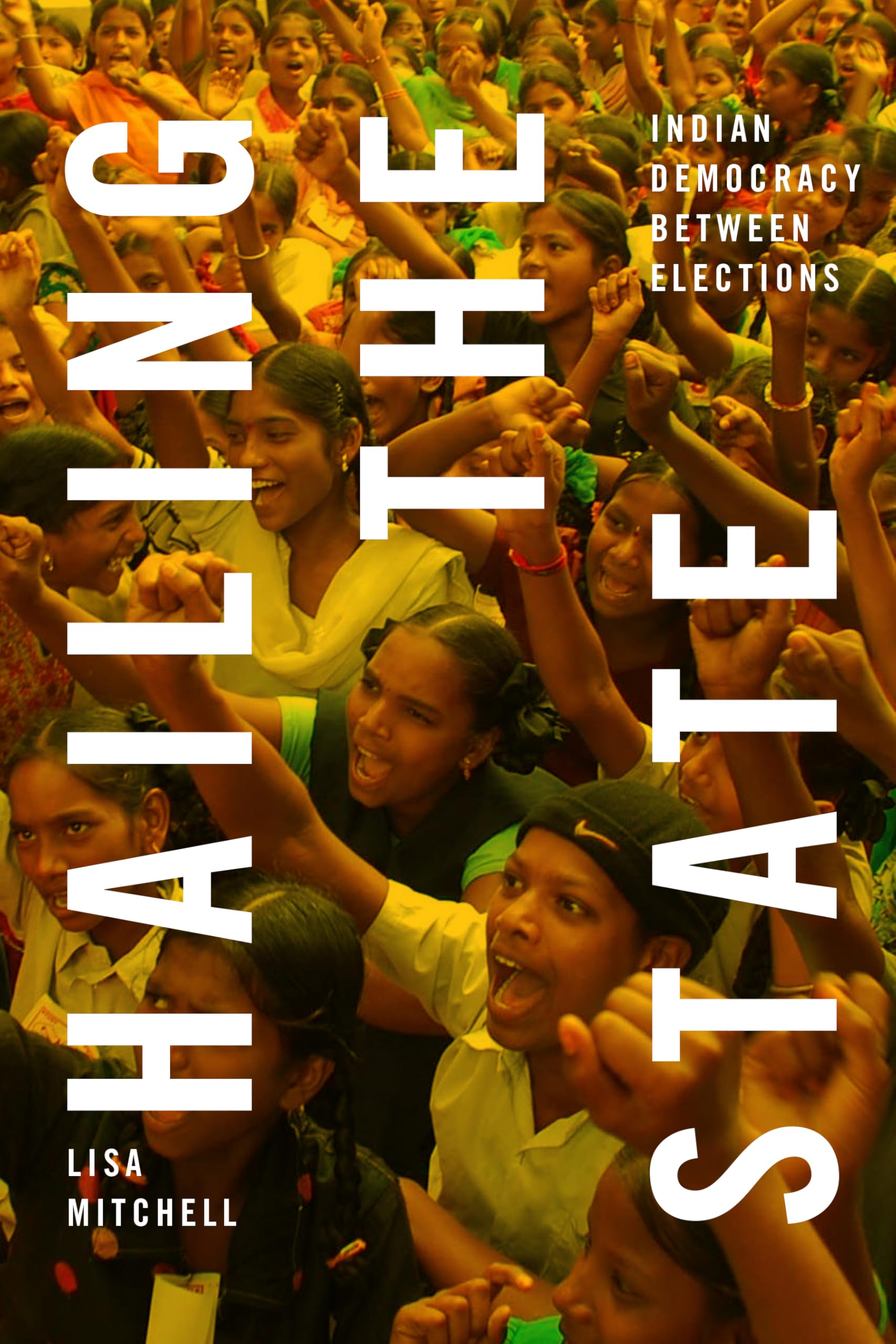



In Hailing the State , Lisa Mitchell explores the methods of collective assembly that people in India use to hold elected officials and government administrators accountable, demand inclusion in decision making, and stage informal referendums. Mitchell traces the colonial and postcolonial lineages of collective forms of assembly, in which—rather than rejecting state authority—participants mobilize with expectations that officials will uphold the law and fulfill electoral promises. She shows how assembly, which ranges from sit-ins, hunger strikes, and demands for meetings with officials to massive general strikes and road and rail blockades, is fundamental to the functioning of democracy in India. These techniques are particularly useful for historically marginalized groups and others whose voices may not be easily heard. Moving beyond an exclusive focus on electoral processes, Mitchell argues that to understand democracy—both in India and beyond—we must also pay attention to what occurs between elections, thereby revising understanding of what is possible for democratic action around the world. "In redefining democratic practice to include collective assembly, Mitchell weaves an intricate picture of how people understand themselves as democratic citizens. Deftly combining approaches from anthropology, history, and political theory, she brings alive the mosaic of actions that they employ in what she terms “hailing the state.” She draws on very rich archival and ethnographic material to tell us the ways in which people have and continue to hail the state." -- Lipika Kamra ― Review of Politics “Mitchell weaves an intricate picture of how people understand themselves as democratic citizens. Deftly combining approaches from anthropology, history, and political theory, she brings alive the mosaic of actions that they employ in what she terms ‘hailing the state.’” -- Lipika Kamra ― Review of Politics "A critical intervention in socio-political thought." -- Chinmaya Lal Thakur ― Contemporary South Asia “Michell’s book is historically rich, ethnographically grounded, and theoretically innovative. Her intervention is at once timely and cautionary for Indian democracy, as it highlights and situates the stakes of political recognizability for marginalized populations. Readers interested in political anthropology and history and subaltern and South Asian studies will no doubt find this book insightful.” -- Roderick Wijunamai ― Exertions "Peppered with many arresting photographs of protests and political posters, the book allows one to feel the energy and almost hear the loud chants of the demonstrators as they go about “hailing the state.” Although the book’s empirical data come primarily from Telangana, Andhra Pradesh, Tamil Nadu, Delhi, and parts of Uttar Pradesh, its analyses and findings are relevant for all of India and indeed beyond." -- Zaheer Baber ― American Ethnologist "In this lucidly written book, Mitchell offers a novel approach to reading collective actions as interpellating the state, particularly with her descriptions of the intimacies of embodied democratic acts. . . . Hailing the State offers compelling insights into democratic theory and practice and would be particularly useful for scholars of postcolonial theory, performance and politics, and the Global South." -- Rashi Mishra ― Performance Research “By being attentive to and stressing the various forms of hailing the state, Lisa Mitchell has produced a richly textured and theoretically nuanced study of how democracy is practiced in those long stretches between elections, the stretches that are arguably the most important aspect of how ordinary people participate. Conceiving of democracy in terms of its everyday practices and what it means for nonelites, Mitchell makes a distinctive and important contribution to a materialist political theory of democracy.” -- Ajay Skaria, author of ― Unconditional Equality: Gandhi’s Religion of Resistance Lisa Mitchell is Professor of History and Anthropology in the Department of South Asia Studies at the University of Pennsylvania and author of Language, Emotion, and Politics in South India: The Making of a Mother Tongue .