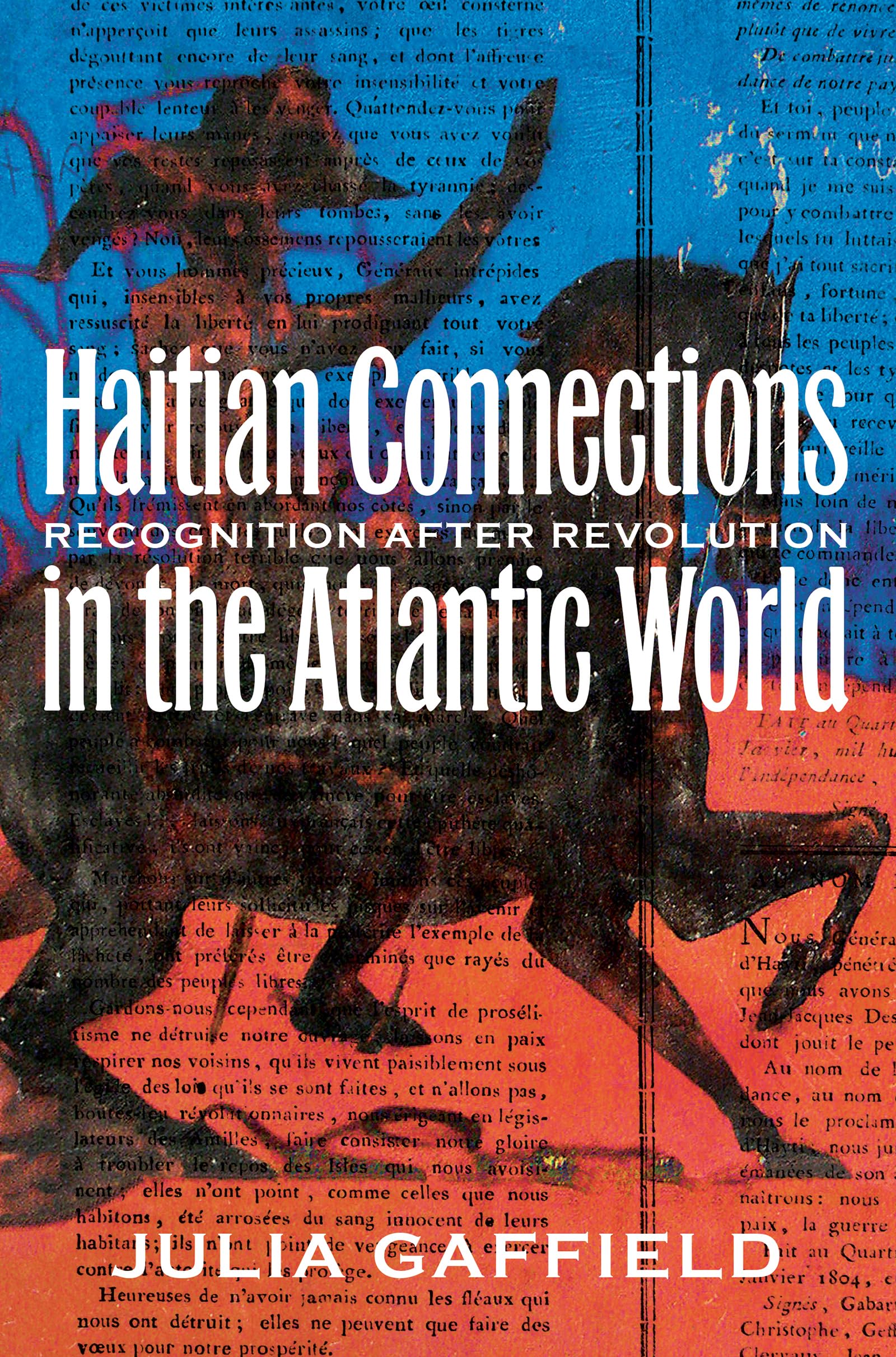
Haitian Connections in the Atlantic World: Recognition after Revolution
$34.75
by Julia Gaffield



On January 1, 1804, Haiti shocked the world by declaring independence. Historians have long portrayed Haiti’s postrevolutionary period as one during which the international community rejected Haiti’s Declaration of Independence and adopted a policy of isolation designed to contain the impact of the world’s only successful slave revolution. Julia Gaffield, however, anchors a fresh vision of Haiti’s first tentative years of independence to its relationships with other nations and empires and reveals the surprising limits of the country’s supposed isolation. Gaffield frames Haitian independence as both a practical and an intellectual challenge to powerful ideologies of racial hierarchy and slavery, national sovereignty, and trade practice. Yet that very independence offered a new arena in which imperial powers competed for advantages with respect to military strategy, economic expansion, and international law. In dealing with such concerns, foreign governments, merchants, abolitionists, and others provided openings that were seized by early Haitian leaders who were eager to negotiate new economic and political relationships. Although full political acceptance was slow to come, economic recognition was extended by degrees to Haiti — and this had diplomatic implications. Gaffield’s account of Haitian history highlights how this layered recognition sustained Haitian independence. “This thoughtful book revises understanding of Haiti’s supposed post-revolutionary isolation. . . .Highly recommended.” — R.I. Rotberg, Harvard University, CHOICE “Sets out a new approach to thinking about Haiti’s attempts to integrate itself into the family of nations.” — Journal of Global Slavery “Julia Gaffield has undertaken a significant research project. . . . Based on this impressive research, she makes considerable headway in unraveling the complex story about the international relations of Haiti after its revolution.” — Hispanic American Historical Review “Show[s] vividly how Haitian sovereignty was negotiated and contested on the international stage. . . . Provide[s] a model for the growing number of scholars engaged in writing the history of sovereignty in the revolutionary era.” — Nathan Perl-Rosenthal, University of Southern California, William and Mary Quarterly “A pioneering work in the new scholarship on Haitian revolutionary studies.” — American Historical Review “Opens up exciting avenues for rethinking the interconnections between maritime circulation, state formation and diplomacy.” — The International Journal of Maritime History “Unravel[s] the vibrant history of Haiti’s incipient political, diplomatic and commercial connections with the Atlantic world. . . . Offers an impressive reconstruction of Haiti’s relationship with the lager Atlantic.” — Journal of Latin American Studies “[Gaffield’s] subtlety in tracing foreign relations and her ability to connect Haiti with multiple territories will appeal to scholars and students outside the specialized fields of Haitian and Caribbean history.” — H-Diplo “Offers a fresh look at Haiti after independence. . . . [and] challenges a long-held understanding that France was successful in keeping Haiti outside the community of nations both economically and politically.” — Journal of Haitian Studies “Timely and compelling, Haitian Connections in the Atlantic World is on the leading edge of a new wave of Haitian Revolution scholarship. Eschewing platitudes about Haiti’s enforced isolation after the revolution, Gaffield traces the complex history — and legacies — of an Atlantic World variably confronting, evading, ignoring, and interacting with the new Haitian state.” — Ada Ferrer, New York University “Timely and compelling, Haitian Connections in the Atlantic World is on the leading edge of a new wave of Haitian Revolution scholarship. Eschewing platitudes about Haiti’s enforced isolation after the revolution, Gaffield traces the complex history — and legacies — of an Atlantic World variably confronting, evading, ignoring, and interacting with the new Haitian state.” — Ada Ferrer, New York University The layered recognition of newly independent Haiti Julia Gaffield is assistant professor of history at Georgia State University.