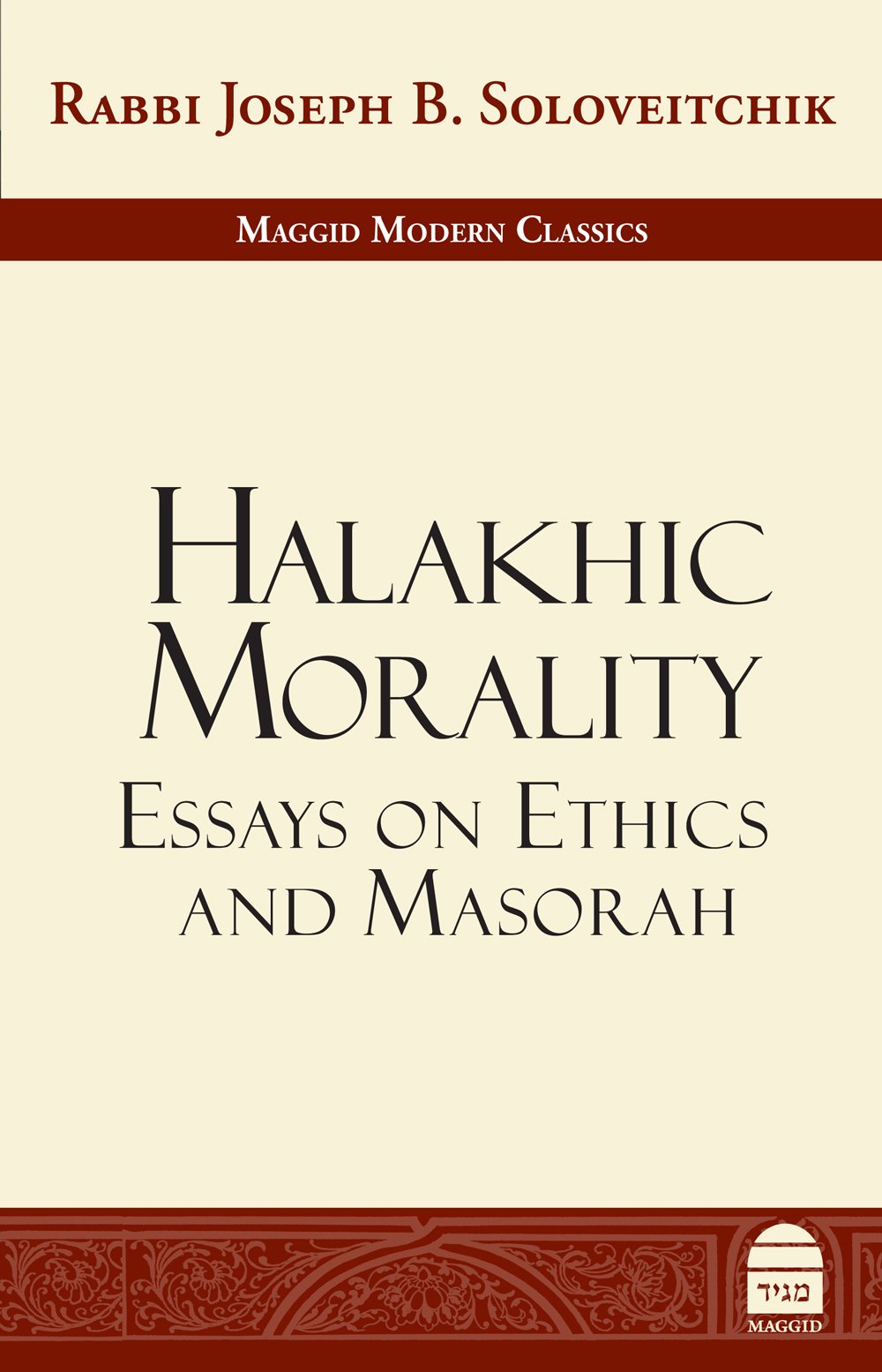
Halakhic Morality: Essays on Ethics and Masorah (Maggid Modern Classics)
$24.95
by Rabbi Soloveitchik, Joseph B



Nowadays a basic investigation of morality and ethos would be of great importance. There is a crying need for clarification of many practical problems, both in the individual-private and in the social-ethical realms. There are too many uncertainties in which we live today, uncertainties about what we ought to do. We should try to infer from our ethical tradition certain standards that should govern our conduct. In particular, I notice confusion among rabbis as regards basic problems whose solution cannot be found in the Shulhan Arukh and must rather be inferred by way of deduction from ancient principles and axioms.He approaches this task through an in-depth examination of the beginning of Pirkei Avot, raising topics such as: the sources of ethics, power and persuasion, elitism and democracy, educational philosophy, study and action, freedom and coercion, and more. These follow essays on a variety of related themes, including charity and fellowship, law and ethics, styles of religious observance, and the centrality of humility in Jewish life. Maggid Books is honored to bring these hitherto unpublished essays to a long-awaiting public. Rabbi Joseph B. Soloveitchik (1903-1993) was not only one of the outstanding talmudists of the twentieth century, but also one of its most creative and seminal Jewish thinkers. Drawing from a vast reservoir of Jewish and general knowledge, “the Rav,” as he is widely known, brought Jewish thought and law to bear on the interpretation and assessment of the modern experience. For over four decades, Rabbi Soloveitchik commuted weekly from his home in Boston to New York in order to give the senior shiur (class in Talmud) at Yeshiva University’s affiliated Rabbi Isaac Elchanan Theological Seminary (RIETS), where he taught and inspired generations of students, among them many of the future leaders of all areas of Jewish communal life. Renowned for his broad knowledge and creative conceptualization of Jewish law, he was regarded as the leading intellectual figure in the effort to build bridges between Orthodox Judaism and the modern world. By his extensive teaching and personal influence, he contributed vitally to the dynamic resurgence of Orthodox Judaism in America.