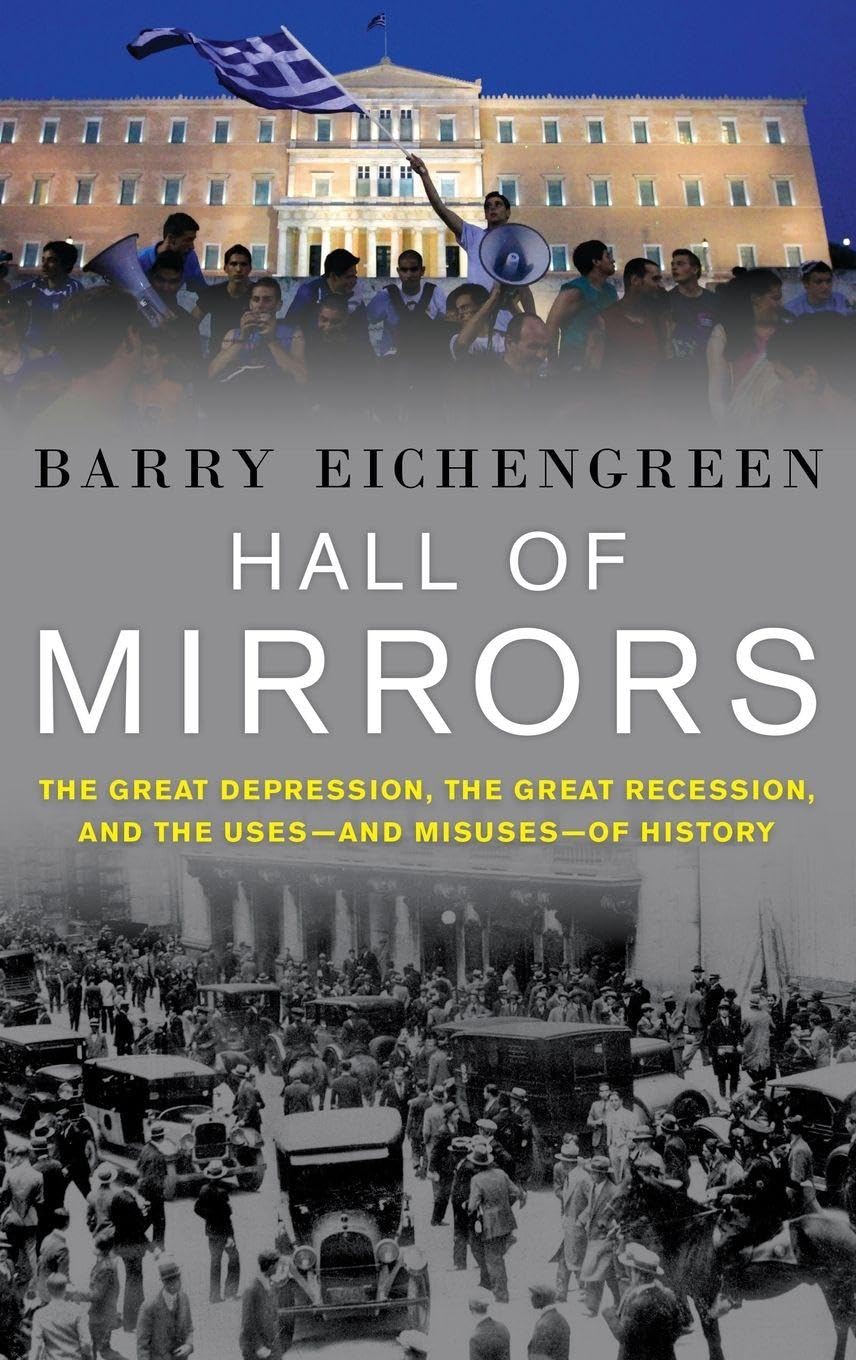
Hall of Mirrors: The Great Depression, the Great Recession, and the Uses-and Misuses-of History
$15.35
by Barry Eichengreen



The two great financial crises of the past century are the Great Depression of the 1930s and the Great Recession, which began in 2008. Both occurred against the backdrop of sharp credit booms, dubious banking practices, and a fragile and unstable global financial system. When markets went into cardiac arrest in 2008, policymakers invoked the lessons of the Great Depression in attempting to avert the worst. While their response prevented a financial collapse and catastrophic depression like that of the 1930s, unemployment in the U.S. and Europe still rose to excruciating high levels. Pain and suffering were widespread. The question, given this, is why didn't policymakers do better? Hall of Mirrors , Barry Eichengreen's monumental twinned history of the two crises, provides the farthest-reaching answer to this question to date. Alternating back and forth between the two crises and between North America and Europe, Eichengreen shows how fear of another Depression following the collapse of Lehman Brothers shaped policy responses on both continents, with both positive and negative results. Since bank failures were a prominent feature of the Great Depression, policymakers moved quickly to strengthen troubled banks. But because derivatives markets were not important in the 1930s, they missed problems in the so-called shadow banking system. Having done too little to support spending in the 1930s, governments also ramped up public spending this time around. But the response was indiscriminate and quickly came back to haunt overly indebted governments, particularly in Southern Europe. Moreover, because politicians overpromised, and because their measures failed to stave off a major recession, a backlash quickly developed against activist governments and central banks. Policymakers then prematurely succumbed to the temptation to return to normal policies before normal conditions had returned. The result has been a grindingly slow recovery in the United States and endless recession in Europe. Hall of Mirrors is both a major work of economic history and an essential exploration of how we avoided making only some of the same mistakes twice. It shows not just how the "lessons" of Great Depression history continue to shape society's response to contemporary economic problems, but also how the experience of the Great Recession will permanently change how we think about the Great Depression. "This is undoubtedly one of the best books on the history of economic policy-making to be published in the last half century... clear, compelling account of the Great Depression and the Great Recession." -- Professor Brad Bratley Bateman (Randolph College), HETP Vol.2 "This important book and the ideas behind it are already entering the public policy sphere at the highest level."-- 2016 Alice Jones Prize Award Presentation "Barry Eichengreen's Hall of Mirrors: The Great Depression, the Great Recession, and the Uses - and Misuses - of History stands in contrast to contemporary mainstream economics by pointing out how much we can learn from history when attempting to understand the contemporary economic world."-- Mediterranean Studies "The Great Depression was the signal economic event of the 20th century and, we hope, the Great Recession will be the signal event of the 21st. Few people on earth can draw out the similarities and differences as well as Barry Eichengreen, who paints with equal facility in broad strokes and in fascinating detail. Reading Hall of Mirrors is a joy. Keeping it on your bookshelf for future reference is a necessity."--Alan Blinder, author of After the Music Stopped "Historical analogies come cheap, but historical insight relevant to today is both rare and valuable. Barry Eichengreen's Hall of Mirrors is packed with the essential insights that give the reader understanding of the macro policy mistakes of the 1930s and the 2000s, both why they occurred and how devastating they were. A must-read." --Adam S. Posen, President, Peterson Institute for International Economics "Much of modern economics has ignored the study of economic history. Barry Eichengreen's Hall of Mirrors shows why that is a huge mistake. Combining fascinating narrative detail with cogent analysis of the relevant theory, it illuminates crucial parallels and differences between the causes of and policy response to the Great Depression and the Great Recession. It illustrates how good historical analysis must inform current policy choices, but also how superficial historic analogy can lead us astray. It carries powerful implications for the policies still needed to drive continued recovery from the Great Recession, and to stop us repeating in future the mistakes which led to disaster in the past." --Adair Turner, Senior Fellow, Institute for New Economic Thinking "Eichengreen the economist joined forces with Eichengreen the historian to produce a truly unique book that revisits the past in the light of current discussions and exa