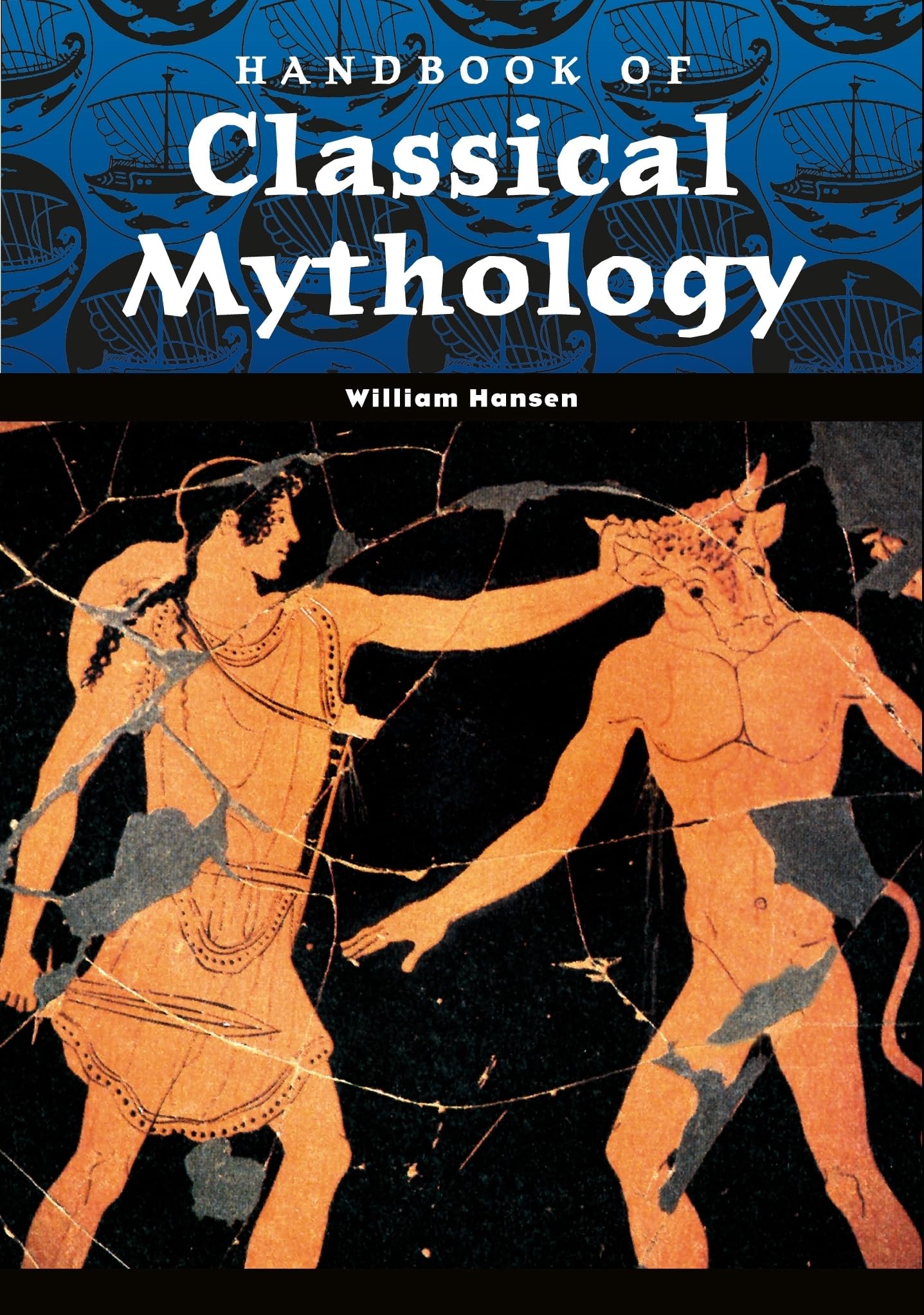



An introduction to the mythological world of the Greeks and the Romans, combined with a chronology of myths and a dictionary of key characters, objects, and events. Handbook of Classical Mythology offers newcomers and long-time enthusiasts new ways to navigate the world of Greek and Roman myths. Written by a foremost mythologist, the book begins by exploring the sources and landscapes from which the myths emerged. It then provides a richly detailed timeline of mythic episodes from the creation of the cosmos to the end of the Heroic Age― plus an illustrated mythological dictionary listing every significant character, place, event, and object. Whether exploring the world that gave rise to ancient mythology or researching a specific piece of the whole, the handbook is the best introduction available to the extraordinary cast of these tales (gods, nymphs, satyrs, monsters, heroes) and the natural and supernatural stages upon which their fates are played out. Grade 10 Up–This excellent addition to a series exploring regional mythologies is also a stand-alone success. A substantial introduction explains the origins, geography, and narrative strategies of classical myths. A slightly shorter essay discusses time in the myths and provides an organized account of the development of the world from creation through the heroic age. Nearly 100 entries on "Deities, Themes, and Concepts" include topics such as "Hubris," "Romantic Narratives," "Succession Myth," and "Combat Myth and Legend." An annotated bibliography, glossary, and index (essential since specific myths may lurk in a concept entry) increase the book's usefulness. Hansen does not cover cultic aspects as comprehensively as Simon Price and Emily Kearns's Oxford Dictionary of Classical Myth & Religion (2003); nevertheless, there is a lot of overlap with that volume and with Mike Dixon-Kennedy's Encyclopedia of Greco-Roman Mythology (ABC-CLIO, 1998). Many well-chosen line and halftone illustrations from antique art add interest. The book's non-columnar format is a bit daunting, despite the writer's clear prose and narrative skill, and the generous typeface. Serious students of classics or mythology will value this informative volume. –Patricia D. Lothrop, St. George's School, Newport, RI Copyright © Reed Business Information, a division of Reed Elsevier Inc. All rights reserved. In this title in the publisher's Handbooks of World Mythology series, classical refers to Greek and Roman civilizations (a slightly Eurocentric perspective). The author is a university professor of classical studies and folklore and has written other books on the topic. He cites about five pages of books and articles and provides a list of "Annotated Print and Nonprint Resources." The first third of the volume is an extensive essay on basic concepts and "chronology" of the myth stories, concluding with general Greek and Roman notions about the nature of the world and its mythological characters. The author also discusses how classical Greeks and Romans regarded mythology: some literally, some allegorically, and some as fantasy. The majority of the volume consists of individual entries on deities, themes, and concepts. Deities, the main emphasis, are inconsistently listed under Greek or Roman nomenclature (e.g., Greek Apollon, Roman Satyrs ). Entries range from a page (e.g., Titans, Nectar ) to nine pages (e.g., Divine guilds ); most entries are two to three pages in length. Each entry starts with a definition and then provides a narrative description of the main associated stories, citing the source of information. About a quarter of the entries include black-and-white drawings that appear to be based on ancient artworks. Cross-references and suggested readings end each entry. In addition to the lists of references and resources, the reader will find a four-page glossary of terms that are used throughout the text. The detailed index includes various aspects of the deities; for instance, under Athena are references to her birth, judgment, craftsmanship, transformation, and relationship with other characters. This volume combines a traditional reference tool and a textbook. Although it does not appear to break new ground, it is a convenient way to package information about Greek and Roman mythology, particularly as part of a mythology series. Recommended for libraries that serve the apparent audience of college-bound high-schoolers and university students. Lesley Farmer Copyright © American Library Association. All rights reserved “Instead of creating another dry dictionary, the author succeeds in bringing these myths to life in their original mythical context and provides a tool that the student of Classics can begin with, and continue to use over time.” ― Bryn Mawr Classical Review “This volume combines a traditional reference tool and a textbook. . . . it is a convenient way to package information about Greek and Roman mythology, particularly as part of a mytho