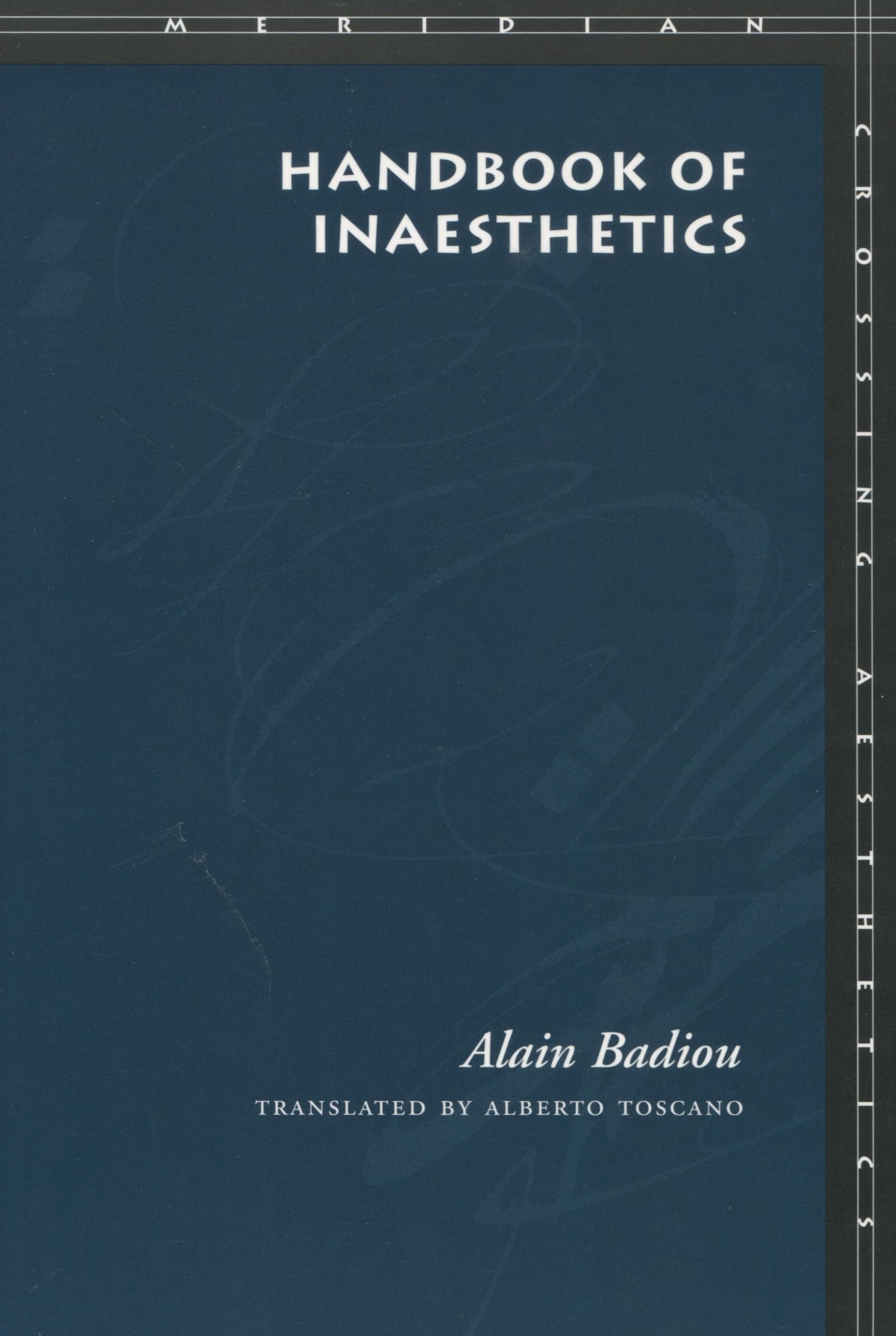



Didacticism, romanticism, and classicism are the possible schemata for the knotting of art and philosophy, the third term in this knot being the education of subjects, youth in particular. What characterizes the century that has just come to a close is that, while it underwent the saturation of these three schemata, it failed to introduce a new one. Today, this predicament tends to produce a kind of unknotting of terms, a desperate dis-relation between art and philosophy, together with the pure and simple collapse of what circulated between them: the theme of education. Whence the thesis of which this book is nothing but a series of variations: faced with such a situation of saturation and closure, we must attempt to propose a new schema, a fourth type of knot between philosophy and art. Among these “inaesthetic” variations, the reader will encounter a sustained debate with contemporary philosophical uses of the poem, bold articulations of the specificity and prospects of theater, cinema, and dance, along with subtle and provocative readings of Fernando Pessoa, Stéphane Mallarmé, and Samuel Beckett. Didacticism, romanticism, and classicism are the possible schemata for the knotting of art and philosophy, the third term in this knot being the education of subjects, youth in particular. What characterizes the century that has just come to a close is that, while it underwent the saturation of these three schemata, it failed to introduce a new one. Today, this predicament tends to produce a kind of unknotting of terms, a desperate dis-relation between art and philosophy, together with the pure and simple collapse of what circulated between them: the theme of education. Whence the thesis of which this book is nothing but a series of variations: faced with such a situation of saturation and closure, we must attempt to propose a new schema, a fourth type of knot between philosophy and art. Among these “inaesthetic” variations, the reader will encounter a sustained debate with contemporary philosophical uses of the poem, bold articulations of the specificity and prospects of theater, cinema, and dance, along with subtle and provocative readings of Fernando Pessoa, Stéphane Mallarmé, and Samuel Beckett. Didacticism, romanticism, and classicism are the possible schemata for the knotting of art and philosophy, the third term in this knot being the education of subjects, youth in particular. What characterizes the century that has just come to a close is that, while it underwent the saturation of these three schemata, it failed to introduce a new one. Today, this predicament tends to produce a kind of unknotting of terms, a desperate dis-relation between art and philosophy, together with the pure and simple collapse of what circulated between them: the theme of education. Whence the thesis of which this book is nothing but a series of variations: faced with such a situation of saturation and closure, we must attempt to propose a new schema, a fourth type of knot between philosophy and art. Among these “inaesthetic” variations, the reader will encounter a sustained debate with contemporary philosophical uses of the poem, bold articulations of the specificity and prospects of theater, cinema, and dance, along with subtle and provocative readings of Fernando Pessoa, Stéphane Mallarmé, and Samuel Beckett. Alain Badiou holds the Chair of Philosophy at the École Normale Supériere in Paris. Many of his books have been translated into English, including Saint Paul: The Foundation of Universalism (Stanford, 2003), Manifesto for Philosophy (1999), and Deleuze: The Clamor of Being (1999). HANDBOOK OF INAESTHETICS By Alain Badiou Stanford University Press Copyright © 2005 Board of Trustees of the Leland Stanford Junior University All right reserved. ISBN: 978-0-8047-4408-9 Contents Translator's Note.....................................................................................ix§ 1 Art and Philosophy...........................................................................1§ 2 What is a Poem?, Or, Philosophy and Poetry at the Point of the Unnamable.....................16§ 3 A French Philosopher Responds to a Polish Poet...............................................28§ 4 A Philosophical Task: To Be Contemporaries of Pessoa.........................................36§ 5 A Poetic Dialectic: Labîd ben Rabi'a and Mallarmé..................................46§ 6 Dance as a Metaphor for Thought..............................................................57§ 7 Theses on Theater............................................................................72§ 8 The False Movements of Cinema................................................................78§ 9 Being, Existence, Thought: Prose and Concept.................................................89§ 10 Philosophy of the Faun......................................................................122Source Materials.............................................