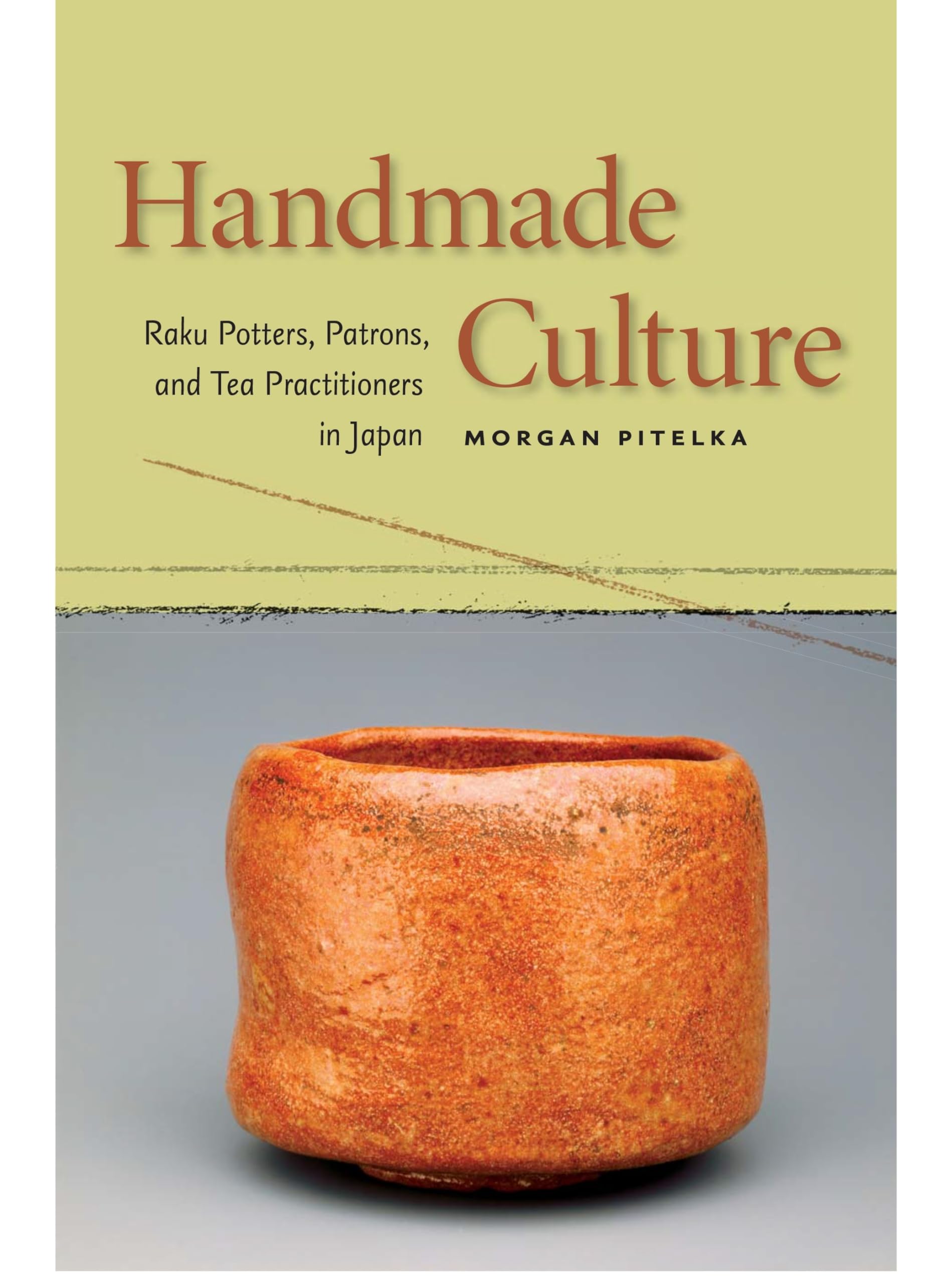
Handmade Culture: Raku Potters, Patrons, and Tea Practitioners in Japan
$31.00
by Morgan Pitelka



Handmade Culture is the first comprehensive and cohesive study in any language to examine Raku, one of Japan’s most famous arts and a pottery technique practiced around the world. More than a history of ceramics, this innovative work considers four centuries of cultural invention and reinvention during times of both political stasis and socioeconomic upheaval. It combines scholarly erudition with an accessible story through its lively and lucid prose and its generous illustrations. The author’s own experiences as the son of a professional potter and a historian inform his unique interdisciplinary approach, manifested particularly in his sensitivity to both technical ceramic issues and theoretical historical concerns. Handmade Culture makes ample use of archaeological evidence, heirloom ceramics, tea diaries, letters, woodblock prints, and gazetteers and other publications to narrate the compelling history of Raku, a fresh approach that sheds light not only on an important traditional art from Japan, but on the study of cultural history itself. Far broader in scope than simply a book about Raku ceramics, Pitelka’s work adeptly challenges accepted notions about nearly every aspect of Raku’s history, making a major contribution to the emerging scholarly paradigm for investigating Japanese craft traditions. . . . The importance of Handmade Culture to an international understanding of Japanese culture is clear. ― www.caa.reviews.org A superb study of the Raku house of ceramics. It emphasizes not the Momoyama origins of Raku, but the four hundred plus years of evolution that are, as Pitelka knows, responsible for Raku’s profound presence in Japanese cultural history. . . . [His] book is not a paean to Raku masterpieces, but instead performs the more significant task of identifying and discussing the issues behind this ongoing tradition. As such it defines the field and is essential reading. ― Artibus Asiae [Pitelka’s] book brings insight and clarity to the fundamental questions that lie at the heart of our apprehension of the past. ― Impressions An important, comprehensive, and cohesive study of raku pottery. Pitelka’s book has merit and importance for contemporary understandings based on mythnohistories, the assumptions that shape perceptions and appreciations. Handmade Culture demonstrates the value of deconstructing contexts of material culture through an analysis of institutionalized instruction, connoisseurship, and transmission of a cultural form as chanoyu shifts from a Japanese tradition to invite a global audience. ― Studies in Art Education: A Journal of Issues and Research Pitelka has issued the first challenge to Raku orthodoxy, and his analysis is both responsible and courageous. ― Monumenta Nipponica A meticulously researched yet highly accessible history of Raku. . . . Pitelka offers a new approach to interpreting Japanese ceramic culture, through the productive and social forces at work, and does so with considerable erudition and readability. . . . An exceptional contribution to English-language scholarship on Japanese culture. ― Crafts Morgan Pitelka’s Handmade Culture, an interpretive history of the raku tradition, is both informative and innovative. It begins with the tradition’s local origin in late-sixteenth-century Kyoto, traces its emergence as a distinctive national discourse, and closes with an account of its survival in modern times. Pitelka’s attention to raku’s broader social and economic contexts, inspired by Pierre Bourdieu’s theory of cultural production, offers a new approach to Japanese art history. -- Samuel Yamashita , Pomona College Morgan Pitelka is associate professor of Asian studies at the University of North Carolina at Chapel Hill. Used Book in Good Condition