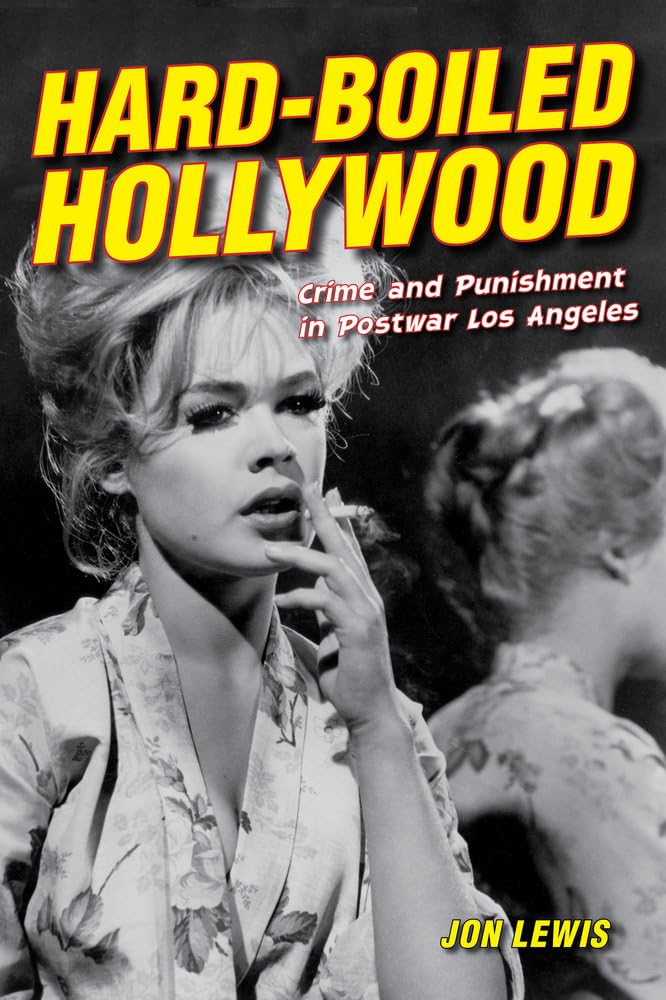



The tragic and mysterious circumstances surrounding the deaths of Elizabeth Short, or the Black Dahlia, and Marilyn Monroe ripped open Hollywood’s glitzy façade, exposing the city's ugly underbelly of corruption, crime, and murder. These two spectacular dead bodies, one found dumped and posed in a vacant lot in January 1947, the other found dead in her home in August 1962, bookend this new history of Hollywood. Short and Monroe are just two of the many left for dead after the collapse of the studio system, Hollywood’s awkward adolescence when the company town’s many competing subcultures—celebrities, moguls, mobsters, gossip mongers, industry wannabes, and desperate transients—came into frequent contact and conflict. Hard-Boiled Hollywood focuses on the lives lost at the crossroads between a dreamed-of Los Angeles and the real thing after the Second World War, where reality was anything but glamorous." "Lewis binds the bleak irony of Hollywood - thecruelty of life lived in the shadow of the dream factory - to a concretesocio-historical moment, and demonstrates why it left so many inhabitantsfeeling, in the words of the actress Sandra Dee, "like a has been who neverwas."( Times Literary Supplement , 2017-08-08) "This book is a fascinating on-location excursion down the mean streets of a metastasizing metropolis and the shuttered backlots of a sputtering studio system, an anthropological thick description of the gangsters, stars, hustlers, hookers, and hangers-on in the lonely place that is Hollywood."&;Thomas Doherty, Professor of American Studies, Brandeis University "Where previously Lewis focused most on top-level power plays and money grabs, he now trenchantly probes Hollywood's underworlds: grifters, gossip-mongers, and gangsters, loners and losers&;bodies 'left by the side of the road.' A fascinating rewriting of Hollywood history, especially around production culture, including cultures of failure and despair." &;Dana Polan, Cinema Studies, New York University "This book is a fascinating on-location excursion down the mean streets of a metastasizing metropolis and the shuttered backlots of a sputtering studio system, an anthropological thick description of the gangsters, stars, hustlers, hookers, and hangers-on in the lonely place that is Hollywood."—Thomas Doherty, Professor of American Studies, Brandeis University "Where previously Lewis focused most on top-level power plays and money grabs, he now trenchantly probes Hollywood's underworlds: grifters, gossip-mongers, and gangsters, loners and losers—bodies 'left by the side of the road.' A fascinating rewriting of Hollywood history, especially around production culture, including cultures of failure and despair." —Dana Polan, Cinema Studies, New York University Jon Lewis is the Distinguished Professor of Film Studies and University Honors College Eminent Professor at Oregon State University. He has published eleven books, including Whom God Wishes to Destroy . . . : Francis Coppola and the New Hollywood and Hollywood v. Hard Core: How the Struggle over Censorship Saved the Modern Film Industry , is past editor of Cinema Journal, and served on the Executive Council of the Society for Cinema and Media Studies. Hard-Boiled Hollywood Crime and Punishment in Postwar Los Angeles By Jon Lewis UNIVERSITY OF CALIFORNIA PRESS Copyright © 2017 The Regents of the University of California All rights reserved. ISBN: 978-0-520-28432-6 Contents Acknowledgments, Introduction, 1. The Real Estate of Crime: The Black Dahlia Dumped by the Side of the Road, 2. Mobsters and Movie Stars: Crime, Punishment, and Hollywood Celebrity, 3. Hollywood Confidential: Crime and Punishment in Postwar Los Angeles, 4. Hollywood's Last Lonely Places: The Sad, Short Stories of Barbara Payton and Marilyn Monroe, Notes, Index, CHAPTER 1 The Real Estate of Crime The Black Dahlia Dumped by the Side of the Road The January 15, 1947, edition of William Randolph Hearst's Los Angeles Examiner ran with the following sensational headline: "Girl Tortured and Slain: Hacked Nude Body Found in L.A. Lot." The crime scene was indeed remarkable, and no photographs were run to accompany the story. Instead the Examiner printed an artist's rendering: a sketch, really. It was a gesture at propriety — though given the headline, propriety seemed even at first gasp beside the point. Absent pictures, an image of the crime scene nonetheless found its way into the city's collective imagination, thanks in part to the Examiner 's ace crime reporter, Will Fowler, who cast the murder scene in colorful, Chandleresque prose, describing a dead young woman "lying there like a discarded marionette." With this news story the body-dump murder entered the paper's lexicon. And there would be reason to use the term again in just a matter of weeks — which is to say, there would be a second body-dump murder to write about by then. By the decade's end, the body-dump murder wo