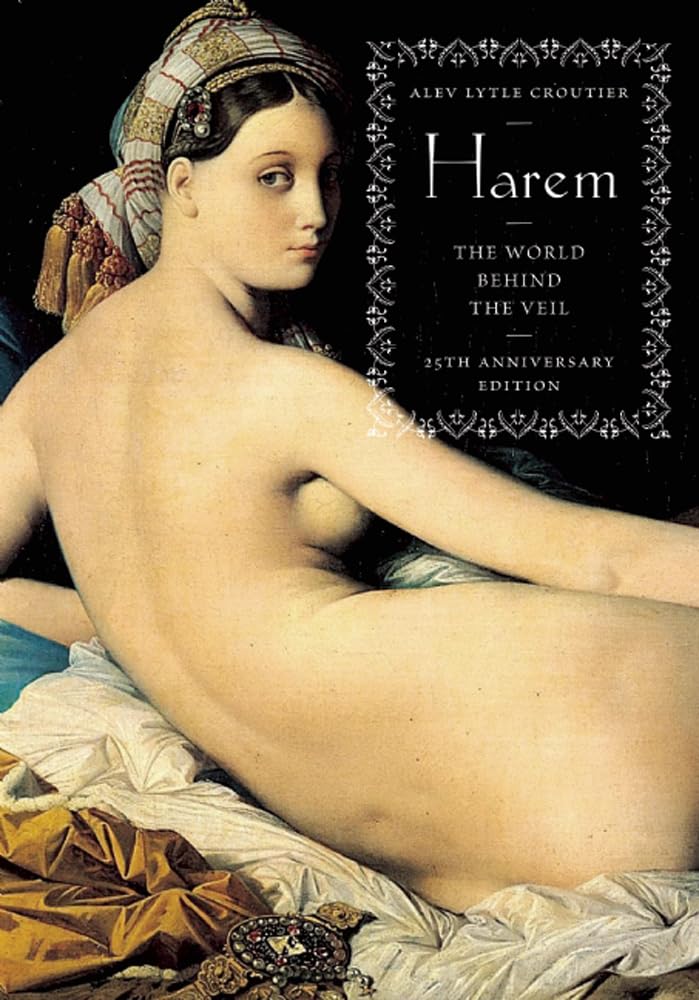



A fascinating illustrated history of one of the strangest, and cruelest, cultural institutions ever devised. A worldwide best seller, translated into twenty-five languages. “I was born in a konak (old house), which once was the harem of a pasha,” writes Alev Lytle Croutier. “People around me often whispered things about harems; my own grandmother and her sister had been brought up in one.” Drawing on a host of firsthand accounts and memoirs, as well as her own family history, Croutier explores life in the world’s harems, from the Middle Ages to the early twentieth century, focusing on the fabled Seraglio of Topkapi Palace as a paradigm for them all. We enter the slave markets and the lavish boudoirs of the sultanas; we witness the daily routines of the odalisques, and of the eunuchs who guarded the harem. Here, too, we learn of the labyrinthine political scheming among the sultan’s wives, his favorites, and the valide sultana ―the sultan’s mother―whose power could eclipse that of the sultan himself. There were the harems of the sultans and the pashas, but there were also “middle-class” harems, the households in which ordinary men and women lived out ordinary―albeit polygamous―lives. Croutier reveals their marital customs, child-rearing practices, and superstitions. Finally, she shows how this Eastern institution invaded the European imagination―in the form of decoration, costume, and art―and how Western ideas, in turn, finally eroded a system that had seemed eternal. Juxtaposing a rich array of illustrations―Western paintings, Turkish and Persian miniatures, family photographs, and even film stills―Croutier demystifies the Western erotic fantasy of “the world behind the veil.” This revised and updated 25th anniversary edition of Harem includes a new introduction by the author, revisiting her subject in light of recent events in Turkey, and the world. "This is a serious history, yet an immensely readable one―informative, gossipy, and grand fun." ― New York Times Book Review "This beautiful book…stimulates the mind as well as the eye." ― Chicago Sun-Times "A book of breathtaking beauty, lavishly illustrated with color plates and written in an ingratiating prose." ― Washington Post "An alluring invitation into the labyrinthine corridors of the Turkish harem." ― San Francisco Chronicle "A delight to the eye but also a poignant statement about the lonely…world of women who lived in virtual slavery." ― Marin Independent Journal Alev Lytle Croutier is the author of Taking the Waters (Abbeville), a history of spas, and three critically acclaimed novels, The Palace of Tears, Seven Houses, and Leyla: The Black Tulip. Born in Turkey, Croutier studied at Oberlin College and founded the publishing company Mercury House. Excerpt from Harem: The World Behind the Veil Preface These flower women, women-flowers, he prefers them to any others, and spends his nights in the hothouses where he hides them as in a harem. Guy de Maupassant, Un Cas de Divorce (1886) I was born in an old house in Izmir, Turkey, which had previously been inhabited by a pasha who had a harem. I grew up listening to stories that could easily have come from One Thousand and One Nights. People often whispered things about harems; my own grandmother and her sister had been brought up in one. Since then, I have come to see that these were not ordinary stories. But for me, as a child, they were, for I had not yet known any others. My paternal grandmother, Zehra, was the first person from whom I heard the word harem and who made allusions to harem life. She was the daughter of a prosperous gunpowder maker in Macedonia. As was not uncommon until the twentieth century, she and her sisters had been brought up in a harem”which really means a separate part of a house where women lived in isolation, having no contact with men other than their blood relatives. The term does not necessarily imply the practice of polygamy. Rarely did they go out; and when they did, they were always heavily veiled. The most poignant image I know is that of silk tunnels being stretched from the door of the house to a carriage, so that the ladies could leave without being seen from the street. The family had already arranged their marriages. None of them saw their husbands until their wedding day. Then they moved to his house, to live together with his mother and other women relativesand occasionally another wife or two. My grandmother married my grandfather when she was fourteen. He was forty and her father's best friend. She was a simple, uneducated girl from Pirlepe. He was a respected scholar from Kavala. Ten years later, she would be widowed. Threatened by the Balkan Wars, my grandparents left everything behind in Macedonia, including their parents, and fled to Anatolia. They sought refuge and settled down in Istanbul in 1906. My grandfather soon died, and my grandmother moved in with one of her sisters for a time. Th