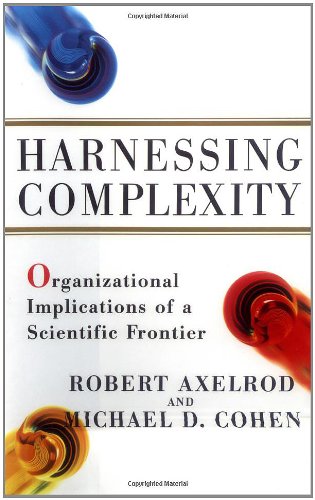
Harnessing Complexity: Organizational Implications of a Scientific Frontier
$37.70
by Robert Axelrod



Recent advances in the study of complexity have given scientists profound new insights into how natural innovation occurs and how its power can be exploited. Now two pioneers in the field, Robert Axelrod and Michael D. Cohen, provide leaders in business and government with a guide to complexity that will help them make effective decisions in a world of rapid change. Building on evolutionary biology, computer science, and social design, Axelrod and Cohen have constructed a unique framework for improving the way people work together. Their approach to management is based on the concept of the Complex Adaptive System, which can describe everything from rain forests to the human gene pool, and from automated software agents to multinational companies. The authors' framework reveals three qualities that all kinds of managers must cultivate in their organization: Variation What is the best way to manage the development of software? Should the problem be broken up into small pieces for programmers working independently, thus enhancing variation, or should there be a centralized hierarchy of programmers ruled by a chain of command? The authors show how the decentralized creation of variation combined with the centralized maintenance of standards was the key to the success of the Linux "open source software" project, which brought together thousands of volunteers in cyberspace to produce an operating system that can outperform Microsoft's. Interaction Why did northern Italy prosper while southern Italy remained poor? Recognizing the internal interactions of a Complex Adaptive System -- be it a national region, a company, or a nonprofit group -- reveals vital networks of trust. Axelrod and Cohen explain that in successful adaptive systems, rich networks of horizontal linkages foster cooperation and provide an advantage over other less cooperatively networked groups. In the case of Italy, voluntary associations created networks of trust in the Middle Ages that became northern Italy's critical advantage over the south. Selection Is a Pulitzer Prize better than a National Book Award? How can foundations and corporations design competitions that have a positive effect on the evolution of excellence? The authors' framework makes clear that the worst selection processes are mired in orthodox standards that have not adapted to a new environment. The best selection processes, on the other hand, are created and run by leaders who understand how the standards they use can transform their organization and its environment. This simple, paradigm-shifting analysis of how people work together will transform the way we think about getting things done in a group. Harnessing Complexity is the essential guide to creating wealth, power, and knowledge in the 21st Management theorists are increasingly turning to complexity science in their search for answers to questions about organizational behavior. Axelrod and Cohen are professors of public policy. Their perspective on complexity is on building effective teams from complex groups of individuals. Axelrod is the author of the groundbreaking The Evolution of Cooperation (1984) and its follow-up, The Complexity of Cooperation (1997). Cohen has served on the external faculty at the Santa Fe Institute, a leading research facility in the field of complexity. Drawing on their research done for a report on national information policy by the Highlands Forum under the aegis of the Department of Defense, the authors offer numerous business, political, and cultural applications for their model of complex adaptive systems. Clarifying the differences between complexity and chaos theories, they trace the principles of complex adaptive systems to evolutionary biology, computer science, and social design; and they outline three key processes of such systems: variation, interaction, and selection. David Rouse Copyright © American Library Association. All rights reserved Hal Varian Dean, School of Information & Management Systems, University of California, Berkeley, and coauthor of Information Rules: A Strategic Guide to the Network Economy You can't control complex systems, but you can influence them. Harnessing Complexity shows how. It is the first book to show how to make complexity work for you. -- Review Advance praise for Harnessing Complexity: Harnessing Complexity distills the managerial essence of current research in complexity. Any manager confronted with disruptive change will find that Axelrod and Cohen have made a very valuable contribution to the emerging theory of competition and competitive advantage. --C. K. Prahalad, University of Michigan, coauthor of Competing for the Future A brilliant exposition that demystifies both the theory and use of complex adaptive systems. --John Seely Brown, Chief Scientist, Xerox Corporation, and Director, Palo Alto Research Center Insightful and refreshingly honest, Axelrod and Cohen have created a major contribution to complexity literatu