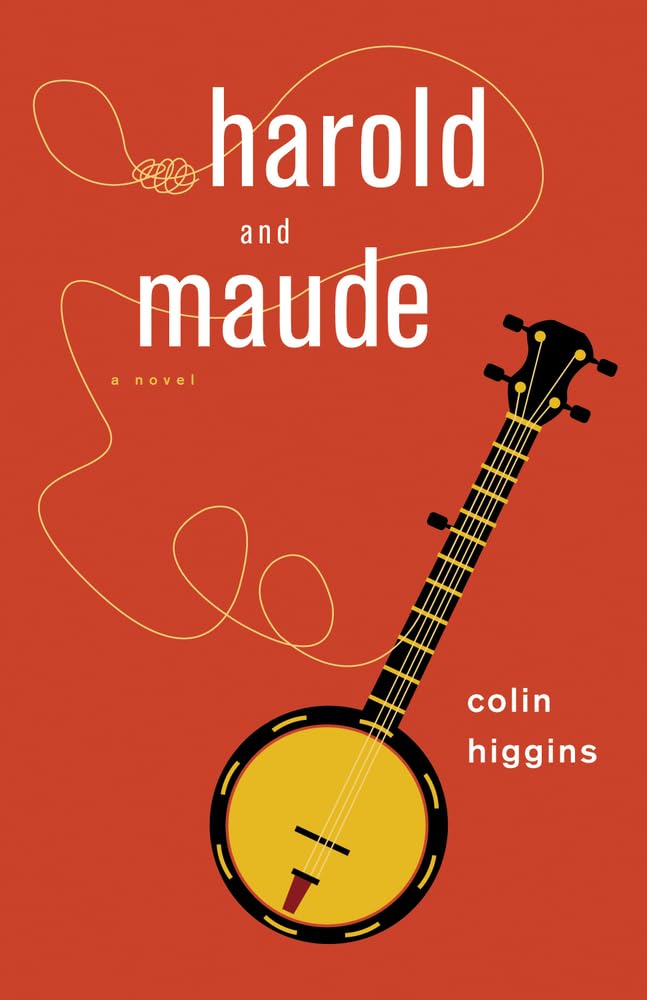



Nineteen-year-old Harold Chasen is obsessed with death. He fakes suicides to shock his self-obsessed mother, drives a hearse, and attends funerals of complete strangers. Seventy-nine-year-old Maude Chardin, on the other hand, adores life. She liberates trees from city sidewalks and transplants them to the forest, paints smiles on the faces of church statues, and “borrows” cars to remind their owners that life is fleeting— here today, gone tomorrow! A chance meeting between the two turns into a madcap, whirlwind romance, and Harold learns that life is worth living, and how to play the banjo. Harold and Maude started as Colin Higgins’s master’s thesis at UCLA film school before being made into the 1971 film directed by Hal Ashby. The quirky, dark comedy gained a loyal cult following, and in 1997 it was selected for inclusion on the National Film Registry at the Library of Congress. Higgins’s novelization was released with the original film but has been out of print for more than thirty years. Fans who have seen the movie dozens of times will find this a valuable companion, as it gives fresh elements to watch for and answers many of the film’s unresolved questions. “While the book closely mirrors its source, it reads not as the film’s inspiration or replacement, but as its valuable companion.” — Windy City Times Colin Higgins was a screenwriter, director, and producer of films that included Harold and Maude , Silver Streak , Foul play, 9 to 5 , and The Best Little Whorehouse in Texas . He died in 1988 at the age of forty-seven. Harold and Maude A Novel By Colin Higgins Chicago Review Press Incorporated Copyright © 1971 Colin Higgins Trust All rights reserved. ISBN: 978-1-61373-126-0 CHAPTER 1 Harold Chasen stepped up on the chair and placed the noose about his neck. He pulled it tight and tugged on the knot. It would hold. He looked about the den. The Chopin was playing softly. The envelope was propped up on the desk. Everything was ready. He waited. Outside, a car pulled into the driveway. It stopped, and he heard his mother get out. With barely a smile he knocked over the chair and fell jerkily into space. In a few moments his feet had stopped kicking, and his body swayed with the rope. Mrs. Chasen put her keys down on the entrance table and called to the maid to take the packages out of the car. It had been a boring luncheon and she was tired. She looked at herself in the mirror and absently pushed at her hair. The frosted wig would be fine for dinner this evening, she decided. She'd cancel her appointment with René and take a nap for the rest of the afternoon. After all, she deserved to indulge herself once in a while. She went into the den and sat at the desk. As she flipped through her book for the hairdresser's number, she listened to the Chopin playing softly. How soothing, she thought, and began to dial. René would be furious but it couldn't be helped. The phone buzzed, and she settled back, drumming her fingers on the arm of the chair. She noticed on the desk the envelope addressed to her. She looked up and saw, suspended from the ceiling, the hanging body of her son. She paused. The body swayed slightly from side to side, making the rope around the large oak beam squeak rhythmically to the sound of the piano. Mrs. Chasen stared at the bulging eyes, at the protruding tongue, at the knot stretched tight about the grotesquely twisted neck. "I'm sorry," said a tiny voice. "You have reached a disconnected number. Please be sure you are dialing the right number and are dialing correctly. This is ..." Mrs. Chasen put down the phone. "Really, Harold," she said as she dialed again. "I suppose you think this is all very funny. Apparently it means nothing to you that the Crawfords are coming to dinner." "Oh, Harold was always a well-mannered boy," said Mrs. Chasen to the elderly Mrs. Crawford at dinner that evening. "Yes, indeed. I had him using a little knife and fork at three. He was never any trouble as a baby, although he was perhaps more susceptible to illness than the average child. He probably got that from his father, because I've never been sick a day in my life. And, of course, he did inherit his father's strange sense of values — that penchant for the absurd. I remember once we were in Paris, Charlie stepped out for some cigarettes and the next thing I heard, he was arrested for floating nude down the Seine — experimenting in river currents with a pair of yellow rubber water wings. Well, that cost quite a bit of enfluence and d'argent to hush up, I can tell you." The younger Mrs. Crawford laughed appreciatively, as did Mr. Crawford, Mr. Fisher, and Mr. and Mrs. Truscott-Jones. The elderly Mrs. Crawford sipped her champagne and smiled. "Are you ready for dessert?" Mrs. Chasen asked her. "Is everyone ready for a delightful Peach Melba? Harold, dear, you haven't finished your beets." Harold looked up from the end of the table. "Did you hear me, dear? Eat up your b